Ervin Salianji spent ten months in prison while Albania voted. Now he wants to run against Sali Berisha for the leadership of the Democratic Party. Berisha has a single answer, repeated until it sounds like fact: the man excluded himself.
By Ardit Rada (Tirana)
There is a word Sali Berisha reached for three times in two days last week, and the repetition was itself a kind of answer. “I vetëpërjashtuar.” The self-excluded. Not expelled, not banned, not defeated in a vote he refused to hold. Self-excluded. It removes agency from Berisha and assigns it entirely to the man he is trying to erase. He said it with the studied boredom of a man closing a door he has already locked from the outside.
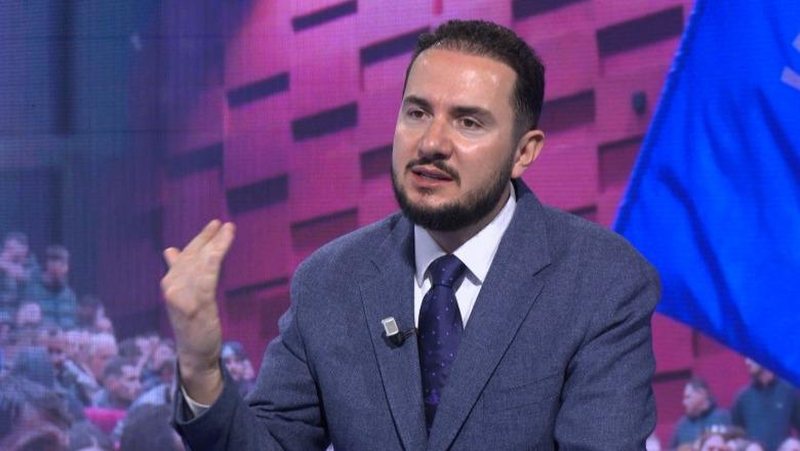
Ervin Salianji, appearing two days later on Euronews Albania’s “Now” programme with Erla Mëhilli, did not sound like a man who had accepted the closure.
The prison arithmetic
To understand what is happening inside the Democratic Party of Albania, it helps to begin with a number. Ten months. That is how long Salianji spent in detention while the country held its general election in May 2025. He had been among the most prominent opposition figures of the previous parliamentary cycle, leading the party’s investigative commission on the TIMS data scandal and carrying 9,420 preference votes out of Korça, the highest total among all DP candidates in that district. Berisha, who by then had consolidated full control of the party apparatus, had trusted him enough to assign him the harder electoral fight in Elbasan. He was, by every internal measure, a figure of consequence.
Then came the conviction and the cell.
On Tuesday night, Salianji offered his own accounting of what those ten months meant politically. He told Mëhilli that he had been held in prison precisely during the electoral period, and that this was not coincidence. Wherever he had run, he said, he had won. He did not elaborate. He did not need to. The implication was left for viewers to draw: his detention served someone’s interests, and those interests were not exclusively the government’s.
This is the allegation that sits beneath everything else in this story, and it is a serious one. Salianji is not claiming mere judicial bias. He is describing a political geometry in which his imprisonment served Berisha as much as it served Rama. He spent ten months in a cell. Berisha spent the same period running unopposed through a general election, commanding a party whose most capable internal rival had been removed from the field by a court Salianji regards as politically directed. The question he is posing, carefully and without yet stating it directly, is: who benefited from the removal?
The meeting at the balcony
Salianji saved the most consequential detail for the middle of the interview, almost as though testing whether the room could hold it.
According to Salianji, Berisha told him that his own earlier release from house arrest had carried a price. The courts, Berisha reportedly said, are under the government’s control. His transition from pretrial detention to house arrest had been arranged, and the cost was an implicit obligation: the guarantee that Edi Rama would remain in power until 2033.
“He told me: I have this debt to Edi Rama, to keep him in power until 2033, because they asked me for this at the moment they took me out from the balcony,” Salianji recounted, rendering Berisha’s words in the first person.
The “balcony” is Albanian political shorthand for house arrest. Berisha’s transfer from a detention cell to his Tirana residence, in the months before the May 2025 election, attracted significant commentary at the time. The government denied any political dimension. The courts cited procedural grounds. Salianji is now placing a different version of that sequence into the public record, one he attributes to Berisha himself, spoken in the privacy of a home visit.
Berisha’s version of the same meeting, offered at Monday’s press conference, was entirely different in character and entirely different in what it revealed about him. He acknowledged the visit. He said Salianji had come to his home during a period of leave, that he had received him well, and that he had offered advice: do not sign any statement distancing yourself from alleged threats against Fatmir Xhafa, because such a signature would imply guilt. You are young, Berisha told him, you have a career ahead of you. Salianji agreed, left, and then apparently did as he wished regardless. “I don’t bear responsibility for what gets politically adopted here or there,” Berisha concluded.
Two men. One meeting. In one account, a party leader dispenses paternal counsel to a loyal younger figure navigating a difficult legal situation. In the other, that same party leader acknowledges, in private, that his own freedom was purchased through a political arrangement with the prime minister he publicly calls the head of a narco-dictatorship.
The public cannot know which account is accurate. What is clear is that Salianji has chosen to put his version into circulation, with full awareness of what it costs to do so. He is not a man making careless accusations. He spent ten months calculating the value of what he knows. Tuesday was the first installment.
Salianji confirmed the meeting took place at Berisha’s residence, then reached for a principle he described as part of the traditional Albanian code: what is discussed in someone’s home stays in that home. The fact that Berisha had broken this convention, by offering his own version of the conversation from a press conference podium, was for Salianji not merely a betrayal. It was evidence of fear.
The race that does not yet exist
Salianji said on Tuesday that he intends to continue through the political process. When the verification commission is established, he will present himself. He does not plan to form a new party. He has spent years building inside the DP and sees no logic in abandoning that investment. He does not want the situation to migrate into the courts.
These were careful positions, and notably restrained given the weight of what he had said minutes earlier. But the structural picture he described was not restrained at all. No electoral list of eligible voters has been published. No rules for candidacy have been made public. The May 23 date has been announced without any of the procedural infrastructure that a legitimate internal election requires. Berisha, as both incumbent leader and declared candidate, controls the party headquarters, its financial resources, its salaried staff, and his own uninterrupted access to the party’s media presence.
“Mr. Berisha as a candidate is at the headquarters of the Democratic Party, appearing a hundred times a day,” Salianji said. “The financial resources of the Democratic Party are being used by one of the candidates. The party structures, those on salary, are being used likewise by one candidate. And here I cannot do anything. Here is what he who controls it all is doing.”
This is not a complaint about fairness in the abstract. It is a description of a race whose outcome is structurally determined before any vote is cast. The commission that is supposed to verify candidacies has not been constituted. The lists against which candidacies would be verified have not been published. The rules that would govern equal access to party resources have not been written. What exists is a date, chosen by the incumbent, and a process controlled entirely by the man whose continuation in office that process is meant to adjudicate.
The mechanism for exclusion is already operating at the margins. Salianji’s name was removed from the membership rolls during the most recent refresh of party lists, on the basis of a directive issued at the start of this year. The directive stipulated that those who had acted against the party’s political line, or whose public positions had aligned with political opponents on matters of importance, would no longer be considered members. Applied selectively, as it has been, such a directive can eliminate any challenger without a formal vote, without a hearing, and without a record that could be contested in court. Two municipal councillors in Durrës who expressed support for Salianji’s movement were expelled from the DP group within days of his going public. The party secretary attributed the removals to requests from the local branch.
The pattern is not new. It is the same instrument Berisha used against Lulzim Basha, scaled down from the national to the municipal level, applied faster and with less ceremony than before. The Democratic Party has done this before. It knows how.
What the metaphor conceals
Berisha’s rhetorical strategy across Monday’s press conference and the subsequent National Council session was consistent: deny Salianji political existence rather than engage his arguments. The adoption metaphor carried the weight of this strategy. Salianji had been politically adopted by others, had made his choice, had left and ended up where he ended up. The formulation frames him as a ward who chose another family, rather than a competitor who chose a fight.
After the National Council concluded, Berisha told reporters he would not move a single comma from his earlier statements. The party’s red line, he said, was cooperation with criminal gangs. This addition was deliberate. The “red line” language elevates Salianji’s disqualification from the procedural to the moral. He has not merely fallen outside the membership rules through a technicality. He has, in Berisha’s framing, crossed into territory adjacent to criminality. The accusation is serious enough to function as a disqualifier, and vague enough to be impossible to contest.
Salianji’s written response to Monday’s conference was precise. In the absence of voting, he wrote, Berisha invents labels. In the absence of competition, he declares people self-excluded. The more he speaks of exclusions, the more clearly his fear of competition becomes visible. The Democratic Party is not a private club where entries and exits are decided according to one man’s mood.
The analytical content of that response is accurate. A party leader who controls the membership rolls, the verification commission, the financial apparatus, the salaried staff, and the media calendar of his own organization is not administering a race. He is administering a result. The distinction between the two is the difference between a party and a vehicle, and it is a distinction the Democratic Party’s current leadership has not been asked to make in public since it retook the Blue House.
What comes next
Analysts observing the situation have noted that the fault line inside the DP runs deeper than any single candidacy. There are two recognizable blocs: those who remain committed to Berisha’s leadership as the only available framework for opposition politics, and those who have concluded that the party has no viable electoral future with him at its head. Salianji is the most visible expression of the second tendency, but he is not its only one. His public movement has attracted enough support at the grassroots level to prompt retaliatory action within days of its emergence.
Salianji told Mëhilli he holds information he has not yet disclosed. There are truths, he said, that he can place into the public domain if the pressure continues, truths he will leave to the public to judge. He did not specify what they are. He said only that Tuesday was not the moment.
The restraint is tactical. A man who has spent ten months in detention, who missed an election he believes he would have won, who has now publicly attributed to Berisha an acknowledgment of political arrangements with the prime minister he professes to oppose, does not go on television to stop. He goes on television to begin.
Before May 23, one of these two assessments of the situation will prove correct. The party forgot to fear the man it left in prison. He has not forgotten anything.