On what the Albanian State Police did in front of the Prime Ministry, and what the opposition did afterward.
By Renada Bici | Legal Desk
Two operations, forty-eight hours apart, in two European capitals.
On Sunday afternoon at the Fröttmaning U-Bahn station north of Munich, several hundred masked Stuttgart ultras moved toward the Allianz Arena with a single target: the Bayern Munich fan bloc at the south stand. What followed was a type of confrontation German police have trained for over decades. Batons. Pepper spray. A kettle. Six officers injured. Five hundred supporters surrounded, photographed, searched, and loaded onto special buses operated by the Munich Transport Company. The buses, escorted by a police convoy, drove them from the stadium to the police headquarters at Löwengrube 3 in the city center, where each man was processed on suspicion of breach of the peace and held, in some cases, until eleven at night. The command staff described the operation, by its scale, as unprecedented in the German football context.
What did not happen around the operation is what makes it ordinary. No Bundestag deputy appeared at Löwengrube to place himself between the officers and the detainees. No party statement named the Bavarian police chief and three of his commanders and declared them members of a criminal organisation. No editorial in Die Welt or the Süddeutsche Zeitung suggested that the injured officers had in fact been hit by projectiles thrown by the police themselves from an upper floor. Some of the Stuttgart supporters, as they were walked the last few meters to the entrance, sang “Always Look on the Bright Side of Life.” That is the tell. A political culture that treats a mass arrest as a procedural consequence, not as an atrocity, is a political culture in which procedure is load-bearing.
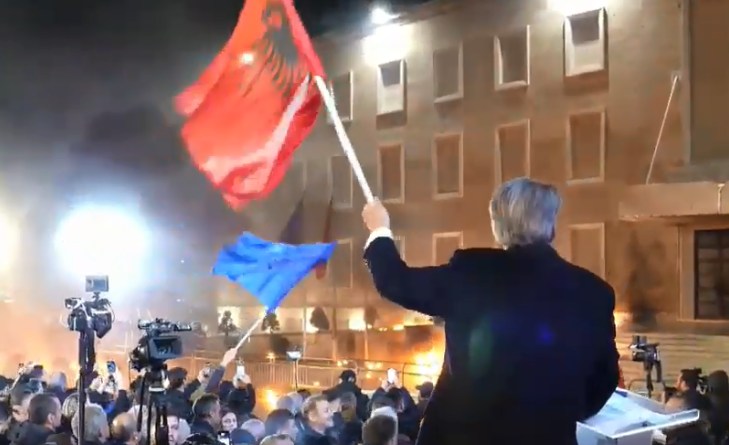
On Friday evening in Tirana, on the esplanade in front of the Prime Ministry, an operation of similar structural character played out. One thousand five hundred officers had been deployed across the center of the city. At a quarter to nine, as Sali Berisha closed his address at the seventh Democratic Party protest in three months by waving the national flag, a group of masked militants positioned behind the placards threw a volley of Molotov cocktails at the façade. The police response began within seconds: water cannon, tear gas, chemical spray. Forty-five unexploded incendiaries were subsequently recovered. Eleven militants were formally arrested by Saturday morning. Five police officers required hospital treatment, one of them admitted. A secondary column attempted to redeploy toward Parliament and was held at the Lana Bridge cordon, where Democratic Party secretary general Flamur Noka confronted the police line and failed to breach it.
In operational terms, the Albanian State Police did, on a smaller scale, what the Bavarian police did two days later. They contained a pre-armed militant element operating inside a larger political gathering. They preserved the perimeter of the institution under attack. They made arrests where arrests were warranted. The first public test of Skënder Hita, appointed director general at the end of March, produced the first protest in the recent sequence to be stopped before wider escalation.
What then happened around the operation is what makes it an Albanian operation rather than a German one. Berisha, speaking from the Trauma Hospital late Friday evening, advanced the claim that the Molotov cocktails had been thrown not by his militants but by police officers positioned on the roof of the Prime Ministry, and that one of the injured officers had been struck by a bottle thrown by a colleague from above. No publicly available footage or evidence has so far substantiated that claim. It was, however, sufficient as a claim: the function of the statement is not to be proven but to circulate. Flamur Noka then named Skënder Hita and three further senior officers of the State Police and announced that each would, from that evening, be considered by the opposition “a member of the criminal organisation that runs the State Police.” A sitting member of parliament, the opposition’s number two, publicly applied to the national police the statutory label reserved for organised crime. To the head of government, he extended a different kind of formula: “the end of the Ayatollah of Iran, the end of Rama and his gang.”
This is the Albanian variation on the theme. The legal vocabulary of the Criminal Code, developed to describe organised crime, is turned around and applied to the institution conducting the operation. Officers who faced a forty-five-bottle Molotov volley on Friday evening and secured a political perimeter without fatalities were, within ninety minutes, named by the opposition’s number two as members of a criminal group. The Prime Minister, in the same breath, was compared to the Supreme Leader of the Islamic Republic and promised his end. These are not the words of an unknown activist on the margin of a crowd. They are the words of an elected deputy, flanked by colleagues of the same institution, at a public gathering, on the same evening as the injuries he would not acknowledge were still being registered at the Trauma Hospital a short distance away.
A state that absorbs a forty-five-Molotov volley with eleven arrests and five hospitalised officers has done what a state is supposed to do. A political class that, on the same evening, responds to that operation with an unsubstantiated rooftop claim and a statutory accusation against the police directorate has not done what a political class is supposed to do. The gap between the two is the precise territory in which Albania’s rule-of-law consolidation either advances or fails. Germany did not inherit the arrangement in which a police operation is the work of professionals and the political response to it is procedural. It built that arrangement across seven post-war decades, by refusing to allow political actors to place themselves, rhetorically or bodily, between the officer and the suspect.
The Republic has built mechanisms for contesting the actions of the State Police: administrative review, parliamentary inquiry, criminal referral where warranted. None of them was used on Friday evening. The microphone on Dëshmorët e Kombit was used instead, and then a statement from a hospital ward. Whether Albania’s main opposition party is capable of locating the courtroom at all is now the open question, and it is not a question for the police.
Renada Bici is a Tirana-based lawyer practicing in civil, criminal, and administrative law. She holds a law degree from the University of Tirana and has experience in both private legal practice and public administration. She writes for the Tirana Examiner Legal Desk.