By Ardit Rada | Tirana Examiner Staff Writer
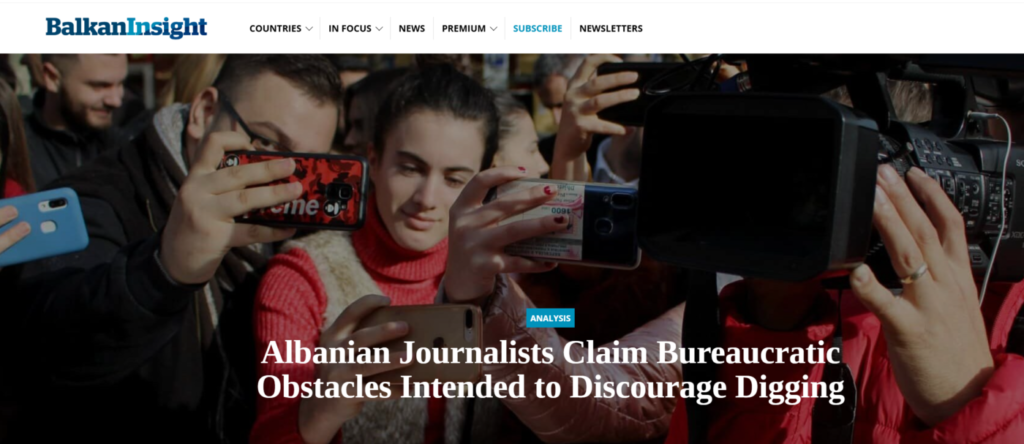
A report published by Balkan Insight on April 8 carries a serious charge: that Albanian public institutions are deliberately obstructing journalists’ Freedom of Information requests, and that the decline in FOI filings from journalists last year is evidence of a system designed to wear people down. The piece quotes four journalists expressing frustration, cites the Commissioner’s own annual report, and arrives at a verdict of institutional bad faith.
The annual report, however, does not say what BIRN says it says.
This is not a minor discrepancy. The Commissioner for the Right to Information and Personal Data Protection submitted his full 2025 report to parliament, and its findings, read in their entirety rather than selectively, describe a transparency regime that improved in nearly every measurable dimension over the previous year. Reconstructing the record matters, not to dismiss the frustrations of working journalists, which are real and deserve to be taken seriously, but because a regional publication of BIRN’s standing owes its readers the full picture.
What the numbers actually show
The BIRN piece anchors its argument on one statistic: FOI requests from journalists and civil society dropped 10 percent in 2025 compared to 2024. The Commissioner’s report does note this. What it also notes, and what the BIRN piece does not engage with at all, is that total FOI requests across all categories rose, from 11,549 in 2024 to 13,029 in 2025. The decline among journalists and civil society did not occur in a vacuum. It is consistent with a parallel development the data records clearly: institutions published significantly more information proactively, which may have reduced the need to request what was already available. Whether that is the full explanation is not something the aggregate data can settle. But BIRN does not consider the possibility at all.
The Proactive Transparency Index for 2025 makes the structural improvement visible. Of the 284 central and subordinate public authorities monitored by the Commissioner’s office, 149 were rated at the highest transparency level. In 2024, that number was 112. That is a 33 percent increase in one year. The category of institutions with minimal transparency effectively disappeared from the index.
The report also introduces a metric new to this reporting cycle: response speed. Of all FOI requests processed in 2025, 36 percent received a full response within three working days. The legal deadline is ten days. That figure reflects well on a portion of the system. It does not, on its own, account for the remaining 64 percent, whose distribution across the response window is not broken down in the data. Whether those requests clustered near the legal deadline or exceeded it matters considerably, because BIRN’s underlying argument is not statistical. It is functional: a response that arrives too late to serve a story serves no one. That critique is not disproven by the speed data. It is addressed partially, and the gap remains.
Out of 13,029 total requests, 11,017 received complete responses. Roughly 900 escalated to complaints before the Commissioner’s office. Of those 900, 525 were resolved during the administrative review process itself, meaning the institution provided the information once the Commissioner opened a file. That figure supports two readings simultaneously, and intellectual honesty requires holding both. In one reading, the system worked: pressure was applied, information flowed, and the mechanism produced results without requiring formal sanction. In the other reading, which is precisely BIRN’s reading, institutions responded only when compelled, which suggests the original refusal or delay was not accidental. The data does not adjudicate between these interpretations. What it does show is that the information, in 525 cases, ultimately reached the requester. Whether it arrived in time to matter is a separate question.
The sanctions argument, examined
The BIRN article notes that the Commissioner issued only two fines out of hundreds of complaints and suggests this undermines deterrence. The full record is somewhat different: 13 administrative sanctions in total, including penalties against heads of public institutions for failing to implement or update their Transparency Programs, alongside 51 administrative investigations, 14 hearings before final decisions, and 13 inspections at public authorities.
The more precise argument, however, is architectural. Albania’s FOI enforcement system is designed primarily around compliance rather than punishment. The goal is to make information flow, not to generate penalty revenue. In the majority of cases, that design produces results. The harder question, which the data does not fully resolve, is whether compliance-oriented design is sufficient in cases where resistance is deliberate and sustained. At the margins, the deterrence signal from 13 sanctions against 900 complaints remains thin. Acknowledging that does not undermine the system’s overall record. It identifies where the architecture is still being tested.
On the question of journalist status
The BIRN piece, and the broader discussion it reflects, carries an implicit premise: that journalists should receive faster responses, shorter deadlines, or otherwise preferential treatment under FOI law. This argument has circulated in discussions between media organizations and EU interlocutors, and it deserves a clear answer.
Albania’s ten-day response deadline is, by comparative international standards, among the shortest in the world. More fundamentally, the right to information is a constitutional right that belongs equally to every citizen. A law that establishes special categories of requesters, with faster timelines or elevated status for journalists, would not strengthen press freedom. It would create a two-tier system of access that undermines the universality of the right itself. If journalists require a dedicated mechanism for media-related grievances, the appropriate instrument is a media commissioner, not a reconfiguration of a law that serves the entire public.
What Albania has built
There is a broader context the BIRN article does not provide. Albania operates under three distinct legislative pillars that together constitute what are sometimes called sunshine laws: the Law on the Right to Information, the Law on Open Data and Reuse of Public Sector Information, and the Law on Public Notification and Consultation. Taken together, they represent a transparency architecture that most countries in the region have not replicated.
Beyond domestic law, Albania has ratified the Council of Europe’s Convention 205 on Access to Official Documents. The majority of EU member states have not yet done so. A country that EU capitals sometimes discuss as a candidate requiring guidance on rule of law has, in this specific domain, outpaced a significant portion of the bloc it is seeking to join.
None of this appears in the BIRN report.
What neither account fully captures
The frustrations described by the journalists quoted in the BIRN piece are not invented. Delayed responses, superficial answers, and the exhaustion of chasing institutions that ignore requests are genuine problems. The Commissioner’s own report documents the same frictions: frequent turnover of information coordinators, complex multi-point requests that strain administrative capacity, institutional restructuring that disrupts response chains.
But BIRN’s account and the Commissioner’s record are not simply in conflict. They are looking at different parts of the same system. BIRN captures the friction: the lived experience of journalists who find the process slow, incomplete, and at times deliberately unresponsive. The Commissioner captures the structure: a legislative architecture that has strengthened, an index that shows measurable improvement, and aggregate data that describes a system performing better than it did the year before. Neither account alone describes the system as it actually functions.
A system can improve structurally while still producing friction in practice. Its strength is visible in its architecture and aggregate performance. Its weakness is visible at the point of contact, where timing, administrative capacity, and institutional incentives still determine whether access is meaningful. Reporting only the structure, as the Commissioner’s framing tends to do, papers over real experience. Reporting only the friction, as BIRN has done, mistakes a portion of the picture for the whole.
The record warrants neither a verdict of deliberate obstruction nor a declaration of success. It warrants the harder, more accurate conclusion: Albania’s transparency system is improving along most dimensions that can be measured, and remains uneven along the dimensions that matter most to the people who use it daily.
Ardit Rada is a staff writer at the Tirana Examiner.