Editorial Board, The Tirana Examiner
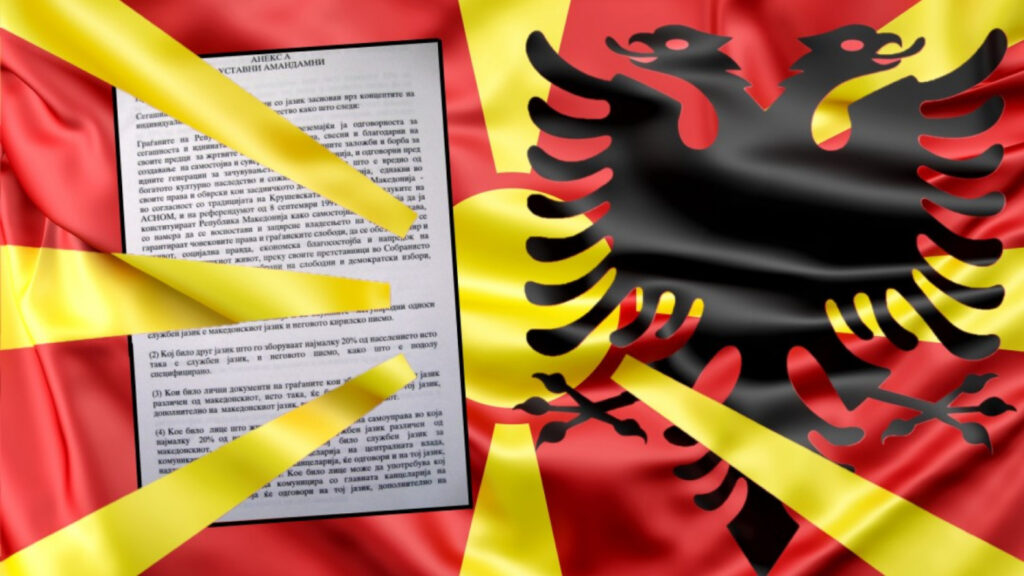
The Ohrid Framework Agreement of 2001 was not a favour granted to Albanians in North Macedonia. It was the price of peace — a binding compact between the Macedonian state and a quarter of its population, extracted at the cost of an armed conflict that brought the country to the edge of dissolution. Its provisions on language, employment, and political representation were not aspirational. They were the architecture of a functional multiethnic state. That architecture is now being systematically contracted, one institution at a time, by a government that has shifted the management of Albanian rights from legislative change to procedural control.
The instrument of that shift is more durable than legislation: the Constitutional Court deployed as a mechanism of contraction, bills expanding professional access removed from the assembly agenda, and a coalition partner drawn from within the Albanian political community installed to absorb the political shock. Whether by design or by convergence of institutional incentives, the effect is indistinguishable. The rollback can be denied at each individual step while remaining unmistakable in aggregate.
The employment mechanism
The first structural blow fell in October 2024. The Constitutional Court abolished the “Ethnic Balancer” — a mechanism introduced in 2015 to enforce proportional Albanian representation in the public sector, itself a direct implementation of the Ohrid Agreement’s equitable distribution principle. The State Anti-Corruption Commission had challenged its constitutionality, arguing that ethnicity-based hiring criteria violate freedom of expression. The court’s ethnic Albanian judges dissented. They were outvoted.
The Balancer’s critics were not wrong that the mechanism had been captured by Albanian political parties as a tool of clientelism — it had. But clientelism is a governance failure, not a constitutional argument for scrapping minority representation entirely. The corrective to a corrupted tool is reform, not abolition. What was abolished was not a flawed mechanism. What was abolished was the only institutional guarantee that Albanians would hold any proportional stake in the public employment that defines access to the Macedonian state. Nothing has replaced it.
The language law
The 2019 Law on the Use of Languages extended the official status of Albanian across state institutions nationwide — the final legal piece of the Ohrid framework’s language provisions. VMRO-DPMNE opposed it then and has not changed its position since returning to power. Thirteen complaints against the law, filed by over forty individuals and groups in 2019, remain pending before the Constitutional Court. In December 2024, the court convened to review them, declined to rule immediately, and announced it would seek expert opinion. That window has passed without a ruling. The threat remains open.
What is operating in that court is not neutral constitutional arbitration. What presents as legal adjudication is functioning, in effect, as a site where the limits of the Ohrid framework are being renegotiated — without a parliamentary vote, without a treaty revision, and outside the scrutiny that either would attract. This pattern is not unique to North Macedonia; it mirrors broader European trends in which courts and administrative practice, rather than legislatures, have become the primary sites of minority rights contraction — a mode of governance that is harder to litigate, harder to name, and harder to reverse than outright legislative repeal. What distinguishes the Macedonian case is the speed and simultaneity of these changes.
The court’s president, Darko Kostadinovski, has made his orientation visible. During proceedings on North Macedonia’s “Safe City” traffic fine system, he stated publicly that fine notifications should be sent in Macedonian and may also be sent in English — but not in Albanian. The court’s dissenting Albanian judge responded with the constitutional text: the law cannot be narrowed or limited, and non-implementation is a violation of the right itself. He was recorded, and set aside.
The DUI demanded Kostadinovski’s resignation, citing what it described as a two-year systematic pattern of rulings that invoke “the memory of the 1990s.” The demand was ignored. The Education Minister’s conduct at the University of Tetovo — repeatedly instructing Albanian-speaking professors to address her in Macedonian during an official event on Albanian-majority territory, then declaring herself under no legal obligation to be understood — is not an isolated provocation. It is the executive branch modelling non-compliance publicly, signalling to state institutions below the ministerial level that the Law on Languages is discretionary rather than binding. That normalisation, conducted in the open, is its own form of legal erosion.
The bar exam
The jurisprudence examination is the gateway to the legal professions — judge, prosecutor, lawyer, notary, bailiff. It is conducted exclusively in Macedonian. Albanian law graduates, who complete four years of study in Albanian at institutions the state itself recognises, cannot sit this examination in the language of their education. The Ministry of Justice has held that this is not a violation of the Law on Languages because the exam tests Macedonian-language competency, and that competency is a statutory prerequisite for legal practice.
The argument is circular, and the government knows it is circular: it requires Albanian speakers to demonstrate fluency in a professional register they were never trained in, in order to access professions whose training they completed in Albanian. In EU accession terms, this is not a technical dispute. It goes directly to Chapter 23 benchmarks on access to justice and non-discrimination in the exercise of public functions — the same chapter where the European Commission recorded no progress in its 2025 country report. A bill correcting the bar exam exclusion was prepared in 2024 under the previous government’s Ministry of Justice. When VMRO-DPMNE took office in July 2024, that bill was removed from the assembly agenda and has not been mentioned since, except when Mickoski was pressed in parliament in March 2026 and promised reform — then deferred the decision to the Venice Commission. Three hundred and eighty-five Albanian law students submitted a petition in February. Hundreds protested in Skopje today. The ministry’s position has not moved.
The political architecture of impunity
None of this would function without VLEN. The coalition of Albanian parties that governs alongside VMRO-DPMNE serves a specific purpose: it converts ethnic rollback into a coalition management question rather than a minority rights question. When the Balancer was abolished, VLEN assured Albanians that their language would be protected. When the language law came under judicial challenge, VLEN assured Albanians that the law would not be repealed entirely — only certain provisions would be reviewed. When the bar exam reform was removed from the agenda, VLEN said nothing of consequence. The pattern is consistent: assurance without intervention, presence without protection.
This is the mechanism’s elegance. VMRO-DPMNE can point to Albanian ministers in the cabinet as proof of inclusivity. VLEN can point to the absence of a catastrophic single act as proof that it is governing responsibly. Neither party is required to account for the cumulative trajectory. The Ohrid compact is not violated in a headline. It is contracted clause by clause, with an Albanian face in the room for each contraction.
What Tirana is watching
Albania’s Foreign Minister Ferit Hoxha did not travel to Skopje today. He did not need to. His statement — posted to coincide with the student protest — made Tirana’s position clear in the language of calibrated restraint: the right to use Albanian is guaranteed by the Constitution and the law, cannot be narrowed by any procedure, and demands institutional seriousness rather than political theatre. Albania’s ambassador had anticipated the same point the night before, with a one-sentence post about politicians and statesmen that required no attribution to land precisely.
The signalling is coordinated and the coordination is deliberate — but the register is not escalation. It is pre-positioning. Tirana is placing the issue within an EU legal and rights frame before it hardens into a bilateral dispute that would require a louder and less deniable response. The message to Brussels and Washington is implicit but legible: the erosion of the Ohrid framework is not an internal Macedonian governance question. It is an enlargement question. The provisions now being contracted were embedded in North Macedonia’s EU accession framework for a reason, and their contraction in the context of stalled accession is a data point about what the process is and is not capable of protecting.
The students in Skopje today — organised across three universities, invoking constitutional text rather than ethnic grievance, calling on judges and prosecutors to stand with them — have made this harder to dismiss than a political rally. They are not asking for a favour. They are demanding that a law already on the books be applied to them. That demand has not been met. The institutions that were supposed to meet it have, one by one, found procedural reasons not to.
The procedural reasons are not incidental. They are the method.