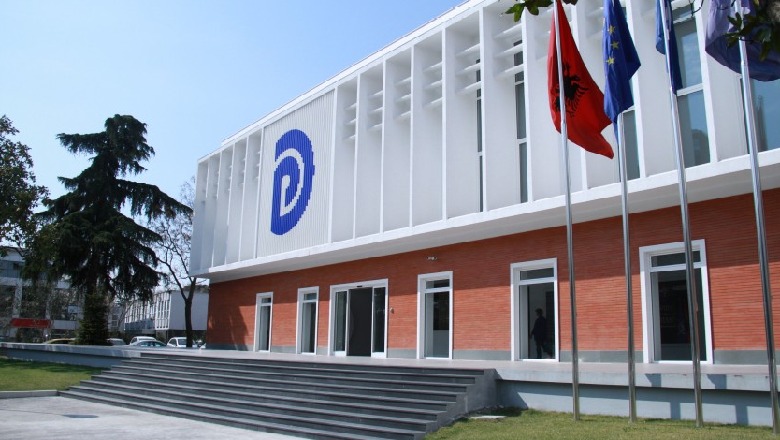
The following column by Jakin Marena was published in Albanian on 3 April 2026. The Tirana Examiner presents it in translation as a contribution to the ongoing debate on the Democratic Party’s internal crisis. The views expressed are the author’s own and do not represent the editorial position of this publication.
Jakin Marena | Tirana
Sali Berisha’s Democratic Party has found a new unit of political measurement, one that does not exist anywhere else in Albanian, regional, or European politics. In the morning, it expels members. In the evening, it appeals to citizens to join.
This is not a metaphor. It is the operational tempo of the largest opposition party in the country, twelve months before a general election.
The expulsions began as a response to a simple provocation. A handful of figures inside the party, among them Presidium member Ervin Salianji, democrat Alesia Balliu, and activist Evi Kokalari based in the United States, announced they intended to run for party chair without Berisha’s permission. The response was not a statutory procedure. It was a purge. It has since spread from central presidium members to branch leaders and rank-and-file members in Elbasan, Durrës, Krujë, Fushë Krujë, Mat, and beyond. Several branches have effectively ceased to exist. Members traveled to Tirana to protest. Some attempted to physically detain deputy chair Flamur Noka, whom they hold responsible for transmitting Berisha’s decisions downward through the party.
The party’s own base, in an election year, tried to corner its second-ranking official in the street. That is where things stand.
To justify what the statute could not justify, the leadership invented a new legal category: “self-expulsion.” Those who declared candidacies against Berisha are described as having expelled themselves. Salianji continues to attend presidium meetings. He continues to appear at party protests. The leadership continues to insist he is no longer a member. This is not doctrine. It is fabrication wearing the clothes of procedure.
The charges have escalated to match. Expelled figures are not merely disloyal. They are, in the formulation now emanating from party headquarters, linked to organized crime, coordinating with the Socialist majority, enemies within. In making this argument, the leadership has accidentally made another: that for thirty-six years, it was organized crime that decided what happened inside the Democratic Party. Berisha is the only founding member still present. He knows this history better than anyone. He has made it.
None of this is new in kind. The Democratic Party has never been a tranquil institution. What is new is the scale at which the turbulence now consumes the party itself, and the moment chosen for it. While Prime Minister Edi Rama runs an open campaign to win every municipality in the country, Berisha is reducing his party’s membership. He is shrinking the organization because someone thought to stand inside it without his authorization.
And then, in the same news cycle, the leadership appeals to citizens to join. The party of the future, they say. Led by a man of 82 who has held every office this state can offer, the presidency, the prime ministership, the party chairmanship, each taken and held in his own name, with no evident intention of releasing the last.
A citizen watching this sequence must make a calculation. They have seen members with thirty-five years of contribution expelled overnight and branded as criminal collaborators. They understand what membership now means: that any independent thought, any ambition not cleared from above, converts a contributor into an enemy without notice. Berisha understands this too. The recruitment appeal is not addressed to undecided citizens. It is addressed to followers who have already decided not to think.
The Democratic Party is not in crisis in the ordinary sense. A crisis implies an open question. There is no open question here. Berisha will run. Berisha will win the internal election. Anyone who ran against him will be expelled, accused, and reclassified as a criminal. The party will enter the 2025 elections smaller, angrier, and more tightly coiled around a single figure than it was before the purge began.
The absurdity is not incidental. It is the method. A party that expels by morning and recruits by evening, that invents legal categories on demand and rebrands thirty-year members as organized crime assets, has concluded that internal coherence is no longer a value worth maintaining. What counts is the loyalty test. The test is not passed through competence or service. It is passed through silence.
The laws of physics, one Albanian commentator observed this week, are not equipped to explain what is happening inside the Democratic Party. The laws of politics offer something simpler: a leader who does not fear losing. He fears the existence of a ballot.
Jakin Marena is a Tirana-based political commentator who writes regularly for Albanian online media.