Opposition rhetoric shifts the debate from street clashes to systemic governance — but the concept remains politically potent and analytically contested.
by Eris Zenelaj (Tirana)
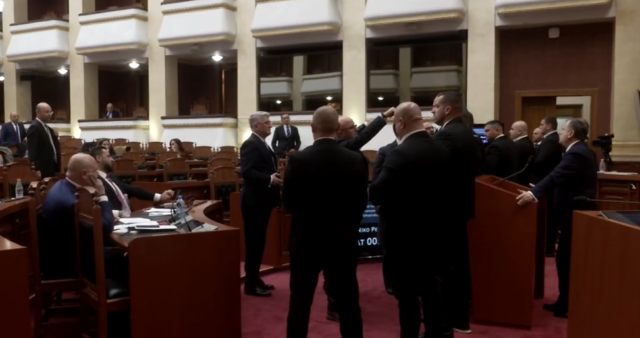
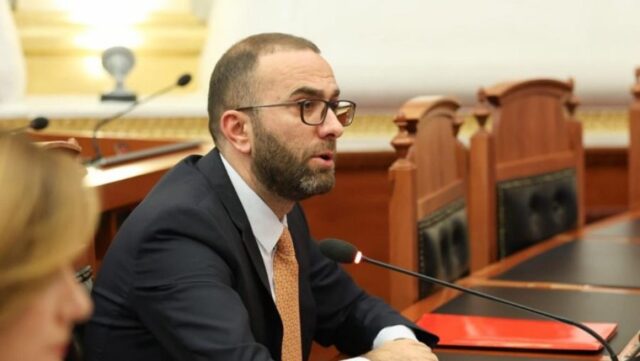
A heated exchange inside Albania’s parliamentary Commission on Tourism, Culture and Diaspora this week revealed how the language of political confrontation in Tirana is evolving.
During a debate with Socialist Party deputies Arkend Balla and Erion Malaj, opposition lawmaker Ina Zhupa introduced a term more commonly found in academic and sociological debates than in parliamentary disputes: “structural violence.”
Responding to accusations that opposition protests have fueled unrest, Zhupa argued that the deeper source of instability lies not in street demonstrations but in systemic failures of governance.
“For the state, the most dangerous form is what is called structural violence,” Zhupa said during the commission meeting.
“The violence produced by poverty, the violence produced by the arrogance of power, the violence that comes from the impossibility of educating one’s children, the violence produced by the state when it expels you from your home — that is the most dangerous violence against Albanian citizens.”
She went further, linking this concept to corruption and institutional dysfunction.
“In the latest report of Transparency International we had only 39 points out of 100, meaning we are considered a corrupt state and far from democratic standards,” she said.
“The violence of corruption is when you cannot achieve anything without paying someone to be corrupted.”
Her conclusion was explicit:
“The reactions of citizens in revolt can never be compared with the damage that this governance has caused.”
From Sociology to Politics
The term structural violence was originally developed by Norwegian sociologist Johan Galtung to describe social systems that harm individuals by preventing them from meeting basic needs — through poverty, inequality, or institutional exclusion rather than direct physical force.
In recent decades the concept has migrated from academic literature into political rhetoric worldwide, often used by opposition movements to frame systemic grievances as a form of coercion.
Zhupa’s intervention shows that this language has now entered Albania’s parliamentary discourse as well.
By invoking structural violence, the opposition attempts to shift the moral focus of the debate: away from isolated incidents of protest violence and toward broader questions about governance, corruption, and economic inequality.
The Government’s Counterargument
The governing majority, led by Edi Rama, approaches the issue from the opposite direction.
Officials emphasize the physical violence associated with recent protests, including attacks on public buildings and the use of Molotov cocktails in demonstrations organized by opposition groups.
From the government’s perspective, the immediate concern is maintaining public order and protecting democratic institutions from destabilization.
This framing places the emphasis on accountability for protest violence, rather than systemic critiques of governance.
A Clash of Narratives
The exchange in parliament illustrates a broader struggle over political narrative in Albania.
The opposition increasingly frames governance failures as systemic injustice, using concepts such as corruption, inequality, and structural exclusion to justify political mobilization.
The government, by contrast, focuses on institutional reform and stability, pointing to judicial reforms, digital governance initiatives, and EU integration progress as evidence of institutional improvement.
Both narratives contain elements of truth — and political strategy.
Albania continues to face persistent challenges in corruption perception rankings and institutional trust. At the same time, it has implemented some of the most ambitious judicial reforms in the Western Balkans under EU supervision.
Why the Language Matters
The growing use of the term “structural violence” is not merely rhetorical.
It signals a shift in how Albanian political actors seek to legitimize protest movements and delegitimize governing institutions.
For international observers — particularly within the European Union accession process — the distinction between systemic governance problems and political rhetoric about structural oppression is more than semantic.
It shapes how Albania’s democratic maturity is assessed.
The country’s political debate increasingly revolves not only around policy performance but around competing interpretations of legitimacy itself.
And as the parliamentary exchange demonstrated, those interpretations are becoming sharper — and more theoretical — than Albania’s political discourse has traditionally allowed.
The Reality Check
Zhupa’s most verifiable claim is the Transparency International CPI figure she cites: Albania is assessed at 39/100 on the Corruption Perceptions Index, produced by Transparency International. The index measures perceived levels of public-sector corruption, where 0 represents a highly corrupt environment and 100 represents a very clean one. While it does not measure individual bribery incidents directly, perception itself plays a critical role in shaping public trust and institutional legitimacy.
On the rule-of-law substance, the European Commission’s Rule of Law country chapter on Albania partly supports Zhupa’s broader argument about institutional pressure—but with important nuance. According to the Commission, Albania continued implementing judicial reform, the vetting process for judges and prosecutors reached completion in first instance, and the anti-corruption prosecution office SPAK has consolidated tangible progress in investigating high-level corruption cases.
At the same time, the Commission notes persistent structural weaknesses. Corruption remains widespread, the state police remains vulnerable to corruption, and preventive anti-corruption institutions have had limited impact. The report also flags concerns about undue influence attempts on the judiciary, media ownership concentration, and instances where parliamentary decisions have not aligned with rulings of the Constitutional Court.
Where Zhupa’s argument becomes more politically interpretive is in the leap from governance shortcomings and corruption perceptions to a claim that Albania displays characteristics of “states with dictatorial tendencies.” European Union reporting generally avoids such terminology. Its assessments typically describe Albania as a reforming system with persistent institutional weaknesses, rather than a system that has crossed into authoritarian territory.
The debate over responsibility for violence follows the same pattern of competing narratives. The opposition argues that protests are reactions to systemic injustice and structural pressure. The government counters that physical violence during demonstrations—including attacks on public buildings and the use of Molotov cocktails—cannot be justified as political resistance.
For international observers and EU policymakers, this distinction matters. The credibility of Albania’s democratic trajectory depends simultaneously on institutional reform, rule-of-law consolidation, and the ability of political actors to conduct opposition and protest within democratic norms.
In that sense, the argument over “structural violence” reflects a deeper tension inside Albania’s political system: the struggle to reconcile legitimate grievances about governance with the responsibilities of democratic contestation.