When Paris does it, it is read as constitutional. When Tirana does it, it is read as backsliding.
By Albatros Rexhaj (Tirana)
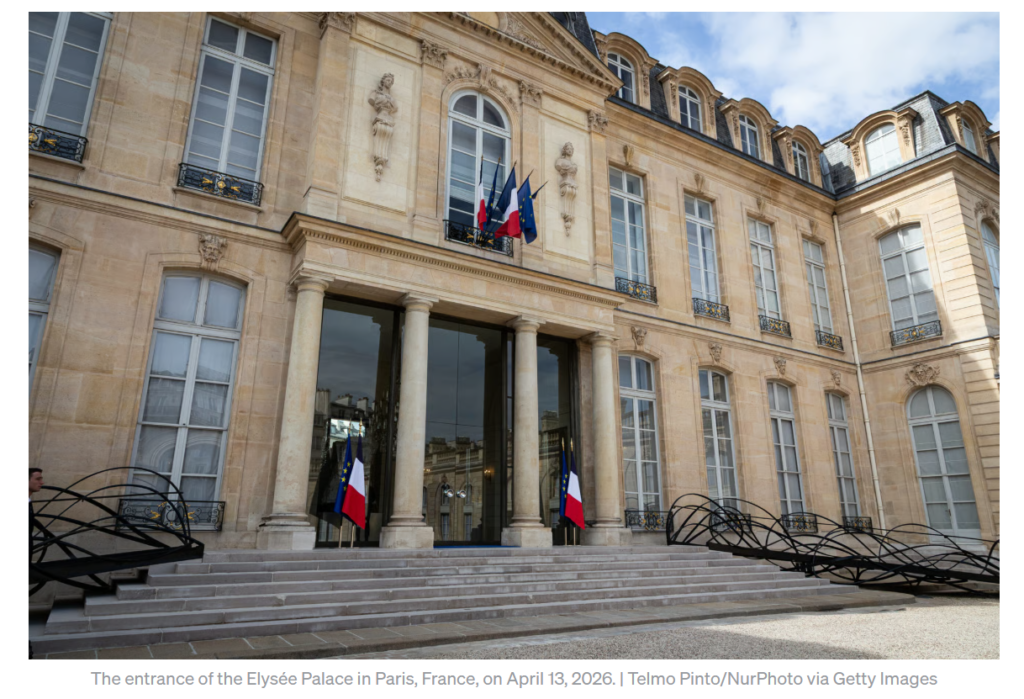
On April 14, French investigators arrived at the Élysée Palace as part of a judicial probe into public procurement contracts worth millions of euros, awarded repeatedly over two decades without competitive tendering to a single events company. The investigators were turned away. The French presidency invoked Article 67 of the constitution, which renders the palace inviolable and shields acts connected to the president’s official duties from judicial search. National Financial Prosecutor Pascal Prache confirmed the blocked entry in an official statement. The case continues. No institutional or European voice described France as a backsliding democracy.
One month earlier, Albania’s parliament voted to block SPAK’s request to lift the parliamentary immunity of Deputy Prime Minister Belinda Balluku, who faces an active indictment on public procurement charges. The vote drew immediate condemnation from the EU delegation in Tirana and several member states. Commentary in regional and international media treated it as evidence of institutional dysfunction, of a system protecting its own at the expense of the rule of law.
The two episodes are not identical, and the differences deserve to be named rather than dissolved. France’s immunity operated through a constitutional provision triggered automatically by prosecutorial action. Albania’s involved a parliamentary majority exercising a political judgment in real time. That distinction matters: a political vote introduces a higher risk of abuse than an automatic constitutional shield, because it requires human actors to make a choice, and human actors have interests. That is precisely why it generated legitimate concern about where legislative prerogative ends and obstruction of due process begins. Those distinctions are real.
And yet the underlying tension is comparable: a prosecutorial authority pressed against a constitutional boundary, and a constitutional boundary held. What changes is the judgment attached to the outcome depending on whose boundary it is.
Albania is not beyond scrutiny. The question is whether the standard being applied is the one actually used elsewhere, or a stricter one reserved for countries whose institutional credibility is still treated as provisional. A parliamentary vote protecting an indicted minister from pre-trial arrest is a legitimate subject of scrutiny. So is a presidency invoking constitutional immunity to block investigators from entering a palace. Scrutiny applied to one and not the other is not a standard. It is a hierarchy.
What distinguishes a democracy from a captured state is not the absence of friction between prosecutorial authority and constitutional protection. It is whether the institutions generating that friction remain independent and operative. SPAK’s indictment of Balluku stands. The case proceeds. The deputy prime minister was removed from government. The prosecutor was not fired, not pressured, not replaced. In France, the probe continues despite the blocked raid, pursuing individuals and documents through every available channel outside the palace walls. Both systems are managing the tension between prosecutorial independence and executive protection through established legal architecture, not through the subordination of one branch to another.
That is what functioning constitutional democracies do. Albania deserves to be judged by the standard applied to them. Not a lenient one. The same one.
READ ALSO: Not the Same: Why the Orbán-Vučić-Rama Equation Fails the Basic Test