A criminal investigation explains how the contract was awarded — but not what it did.
by Rexhina Bici (Tirana)
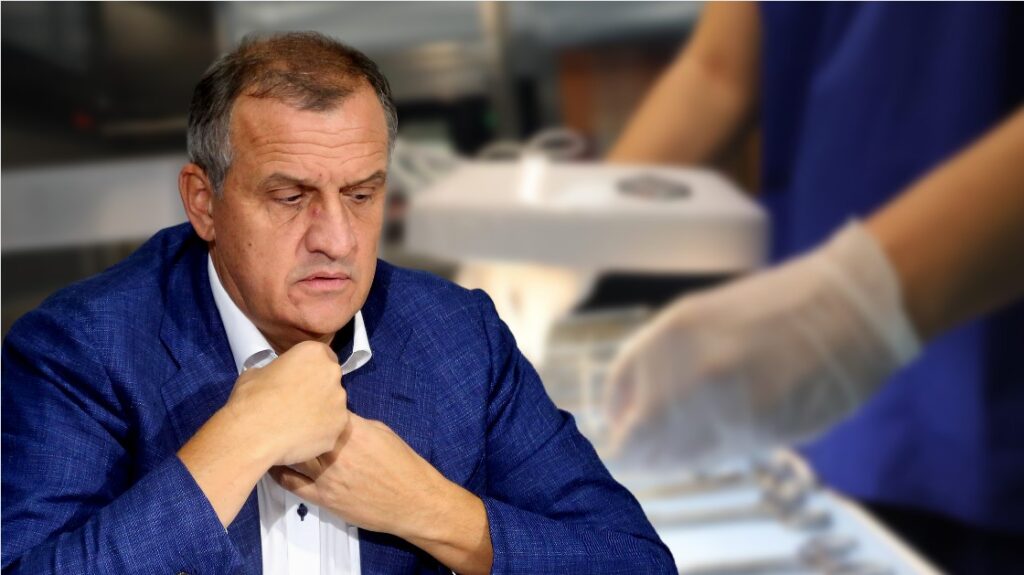
On March 8, 2026, a ten-year concession contract for the sterilization of surgical instruments in Albania’s public hospitals expired quietly. The same day, from detention, former health minister Ilir Beqaj issued a statement calling it a “Partnership for Progress.”
For many observers, the juxtaposition seemed absurd. Beqaj is currently on trial for corruption linked to the very contract he was defending. Yet the uncomfortable truth is that his claim — stripped of its rhetoric — is not entirely wrong.
This is the paradox Albanian public debate has struggled to accept: a policy can be corruptly designed and still produce real public benefits.
Beqaj faces serious charges. Albania’s Special Anti-Corruption and Organized Crime Prosecutor’s Office (SPAK) has indicted him for theft through abuse of office and participation in a structured criminal group. Two co-defendants — former deputy minister Klodian Rrjepaj and businessman Ilir Rrapaj, whose company won the sterilization tender — have already been convicted and sentenced to four years each after abbreviated proceedings.
The prosecution’s case does not argue that hospitals used contaminated instruments or that patients were harmed by poor sterilization. Its argument is different: that the concession contract itself was structured corruptly and that the Albanian state paid far more than it should have.
Those are grave allegations, and the trial is ongoing.
But policy outcomes are not determined by courtroom narratives alone.
Between 2013 and 2025, the number of surgical procedures performed in Albania’s public hospitals rose from roughly 50,000 to 67,000 annually. Those operations took place largely in the same operating rooms, performed by the same surgeons, on a population that had meanwhile declined by more than 600,000 people. Average hospital stays also fell significantly, from 6.5 days to 4.8 days.
These are the numbers Beqaj now cites in his defence. Some claims in his statement — including the assertion that the concession saved forty lives per year — appear without verifiable sourcing and should be treated cautiously. But the broader trajectory aligns with independent assessments of Albanian hospital capacity during the same period: surgical throughput increased and operating theatre sterilization infrastructure improved.
The uncomfortable question is therefore unavoidable: can both of these realities coexist?
The answer is yes.
Recognizing that possibility is not a defence of Beqaj. A politician awaiting trial has every incentive to rewrite his record in the most favourable terms. His statement, distributed through his lawyer and timed for the contract’s final day, is advocacy rather than analysis.
He answers the question of what the contract delivered, while SPAK is investigating how it was awarded and priced. Those are not the same question.
Yet Albanian public commentary has often performed the same conflation in reverse. Because SPAK has indicted, the concession is treated as inherently corrupt and its outcomes dismissed as either fabricated or irrelevant.
That reflex is equally flawed — and arguably more damaging.
The sterilization concession is one of 235 public-private partnership contracts signed in Albania since 1990. PPPs are not inherently corrupt instruments. Under the right institutional conditions they can deliver infrastructure and services that fiscally constrained governments cannot finance directly — and in 2013 Albania’s health system was in precisely that position.
The Ministry of Health was carrying roughly $40 million in arrears to suppliers, public debt stood at 74 percent of GDP, and much of the surgical equipment in use dated — as Beqaj himself once remarked — to the era of “communist-era Chinese friendship.”
Whether a better designed, transparently tendered PPP could have achieved the same results is a legitimate policy question. That a PPP model itself was a rational response to those conditions is harder to dispute.
The deeper problem is that Albania has never developed the institutional capacity to conduct that conversation properly.
SPAK is doing its job. Investigating corruption and prosecuting officials when evidence warrants it is an essential part of democratic accountability. But a prosecutorial narrative cannot substitute for policy analysis.
In the absence of serious health policy evaluation, the criminal case has become the only framework through which the sterilization concession is publicly understood. When a country evaluates major public contracts only through the lens of criminal prosecution, it loses the ability to learn from them.
The relevant questions are different from those currently dominating the debate.
What precisely happened to sterilization quality in Albanian hospitals between 2015 and 2025? How much of the increase in surgical volume was driven by instrument availability, and how much by other reforms — staffing levels, financing changes, demographic shifts? Was the concession fee above market rates, and if so by how much? Who approved the pricing structure at each stage of the procurement process?
These are the kinds of questions a functioning health-policy ecosystem would ask alongside a criminal investigation. They are largely absent from Albania’s public discourse.
The contract’s expiration now opens a new chapter. Its functions are being absorbed by a newly created state enterprise — a transition already being narrated through the familiar political binary: either proof that the concession model failed, or evidence that the state is reclaiming control over an essential service.
Neither interpretation is particularly useful.
What has actually happened is simpler: a procurement model reached the end of its contractual life and is now being replaced by another.
The real test lies ahead, and it is immediate. Can the new public operator maintain ISO sterilization standards? Can it retain the trained workforce developed under the concession? Can it sustain surgical volumes without recreating the supply bottlenecks that existed before 2015?
The answers will matter more to patients than the verdict of any political debate about what came before.
Beqaj will be judged by a court of law on the charges against him. That process must proceed without political interference and without premature verdicts from public opinion.
But the sterilization concession will ultimately face a second tribunal — history.
Courts decide guilt. History asks a different question: what actually happened to patients?
Albania’s public debate has so far struggled to hold those two inquiries in its head at the same time. Serious policymaking requires precisely that capacity — the ability to pursue accountability without abandoning the effort to understand what worked.
About the author
Rexhina Bici is a health policy specialist based in Tirana. She holds a PhD in Health Management from the University for Peace, a United Nations-mandated institution, with research focused on health system governance, institutional reform, and public-policy development. Her work examines health-system modernization, institutional transparency, and the alignment of Albania’s health governance framework with European Union standards.