Belgrade’s official narrative erases Albanian victims by design. Europe’s accession process allows that erasure to harden into fact.
By Albatros Rexhaj
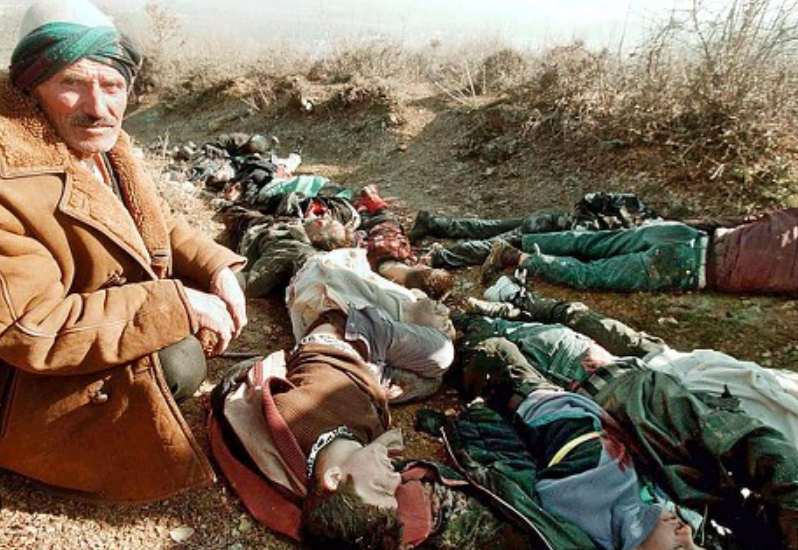
Twenty-seven years after Serbian forces expelled nearly one million Albanians from Kosovo, burning villages, executing civilians, and filling mass graves that would later be discovered on Serbian soil, Belgrade held a commemoration. Officials gathered in Vranje. President Vučić spoke of innocent victims. Foreign Minister Marko Đurić posted statistics on social media: 14,000 bombs, 89 children dead. The Commissariat for Refugees and Migration issued a formal statement on displacement.
In none of these words, across all of these officials and institutions, was a single Albanian mentioned.
Not one.
We should be precise about what this silence is. It is not oversight. It is not the natural compression of official language. It is the output of a system that has decided, with consistency across decades and institutions, that Albanian suffering does not qualify as suffering. That Albanian dead do not qualify as dead. That nearly one million people driven from their homes at gunpoint occupy, in Belgrade’s moral universe, the same category as weather: a condition, not a crime; a fact about the landscape, not something that was done to human beings by other human beings.
This is not a relic of 1999. It is the operating assumption of 2026.
The most instructive document of this year’s commemoration is not Vučić’s speech. It is the formal statement of the Commissariat for Refugees and Migration, a state institution whose legal mandate is the protection of displaced persons. For the 27th anniversary, the Commissariat issued a careful, bureaucratically correct statement about displacement. It noted that a large number of people from Kosovo and Metohija were forced to leave during the bombing. It recorded approximately 200,000 internally displaced persons registered in Serbia today. It closed with a commitment to human rights, dialogue, and the UN Charter.
The approximately one million Albanians displaced from Kosovo in 1999, the largest forced population movement in Europe since the Second World War, appear nowhere in this document.
A state body tasked with counting displaced people counted the displaced people it chose to see and left the others out. That is not error. That is policy. And policy reflects belief. The belief, held and acted upon by Serbian institutions across 27 years and multiple governments, is that Albanians do not fully belong to the category of persons whose displacement constitutes a wrong. They are, in this accounting, subtractions from a Serbian story, not protagonists of their own.
This is not memory. It is engineering.
You do not need a law that says Albanians are lesser. You need only a Commissariat that writes about displacement without mentioning them. You need only a Foreign Minister who posts about victims without including them. Repeat this across enough institutions, across enough years, and it becomes the ambient assumption of an entire political culture. That is what Belgrade has built. That is what Belgrade is still building.
Foreign Minister Đurić’s post was addressed, in English, to a transatlantic audience. This matters. He was not speaking to a domestic constituency that already shares the assumption. He was making an argument, in the language of international law and humanitarian concern, to readers in Washington and Brussels who may not know that the argument rests on a foundation of systematic erasure. The framing, that NATO established a precedent of illegal force that has poisoned the international order ever since, is designed to resonate in a moment when liberal interventionism is under pressure and the legitimacy of the 1990s settlement is openly contested.
It is a coherent argument, on its surface. It becomes incoherent the moment Albanians are allowed into it. The intervention followed years of documented atrocity, a 1998 military offensive that displaced hundreds of thousands before a NATO aircraft had crossed Serbian airspace, massacres at Reçak, Krusha e Madhe and Izbica, and a systematic campaign whose evidence fills the archives of the International Criminal Tribunal for the former Yugoslavia. Whatever judgment one reaches about the legality of the intervention, the sequence of events that produced it is not in historical dispute.
Belgrade’s commemoration works by erasing that sequence. It begins the clock at March 24, 1999, and counts forward. Everything before that date, in this telling, is silence.
Vučić drew a direct line from 1999 to the present, arguing that every subsequent violation of international law traces its permission to that night. The argument is constructed with care. But it is constructed by the president of a country whose forces filled mass graves in Kosovo, whose predecessor was indicted for crimes against humanity, and whose institutions cannot bring themselves to write the word Albanian in a document about displacement. The audacity is not incidental to the project. It is the project. To stand at the podium of victimhood long enough, and loudly enough, is to make the original crime disappear.
Milorad Dodik stood on that platform. His presence was not ceremonial. Dodik’s active political project is the dissolution of a state built on the ruins of a genocide his own entity committed. The axis that gathered in Vranje is not a coalition of the aggrieved. It is a coalition of the unaccountable, and it is actively at work.
There is another party that should be named here. The European Union has granted Serbia candidate status. It negotiates with Belgrade across 35 accession chapters. It funds Serbian institutions. It issues progress reports, expresses concern, calls for dialogue, and continues the process.
Nowhere in the architecture of European enlargement policy is there a requirement that Serbia account for what happened to Albanians in Kosovo. Nowhere is historical reckoning treated as a condition of membership. The EU’s accession framework demands judicial reform, border management, anti-corruption measures, and alignment with the acquis. It does not demand that a candidate country’s state institutions be capable of acknowledging the full humanity of the people its forces expelled and killed.
The result is a process that can accommodate a Serbia whose Foreign Minister erases Albanian victims from the historical record on the anniversary of their expulsion, whose state refugee body issues displacement statistics that exclude the largest displaced population of the war, and whose president stands alongside a sanctioned secessionist, and still remain, in Brussels’ formal assessment, a country on the European path.
What this permissiveness produces is not merely a moral contradiction. It produces a concrete negotiating environment in which Serbia bears no cost for maintaining the erasure. Belgrade continues to receive chapters, funding, and diplomatic legitimacy while its foundational historical claim, that it was the victim and Kosovo the pretext, goes unchallenged by the very institution conducting the accession process. Every year that passes without that challenge, the claim hardens. It moves from political assertion to ambient assumption to the baseline from which future negotiations depart. The EU is not a passive observer of this process. By continuing without condition, it is a participant in it.
The EU cannot credibly present itself as the guardian of human rights and the dignity of victims while extending the courtesies of candidacy to a government that treats an entire people as beneath the threshold of acknowledgment. These two positions are not in tension. They are in contradiction. And the contradiction has a beneficiary.
For Kosovo, none of this is abstract. The erasure of Albanian suffering from Serbian memory politics is the foundation of a legal and political argument: that Kosovo’s separation from Serbia lacked legitimate cause, that its international recognition rests on a violation rather than a remedy, and that the current order is therefore reversible. Every commemoration that omits the Albanian dead advances that argument. Every Commissariat statement that counts only Serbian displaced persons deposits another layer of false foundation under a future claim.
Belgrade is not preparing for a specific operation on a specific date. It is doing something more durable: constructing, institution by institution and anniversary by anniversary, a historical reality in which what happened to Albanians did not happen, or did not matter, or did not happen to people who matter. When the moment comes to press that claim, the groundwork will already be there.
Twenty-seven years ago, Serbian forces drove nearly one million human beings from their homes. The bodies of those killed were loaded onto refrigerator trucks and buried in mass graves on Serbian territory in an attempt to make them disappear. They did not disappear. But in Belgrade’s official memory, in its speeches and its bureaucratic statements and its foreign minister’s social media posts, the attempt continues.
Belgrade has spent 27 years building a history without Albanians in it. Brussels has spent more than a decade funding, negotiating with, and formally validating the state that produces it. The names Belgrade refuses to speak are not lost. They are being deliberately buried, and Europe is providing the ground.
Albatros Rexhaj is an author, playwright, and national-security analyst with nearly three decades of experience in political and security affairs. He is a survivor of a Serbian execution squad in July 1998.