A sharp warning against institutional downgrade: why partial EU integration risks locking Albania into permanent second-tier status and weakening its Euro-Atlantic standing.
By Fatmir Mediu
The joint article published in Frankfurter Allgemeine Zeitung by the duo Rama–Vučić is a mirror of how corrupt power seeks to dominate the European future of Albanians.
Is the acceptance of a “second-tier” status in the European Union a choice made for Rama’s power — or for the future of the Albanian people?
No Albanian would believe that the fate of Albanians in Europe should be determined by Vučić and Serbia.
Political charlatanism often disguises itself as pragmatism, but its real purpose is to serve power and money.
Standing alongside Vučić is a distortion of the Euro-Atlantic interests of Albanians as a nation. It weakens NATO’s consolidation in the region at a time when Russia, China, and their ally Serbia represent clear strategic challenges.
Rama fails to understand that for Albanians the European Union is not merely a common market. It is also a common foreign and security policy aligned with the EU — a policy Serbia has neither accepted nor intends to accept, given its pro-Russian interests, both historical and current.
At a time when EU security and its partnership with the United States through NATO are vital, to create such a caveat in Serbia’s EU trajectory — granting it the same status as Albania — is to open the door to Russian and Chinese interests in the region, interests openly opposed to the EU and NATO.
Rama once again does not surprise in his relationship with Vučić. He takes it upon himself to equate Albania’s foreign and security policy with that of Serbia — policies that are not only diametrically opposed, but where Vučić’s line is openly declared against Kosovo and, consequently, against Albanians.
Rama’s patriotic calls are open demagoguery, intended to mask the transformation of Albania’s foreign policy into a narrow, personalized relationship between himself and Vučić — rather than anchoring Albania as a NATO member among those Balkan countries that share the same positions on democracy, the market economy, free movement, and security.
As with the so-called “Open Balkan” initiative, Rama again places himself against a long-established national policy: full EU membership for Albania.
The common market and Schengen are stages on the path to full accession — not the final destination. To stop at this station, as former chief negotiator Mazi has declared, would make full EU membership impossible and would create serious problems for Kosovo and Albanians in North Macedonia and Montenegro, who see the EU as the framework through which they secure their full rights.
In practice, Albania is no longer functioning as a constitutional parliamentary republic. Nor merely as a prime-ministerial republic. It is becoming a one-man state — a system in which Parliament, the Presidency, and even the National Security Council are reduced to instruments of unlimited personal power.
According to this logic, he is the only one and the irreplaceable one.
The debate over partial integration — participation in the Single Market and Schengen without full institutional membership — is not technical. It is strategic. It touches political sovereignty, geopolitical relevance, and Albania’s democratic identity.
This has been Rama’s choice — not Albania’s. It undermines more than three decades of national consensus on full EU membership. Rama behaves as though the country and the nation were his personal property.
The core truth is simple:
Accepting “second-tier country” status in the EU is not a national interest. It is a narrow political calculation serving the power interests of Edi Rama and Aleksandar Vučić.
Such a model may promise short-term economic benefits. But it carries the risk of permanent peripheral status: implementing rules without representation, gaining economic access without institutional voice. Politically, this means accepting a second-class position in Europe indefinitely.
At a time of deep Euro-Atlantic security challenges — from Russian aggression to Chinese economic penetration in the Balkans — Albania cannot afford strategic ambiguity, particularly when Serbia’s positioning remains openly hostile to Kosovo’s independence and supportive of Serbia without conditions.
PARTIAL INTEGRATION: LIMITED ECONOMIC BENEFITS, HIGH POLITICAL COSTS
What is claimed to be gained from the Rama–Vučić proposal?
Access to the Single Market — supposedly expanding trade flows, harmonizing regulation, and improving the investment climate.
But Albania does not suffer from lack of economic opportunity. It suffers from lack of governance: endemic corruption, organized crime, money laundering, legal insecurity, clientelist rule, and the merging of state with ruling power.
Participation in Schengen would guarantee freer movement for citizens and businesses within the EU. But is that Albania’s primary problem?
Free movement for Albanians has existed since 2011.
Today Albania faces its greatest social, economic, and political wound: mass emigration. Young people, professionals, the intellectual core of society are leaving. The country is aging rapidly. Albania risks becoming a society without voice and without the strength for change — a reality that serves the objective of permanent power.
The promise of economic stability through the Rama–Vučić formula is false. The problem is not lack of opportunity — it is the destruction of opportunity through corruption and criminal governance.
Participation in the Single Market requires strict rules and obligations. Without a functioning economy and rule of law, there is no national gain.
WHAT IS LOST?
There would be no representation in the European Parliament. No seat in the European Commission. No role in shaping common foreign and security policy.
Albanians — currently a Euro-Atlantic factor across four states in the region — would be reduced to irrelevance in European decision-making.
The idea of a multi-speed Europe has existed for years. But the EU has not abandoned its core principles:
Representative democracy
Rule of law
Separation of powers
Institutional accountability
The value of the European Union lies in democratic architecture and equality of member states in decision-making.
NATO AND REGIONAL SECURITY
As a NATO member, Albania is obligated to maintain full coherence with Euro-Atlantic security architecture. In the context of Russian aggression and expanding Chinese influence, ambiguous positioning within the EU weakens Albania’s strategic credibility.
Serbia maintains close ties with Russia in security, intelligence, and foreign policy. It is China’s primary partner in the Balkans.
The U.S. National Defense Authorization Act calls for Balkan countries to counter Russian and Chinese influence and to fight organized crime and corruption. President Trump and European leaders have urged increased investment in security, defense, infrastructure, and technology — requiring coordinated NATO cooperation in the Balkans.
Serbia spends over 3% of its budget on defense while positioning itself openly against NATO in the region and against the security architecture of the Balkans.
There is a striking similarity between the concentration of power under Vučić and Rama — weakening institutions, undermining constitutional balance, marginalizing opposition — creating systems sustained by corruption and power consolidation.
They share the same logic: power for money, and money for power.
The narrative portraying Rama and Vučić as visionary regional stabilizers contradicts the internal realities of both countries — marked by accusations of authoritarianism, corruption, and crime. That narrative is not only anti-national. It is anti-Albanian.
For Albania, the relationship with Kosovo is not tactical. It is central to national security and regional balance.
DEMOCRATIC CONDITIONALITY
Full EU membership is the key mechanism for strengthening rule of law, judicial independence, and the fight against corruption. The partial integration model promoted by Rama and Vučić risks deliberately bypassing the democratic filters required by Europe and Germany.
Faced with Europe’s growing awareness that Albania’s core problem is governmental corruption, organized crime, and flawed elections, Rama seeks to shift blame toward Europe instead of confronting domestic failure.
He attempts to sell Albanians the next falsehood — that Europe is the problem, not his government.
In the end, Albania’s choice is clear:
Full institutional sovereignty inside the European Union — or structural marginalization on its periphery.
The national interest demands full membership, democratic consolidation, and unwavering alignment with NATO.
About the Author:
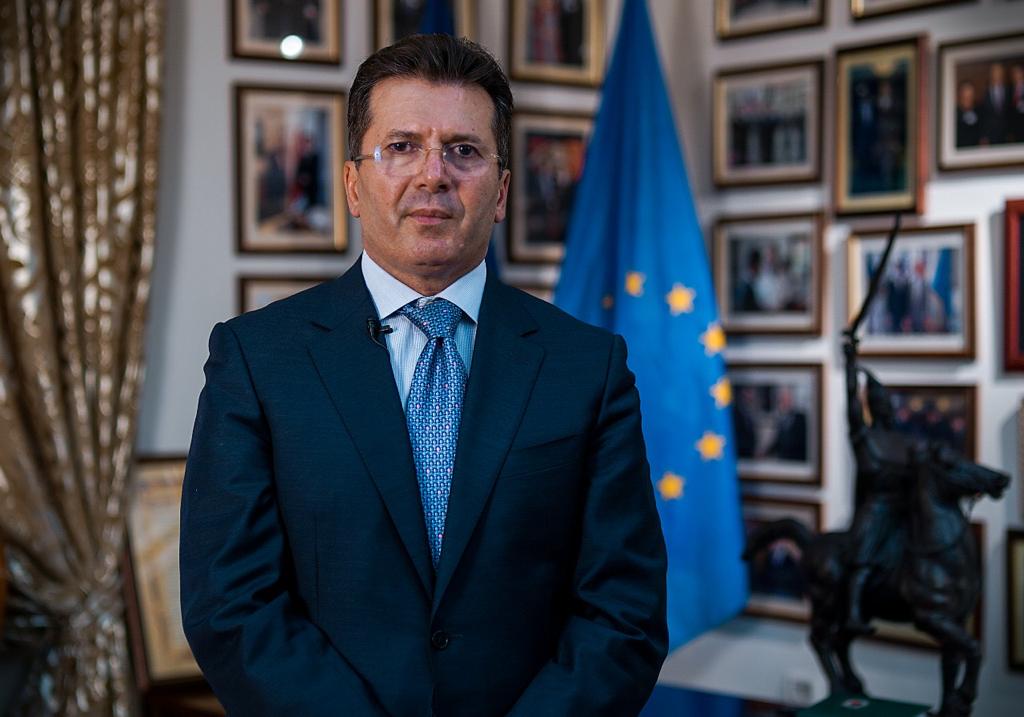
Fatmir Mediu is a former Minister of Defense of Albania and chairman of the Republican Party. He has served multiple terms as a member of Parliament and writes on national security, Euro-Atlantic integration, and regional geopolitics.