Albania’s Parliament, Thursday, 5 March 2026: nine hours from commemoration to chaos, a near-fight, a walkout, and votes passed without the opposition.
by the Tirana Examiner
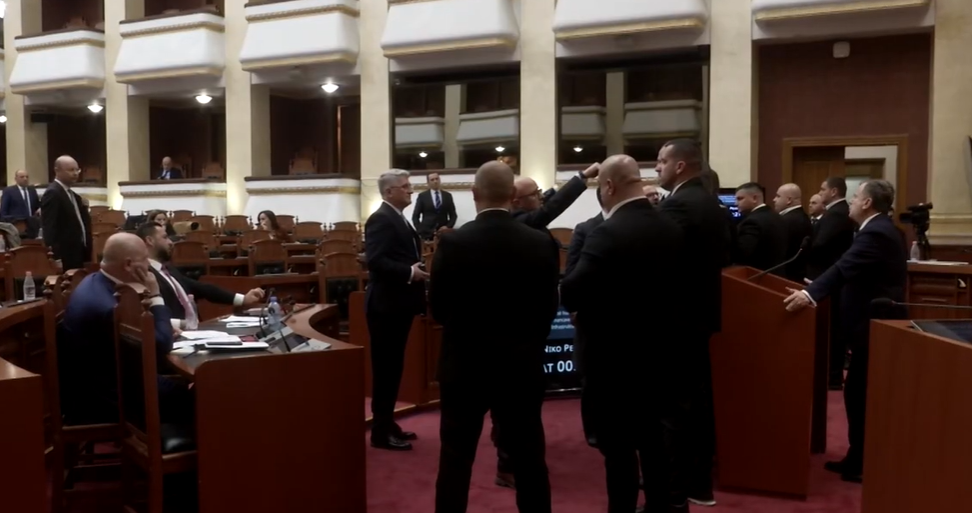
Albania’s Parliament (Kuvendi) spent Thursday in a long, increasingly combustible sitting that opened with commemoration and ended in insults, a brief physical confrontation, an opposition walkout, and the governing majority pushing the day’s remaining votes through on its own.
What happened was not a single incident, but a chain: discipline measures taken before the sitting properly began, procedural warfare over government changes and an immunity request, a thinning chamber during debate on education, and then—late in the day—a verbal escalation that collapsed the session’s remaining political oxygen.
Opening: commemoration, then discipline
The sitting began with a minute of silence for Adem Jashari and his family on the anniversary of the Prekaz attacks, alongside a separate minute of silence requested for former MP Tomor Dosti.
Before the chamber moved through its agenda, the Secretariat for Procedures, Voting and Ethics approved a 20-day exclusion for Agron Shehaj (Mundësia). The majority argued Shehaj had blocked the rostrum in a previous sitting and refused to leave the hall after being ordered out—conduct it said obstructed Parliament’s work. Shehaj had linked his earlier protest to the Rrjoll residents’ month-long demonstrations against a luxury resort project and alleged state favoritism and property violations. The suspension became an early signal of how confrontational the day would be.
Cabinet reshuffle: rostrum blocked, votes proceed anyway
Early in the sitting, the Socialist Party (PS) moved to bring forward votes on presidential decrees tied to dismissals and appointments in the government cabinet. The Democratic Party (PD) responded by blocking the rostrum, creating chaos in the hall and effectively removing itself from the vote.
Despite the disruption, the majority proceeded with the electronic vote.
Dismissals (reported vote totals):
Belinda Balluku — 85 votes in favor of dismissal
Elisa Spiropali — 83
Pirro Vengu — 81
Albana Koçiu — 83
Besfort Lamallari — 83
Toni Gogu — 82
Appointments (reported vote totals):
Albana Koçiu — Deputy Prime Minister — 83 for, 3 against
Ferit Hoxha — Foreign Minister — 83 for, 4 against
Besfort Lamallari — Interior Minister — 83 for, 4 against
Ermal Nufi — Defence Minister — 83 for, 6 against
Toni Gogu — Justice Minister — 83 for, 5 against
Enea Karakaçi — Infrastructure & Energy — 83 for, 6 against
Eriona Ismaili — Minister of State for Parliamentary Relations — 82 for, 4 against
A separate procedural controversy emerged around the voting system: reports circulated about a “mystery” vote allegedly registered under Sali Berisha and Jozefina Topalli regarding Spiropali’s dismissal. Topalli later described it as a technical lapse amid chaos—pressing buttons while attempting to request the floor—adding that she also pressed Berisha’s button because he was physically at the rostrum at the time.
Balluku’s immunity: deadlines and procedural trench warfare
Running in parallel was an intensifying dispute around SPAK’s request connected to MP Belinda Balluku (including opposition demands that Parliament act immediately).
PD parliamentary group leader Gazment Bardhi argued that the majority had delayed the procedure for months and was now stretching the timeline again. He demanded the matter be placed on the day’s agenda and framed the issue as a constitutional obligation to give prosecutors a timely response, warning that delay could function as a de facto refusal.
PS group leader Taulant Balla replied that the majority was operating within the two-week deadline to draft its report and that it would be ready for the 12 March sitting—together with the opposition’s report.
Rules of Procedure: “modernization” vs “provocation”
Another conflict line was PS proposals to amend Parliament’s Rules of Procedure. Balla framed the changes as long-planned institutional modernization and an alignment with European parliamentary practices. The opposition characterized the initiative as unilateral and provocative.
Speaker Niko Peleshi said he would invite parliamentary group leaders for consultations and insisted the process was not being fast-tracked.
A revealing exchange took place when PS MP Ardit Bido criticized the Speaker’s tolerance of abusive language in the chamber. Peleshi replied, sharply, that if Bido could not understand the chair’s behavior toward all MPs—majority and opposition alike—“it may be due to a lack of experience.”
Education debate: teacher pay and a visibly emptying chamber
Midday turned to an education amendment concerning pay treatment for teachers hired before certain Bologna-system diploma equivalencies became standard.
Minister Mirela Kumbaro argued the change would standardize and harmonize pay rules for teachers hired before 1 March 2017, and that 6,761 teachers would benefit.
Opposition MPs accused the majority of lifting and diluting their proposal. The debate unfolded in a chamber that visibly thinned out over time, with reports noting MPs and ministers leaving “one after another” until only a small number remained present during the discussion.
Noka vs Bido: identity taunts and counter-accusations
A separate argument escalated between PD MP Flamur Noka and PS MP Ardit Bido after Noka mocked Bido by describing him as having been presented “sometimes as Cham, sometimes as Greek, sometimes as Lab.”
Bido replied that he had met Noka only once—when Bido was a journalist seeking an interview—denied ties to political patrons Noka named, and then broadened his response into a character attack on Noka and a wider critique of how politics and appointments allegedly functioned during earlier PD periods. The exchange underscored how frequently Thursday’s sitting slid from policy into personal insinuation.
The evening rupture: “0900,” insults, and a near-fight
After roughly nine hours of debate, the sitting detonated around a remark by Taulant Balla directed at PD MP Albana Vokshi. From the rostrum, Balla said (translated):
“In truth, we didn’t have your phone number to call you and ask how it should be done. For you, Albana, we have the number 0900.”
The phrase landed as a sexualized insinuation in the chamber. The response was immediate and explosive.
Bardhi demanded the session be suspended and then shouted back at Balla with a stream of insults. The reported wording included (translated, retaining the original’s explicitness and censoring as it appeared in Albanian coverage):
“Filth, shameless, a vile man—you’re used to the w***es in your party… Who are you showing ‘0900’ to? ‘0900’ is your sister’s number.”
At that point the sitting was interrupted.
When proceedings resumed, the atmosphere did not reset. Balla asked for the floor, saying the reference was not meant as an insult and insisting it referred to an EU information line. He added (translated):
“If Ms. Vokshi feels offended, I apologize.”
But opposition MPs rejected the explanation. The confrontation expanded, with reports describing a moment in which PD MP Klevis Balliu attempted to confront Balla physically—an episode that pushed the session into open disorder.
PD MP Besart Xhaferri demanded Balla’s exclusion from Parliament, arguing that the number and its connotations were being misrepresented and that the insinuation was obvious.
Speaker Niko Peleshi said the Secretariat for Ethics would review audio and video footage and then issue a position.
Balla later returned to the microphone with a broader warning about rising tension and referenced the next sitting, when Parliament is expected to address Balluku’s immunity. He said, in effect, that the chamber was heading toward a more volatile confrontation—and responded to remarks heard from the opposition about someone being beaten with a line that was itself read as threatening. In the reported Albanian wording: “Whoever says ‘this one will be beaten’… you against us… I won’t say it today.”
Walkout and votes: majority passes the day’s agenda without PD
As the confrontation continued, PS moved directly to voting. The opposition walked out.
With PD absent, the majority passed the remaining items on the order of the day and rejected two opposition initiatives. The reported outcomes:
Adopted:
Amendment to Law No. 69/2012 on the pre-university education system — 81 votes for
Ratification of a loan agreement with KfW (Municipal Infrastructure V – Phase II) — 80 for
Law on the Supervisory Agency in the execution of penal decisions — 81 for
Amendments related to state control of international transfers of military goods and dual-use items/technologies — 81 for
Decision amending the composition of standing committees (substitute members) — 80 for
Rejected (opposition initiatives):
Amendment to the national taxes law — 79 against
Amendment to the local self-government finances law — 78 against
After the sitting: Tabaku announces the next procedural move
Later in the evening, PD MP Jorida Tabaku said the PD parliamentary group would submit, the following day, a formal request seeking Balla’s exclusion from Parliament. Her statement framed the “0900” remark as a direct attack on the dignity of a woman MP and accused the Speaker of failing to act with immediate neutrality and authority.