What an Empirical Audit Adds, and What Single-Source Evaluation Costs
Tirana Examiner
Between March 1 and May 5 of this year, a Tirana-based monitoring service recorded 4,536 political articles published by 43 Albanian outlets. Within that corpus, opposition figures received 1,828 mentions against 925 for the prime minister and the government combined. Sali Berisha alone, sixteen months into a non-grata designation that should, on the standard reading of a captured media environment, have suppressed his coverage, accumulated 595 mentions, sixteen percent more than Edi Rama. The state media regulator, in its March audit, reported that the Democratic Party had absorbed 60.12 percent of political television time. None of these figures are advocacy outputs. They are the empirical material an honest assessment of Albania’s press environment is obliged to engage, and the kind the 2026 World Press Freedom Index, which places the country at 83rd of 180, does not collect.
What the Index Reaches and What It Does Not
The Index’s findings on structural conditions are documented and are not contested here. Ownership concentration in outlets with proprietors active in regulated sectors, gaps in the legal framework governing audiovisual media, opacity in state advertising allocation, friction in access to public information, and verbal attacks against individual journalists from political figures across the spectrum exist in the Albanian record. RSF measures them with a recognized methodology and the resulting score is a competent assessment of the institutional environment in which journalism is produced.
The Index does not measure what that environment produces in published output. It does not measure the volume, range, or distribution of political content. It does not measure share of voice. It does not measure the willingness of mainstream outlets to publish severe accusations against the head of government. These are not failures of the Index. They are scope limitations RSF acknowledges. The question this analysis addresses is therefore not whether the structural findings are accurate. It is whether the inferences typically drawn from the rank order, when the ranking is consumed as a single-line summary in policy environments, match what published output actually shows.
The two measurements describe different press-freedom goods. Structural conditions measure the durability of journalism as an institution. Published output measures the present diversity and criticality of the public conversation. A country can present weak institutional durability and high present pluralism simultaneously. That is, on the combined evidence, approximately the Albanian case. Neither finding subsumes the other. Both have to be present for the assessment to be accurate, and the present evaluation regime privileges the first while leaving the second uncollected.
What the Sample Documents
The Buletin Intelligence sample is large enough to be load-bearing. Across 66 days, 4,536 political articles is a daily average of 69, distributed across 43 outlets with editorially distinguishable lines: 2,136 articles in mainstream titles, 1,750 in critical or opposition-aligned outlets, 236 in identifiable pro-government outlets, the remainder in regional and specialist coverage. The asymmetry between critical and pro-government outlets is 7.4 to 1 by article count. Sentiment analysis across the same corpus produced 859 critical articles against 134 positive, a ratio of 6.4 to 1.
The accusation inventory in headlines is severe. Politiko published Berisha’s claim that the interior minister had ordered killings. Vizion Plus carried his characterization of the country as a narco-state. Dosja published his declaration that protests would continue until the prime minister’s removal. None of these publications was sanctioned. None of the journalists who wrote them was detained.
A caveat applies to the article-count framing. Top Channel and Klan reach audiences orders of magnitude larger than Pamfleti or Politiko, and a 7.4-to-1 ratio in raw counts may compress when weighted by reach. The AMA finding is partly responsive, because television share-of-voice is itself a reach-weighted measurement, but it is one indicator in one medium for one month. A longitudinal reach-weighted analysis across the multi-medium ecosystem is the natural extension of this work, and the conclusion this section sustains is correspondingly bounded.
What the Evidence Tests, and What It Refutes
The data is incompatible with the operational definition of media capture as it applies to hard cases. Hungary’s dominant party controls roughly 80 percent of political television time. Russian opposition figures are effectively absent from broadcast media. In Belarus, publishing the phrase “Lukashenko leave” is criminalized. The published-output environment in Albania is structurally different from these cases at a resolution that single-rank summaries do not preserve.
The harder version of the comparison is soft capture, the framework developed primarily on the Visegrád cases to describe environments where suppression operates without producing the signatures of authoritarian control. Soft-capture frameworks make specific empirical predictions about where suppression will be most visible: in criticism of dominant political figures, in accusations of corruption against ministers, and in coverage of contested institutional decisions. These are the dimensions where editorial self-discipline carries the highest cost, and where captured environments are predicted to show the clearest signal.
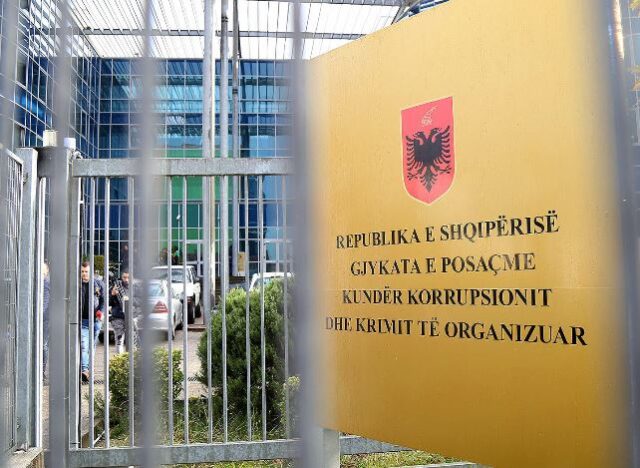
The Buletin sample documents high published output in exactly those three dimensions. The accusation that the interior minister ordered killings appeared in mainstream digital titles. The “narko-shtet” framing of the prime minister’s government circulated freely in headlines across the political spectrum. Coverage of contested institutional decisions, including the GJKKO immunity dispute and the SPAK proceedings, generated sustained editorial attention with no observable bias toward government framing. These are not the secondary territory of soft-capture analysis. They are its core empirical predictions, and the predictions fail.
The dimensions where the sample is silent should be named. The study does not stratify for coverage of major infrastructure procurement, of construction-sector political ties, of organized-crime adjacencies, or of the specific networks through which state advertising allocation operates. A country can present an open conversation about the prime minister and a constrained one about the proprietors of its largest mainstream outlets, and the empirical study does not exclude this possibility. The conclusion the evidence sustains is therefore qualified but not vague: Albania’s published-output environment is incompatible with hard capture and inconsistent with soft capture in the dimensions soft-capture frameworks themselves identify as primary. The remaining untested dimensions are secondary in those frameworks, and require their own measurement rather than functioning as a default presumption of suppression.
The Cost of Single-Source Evaluation
The IBAR conversation, and the Chapter 23 process behind it, places Albanian press freedom in a specific evidentiary environment. The DG NEAR assessment, the rapporteurs in the European Parliament, and the working-level evaluations that feed the COELA discussion rely on a reference set of indicators in which the RSF Index figures prominently. The Index is not the problem. The compression of country assessment into rank-order single-line summaries is.
A rank of 83 generates a comparative impression. The impression places Albania closer to the structurally captured cases than the published-output evidence supports. The Index itself does not make that comparison. The category classification, “problematic” rather than “difficult” or “very serious,” preserves the distinction correctly. Policy environments do not consume category classifications. They consume rank orders, and rank orders compress the structural-output distinction to invisibility. The country pays a cost for that compression that the methodology of the Index alone cannot correct.
The remedy is institutional. The Chapter 23 evidence base on press freedom in candidate countries should require, alongside structural assessment, an empirical reconstruction of published output at production-grade resolution: stratified by medium, weighted by reach, longitudinal in scope, and stratified for the specific topic domains where soft capture is most likely to operate. The methodology exists. The Buletin study demonstrates that it is feasible for the Albanian case. The same approach is feasible for Montenegro, North Macedonia, Kosovo, and Serbia, and would yield a comparative empirical baseline that the present evaluation regime lacks.
This is not a request for the assessment of Albania to be more favorable. It is a request for the assessment of every candidate country to be more accurate. The structural problems will register in either methodology. The published-output dimension will register only in the second. A Chapter 23 conversation that runs on one and ignores the other produces, by construction, an evaluation less complete than the available evidence allows. The cost of that incompleteness is borne by the country being evaluated, by the institution doing the evaluation, and ultimately by the candidate-country populations whose accession trajectory depends on assessments that are taken to be diagnostic.
The 2026 ranking is not a verdict on Albanian press freedom. The empirical study is not a verdict on the ranking. The two findings describe different layers of the same media ecosystem, and neither subsumes the other. The structural layer presents real problems that have not been resolved. The published-output layer presents pluralism that is incompatible with hard capture and inconsistent with soft capture in the dimensions soft-capture frameworks themselves identify as primary.
The conversation Albania owes itself, and the institutions evaluating it, is one that holds both findings simultaneously. The 83rd-place ranking captures one part of the picture. The empirical reconstruction captures another. The complete picture requires both, and a methodology to test what neither yet measures. The country pays a cost for evaluations that proceed without the second. So, on a longer time horizon, does the credibility of the evaluations themselves.