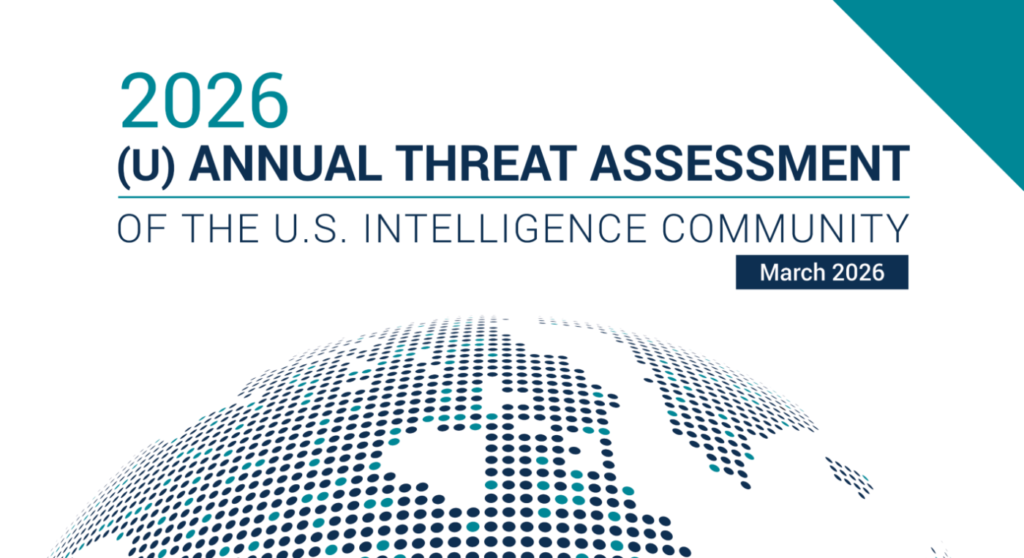
The U.S. Intelligence Community’s 2026 threat assessment names the Russian hybrid campaign running through Albania’s neighborhood with more precision than any previous report. The administration that produced it said nothing about it from the podium. Tirana should not make the same mistake.
By Marinela Pole (Tirana)
On March 18, Director of National Intelligence Tulsi Gabbard sat before the Senate Select Committee on Intelligence and spoke for nearly twenty minutes. She covered fentanyl, cartels, Islamist terrorism, China’s military modernization, North Korea’s nuclear arsenal, Iran’s surviving but degraded regime. She did not mention the Western Balkans. She did not mention Albania. She did not mention the Russian hybrid campaign that the written assessment her office filed the same day describes in terms more direct than any ATA in recent memory.
That silence is not an oversight. It is a policy signal — and the question it raises is the one this piece is built around: if the U.S. Intelligence Community identifies and names a sustained Russian destabilization campaign in the Western Balkans, but the administration that receives that intelligence does not elevate it, who is actually setting Balkan policy? The analysts, or the politics?
The answer has direct consequences for every government in the region that has organized its strategic posture around the assumption that Washington’s analytical products and Washington’s political attention travel together.
The written assessment is unambiguous. The 2026 Annual Threat Assessment, finalized with information through March 14 and representing the consolidated judgment of sixteen U.S. intelligence agencies, states that Russia fuels instability between Serbia and Kosovo over Kosovo’s statehood, backs Republika Srpska’s separatist project within Bosnia and Herzegovina, and deploys state-sponsored nongovernmental entities to run influence campaigns across Bosnia, Montenegro, and Serbia — all aimed at obstructing NATO and EU integration, built around a single operational core: “highlighting Serb victimhood.”
The phrase is worth sitting with. It does not describe a spontaneous expression of historical grievance. It describes a manufactured product — a narrative engineered to generate political constituencies for obstruction, to give Belgrade domestic cover for a foreign policy that serves Moscow far more than it serves Serbia, and to make the argument against Western integration feel like self-defense rather than strategic alignment with a foreign power. The IC is saying, in the language of professional intelligence assessment, that what presents itself as concern is a weapon. That the pipeline runs from Moscow through state-sponsored NGOs to the political surface of three countries. That the instrument is Serb suffering — real in history, synthetic in its current deployment.
Operationally, this means funded civil society organizations, coordinated media amplification across Serbian-language platforms, political messaging delivered through proxies who present themselves as independent voices, and narrative frameworks that activate reliably whenever a Western-aligned government in the region takes a decision that advances integration. When Kosovo enforced the Law on Foreigners on March 14, the machine activated within hours. The ATA explains the machine. It does not explain who approved it running uncontested for this long — and that question the document, by design, does not ask.
Albania sits inside this system, not beside it. The same NGO and media infrastructure the IC identifies in Bosnia and Serbia has Albanian-language extensions that have operated with increasing sophistication since at least 2016. The outlet Portalb and associated aggregator networks have functioned as amplification nodes for narratives that track Russian strategic interests — framing NATO as an occupying rather than a defensive alliance, circulating disinformation about Albanian institutional corruption timed to electoral cycles, and presenting the country’s Euro-Atlantic orientation as elite capture rather than sovereign choice. During the 2021 Albanian electoral period, coordinated inauthentic behavior campaigns — documented in Meta’s quarterly adversarial threat reports — targeted Albanian political discourse with content whose provenance and coordination patterns matched the broader IRA-linked European influence architecture identified in U.S. Senate Intelligence Committee investigations.
This is not coincidental adjacency. It is the downstream expression of the upstream system the ATA names. Russia’s strategic interest in Albania is the mirror image of its interest in Kosovo: a consolidated, stable, EU-integrated Albania with a functioning Kosovo beside it is precisely the outcome the campaign is designed to prevent. Albanian NATO membership is already irreversible. Albanian EU accession is not. That gap — between the security anchor that is settled and the political-economic anchor that is not — is where the operation concentrates.
The ATA’s broader Russia portrait confirms that this is not a campaign in decline. Moscow has maintained the upper hand in Ukraine. Its ground forces have grown despite attrition. It sees little reason to negotiate while it gains ground. The gray zone operations in the Balkans are not a distraction from the war — they are its complement, designed to keep Europe’s southeastern edge unstable while the northwestern edge absorbs the kinetic costs. The November 2025 railway explosion in Poland — Russian sabotage against a NATO member cited in the report — and the NGO campaigns sustaining Republika Srpska’s institutional defiance belong to the same architecture. The scale differs. The logic is identical.
The second story the ATA tells is about the instrument itself, and it requires honesty that is uncomfortable for those who need the document most.
This is the first Annual Threat Assessment produced under the Trump administration, and the first under Gabbard as DNI. Senator Mark Warner noted at the hearing what the report omits: for the first time in years, the ATA contains no assessment of foreign threats to U.S. elections. Warner stated the implication plainly — there must be no foreign threat to elections in 2026. Gabbard did not respond. She moved on.
The election interference omission is not an isolated editorial decision. It is evidence of a filtering process. The question is not whether the IC’s analysts assessed a foreign election threat — they almost certainly did, as they have every year for a decade. The question is whether that assessment was included in the document that reached Congress, and the answer is no. That is political management of an intelligence product, and it has a cost that extends beyond American domestic politics directly into the Balkans.
The ATA’s usefulness as a diplomatic tool for Albania and Kosovo rests entirely on its reputation as the unvarnished output of professional intelligence analysis. When a senior Democratic senator raises the possibility — in open session, on the record — that the document has been selectively edited to protect the administration’s political positioning, that reputation takes a hit. The Balkans paragraph survives intact, and its findings are genuine. But the document now carries a question mark it did not carry before, and that question mark travels with it into every European capital where Albanian and Kosovar diplomats try to use it as an anchor.
Allies should not discard the ATA. They should use it with clear eyes about what it now is: a partially filtered product from an administration that has made deliberate choices about which threats to elevate and which to manage quietly. The Balkans findings made it through the filter. That is significant. It is not a guarantee that future editions will be as forthcoming — and it is not a substitute for European allies developing their own intelligence assessments of Russian hybrid operations in the region, which several have and which are in some cases more granular than what Washington has published here.
The practical question for Tirana is not whether to use this document. It is whether the foreign ministry has the strategic discipline to use it correctly.
The ATA has provided Albanian diplomacy with a formally filed U.S. government characterization of Russia’s regional destabilization campaign. That characterization is most valuable in five specific contexts: bilateral conversations with Spain, Slovakia, Romania, Greece, and Cyprus — the EU member states that have not recognized Kosovo and that have absorbed years of the victimhood narrative without a clear American counter-framing. In each of those capitals, the argument has been available but has lacked an authoritative American anchor. The ATA provides one. The Ministry of Foreign Affairs should be deploying it now, in writing, through its bilateral channels, before the document’s news cycle closes and it recedes into the archive.
At COREPER level, Albania’s EU accession process creates a standing forum for exactly this kind of argument. The case that Russian hybrid operations targeting Western Balkans integration are a documented threat to European security — not an Albanian talking point but a U.S. IC finding — belongs in accession-related working groups where the political will to accelerate integration competes with risk-aversion dressed as procedural caution.
None of this happens automatically. Warsaw, Riga, and Tallinn learned years ago that Washington’s analytical products can be weaponized diplomatically even when Washington’s political attention is elsewhere — that the gap between what American analysts assess and what American politicians prioritize is itself a resource for allies who know how to use it. Tirana has been slower to internalize that lesson. The administration that produced this document will not amplify it. Gabbard’s twenty minutes made that clear. The question is whether Albania’s foreign policy establishment is capable of doing what Washington has declined to do: take the finding seriously, state it plainly, and act on it before the window closes.
That is not a question the ATA answers. It is the question the ATA asks.
The 2026 Annual Threat Assessment of the U.S. Intelligence Community was published March 18, 2026, and is available in full at dni.gov. DNI Gabbard’s opening statement to the Senate Select Committee on Intelligence was delivered the same day.
Marinela Pole writes on hybrid warfare, influence operations, and state resilience in the Western Balkans. Drawing on experience within Albania’s law enforcement structures, her work examines how Russian-aligned campaigns interact with local institutions, electoral environments, and Euro-Atlantic integration processes.