A close reading of the CSDG assessment raises a fundamental analytical question: how much does the report actually demonstrate—and how much does it assume?
By Albatros Rexhaj (Tirana)
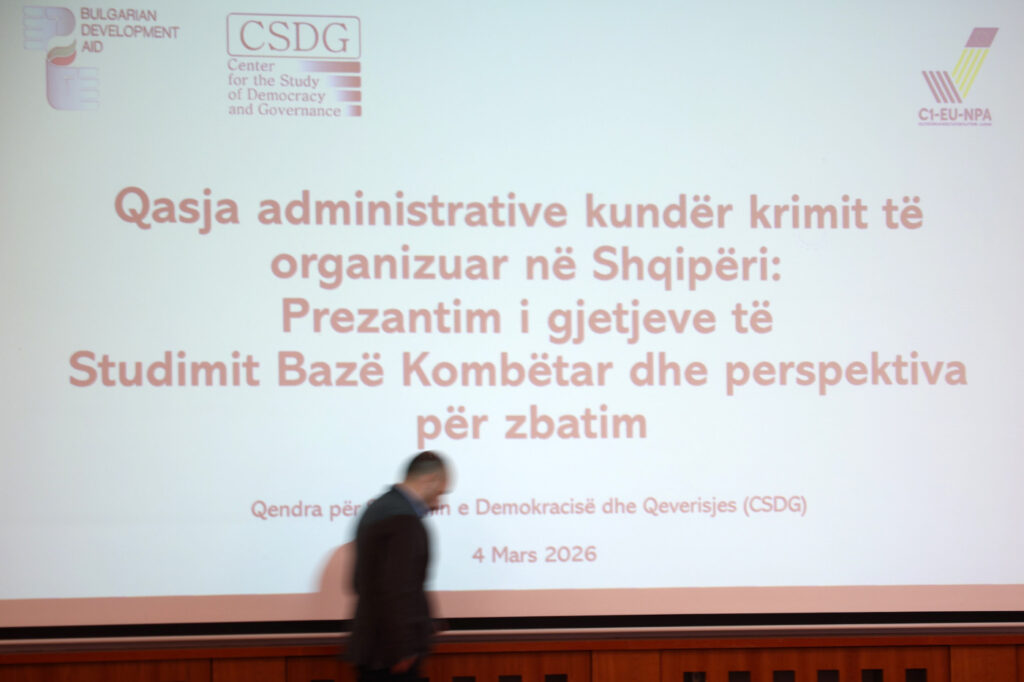
The recent report presented in Tirana by the Center for the Study of Democracy and Governance (CSDG) introduces into Albania’s policy debate the concept of an “administrative approach” to organized crime.
The premise is straightforward: regulatory instruments—licensing regimes, inspections, procurement oversight, and ownership transparency—can be used to prevent criminal networks from penetrating the legal economy.
The concept itself is not controversial. Across Europe, regulatory authorities increasingly complement criminal prosecutions with administrative barriers designed to restrict criminal access to legitimate markets. Organized crime, after all, is not merely a law-enforcement challenge; it is also a governance and economic-integrity problem.
The preventive use of administrative tools against organized crime has become a recognized element of contemporary European governance frameworks. Regulatory instruments—including licensing controls, procurement screening, beneficial-ownership transparency, and financial supervision—are increasingly used alongside traditional criminal justice responses to limit the ability of criminal actors to enter legitimate markets.
In principle, strengthening these mechanisms can create additional barriers that make it harder for criminal networks to operate within the legal economy.
The key question, however, is not whether the administrative approach has conceptual merit. The real question is whether the report presented in Tirana demonstrates—through robust empirical analysis—that Albania’s institutional framework is failing in the ways the study suggests.
The strength of any policy report ultimately depends not on the attractiveness of its framework but on the robustness of the evidence supporting it.
A careful reading of the CSDG study suggests that the distance between its conceptual framework and its empirical demonstration may be wider than the presentation of the report initially implies.
When a “Baseline” Becomes a Structural Diagnosis
The study repeatedly describes itself as a “National Baseline Assessment.”
In governance research, baseline assessments serve a specific methodological purpose: they establish the starting conditions against which institutional reforms can later be evaluated. A baseline therefore requires a set of replicable indicators—qualitative or quantitative—that allow policymakers to measure change over time.
The CSDG report instead provides primarily a qualitative mapping of administrative instruments, describing:
- existing legal frameworks
- institutional mandates
- regulatory procedures
- perceived coordination gaps.
These elements are useful for institutional analysis. But they do not constitute a measurable baseline in the strict analytical sense.
Without defined indicators—such as enforcement outputs, regulatory decisions, or administrative interventions—it becomes difficult to determine whether future reforms will actually produce measurable change.
The report therefore functions less as a baseline measurement and more as an institutional landscape overview. Treating such a mapping exercise as a structural diagnosis risks attributing to it a level of analytical certainty that its methodology does not fully support.
Measuring Institutional Structure, Not Policy Outcomes
The report’s central analytical tool is a three-level “degree of institutionalization” scale, used to evaluate Albania’s readiness to implement the administrative approach.
Within this framework:
- Level 0 represents the absence of administrative instruments
- Level 1 indicates fragmented institutional mechanisms
- Level 2 represents integrated administrative coordination.
Albania is assessed largely at Level 1, meaning that administrative elements exist but remain insufficiently integrated.
At first glance the model appears to offer a clear measurement of institutional maturity. In practice, however, the scale compresses complex governance systems into three broad categories.
Institutional performance typically varies across multiple dimensions, including:
- legal authority
- investigative capacity
- digital infrastructure
- enforcement outcomes
- political independence.
Reducing these dimensions to a simplified index produces what analysts often describe as low-resolution institutional measurement.
More importantly, the scale evaluates organizational structure rather than operational effectiveness.
A regulatory system may appear highly institutionalized and still fail to disrupt criminal networks. Conversely, fragmented administrative environments may still produce significant investigative results through strong law-enforcement institutions.
The model therefore measures administrative maturity, not the real-world impact of anti-crime policy.
Evidence Based on Institutional Narratives
A second methodological issue concerns the report’s evidence base.
The study relies primarily on:
- institutional documentation
- legal frameworks
- expert consultations
- interviews with officials.
These sources are appropriate for describing governance architecture. But they offer limited insight into the economic dynamics of criminal markets.
Notably absent from the analysis are several types of empirical evidence commonly used in economic-crime research, including:
- sector-level financial datasets
- economic estimates of illicit capital flows
- systematic enforcement statistics
- longitudinal analysis of criminal infiltration patterns.
Without such empirical foundations, it becomes difficult to determine whether administrative instruments are actually affecting organized crime—or simply creating the appearance of regulatory activity.
In this sense, the report reads more as a governance inventory than as a data-driven study of criminal economic activity.
The Missing Measurement: How Large Is the Problem?
Perhaps the most striking omission in the report is the absence of any attempt to estimate the scale of criminal infiltration into Albania’s legal economy.
The study identifies risks in sectors such as:
- construction
- public procurement
- real estate
- financial services.
Yet it does not attempt to approximate:
- the proportion of businesses affected
- the estimated value of illicit capital
- the market share of criminal actors within specific sectors.
Serious economic-crime analyses normally attempt at least preliminary estimates of:
- criminal revenues
- sector exposure
- market distortion.
Without such measurement, the report begins with a problem statement whose magnitude remains undefined.
This does not mean the problem is small. But it does mean the analysis proposes institutional reform without establishing the empirical scale of the phenomenon it seeks to address.
The Administrative Approach and Institutional Capacity
The policy framework promoted in the report is rooted in the administrative approach, a governance model that has gained prominence in several Western European countries, particularly the Netherlands and Belgium.
In these environments, regulatory agencies often operate with:
- integrated national databases
- advanced financial intelligence systems
- strong municipal regulatory authority
- dense inter-agency information-sharing structures.
Transferring such models to different institutional environments requires careful examination of administrative capacity and regulatory prerequisites.
The report acknowledges fragmentation within Albania’s institutional framework but does not fully examine whether the administrative approach presupposes:
- higher bureaucratic resources
- deeper digital integration
- stronger investigative authority within regulatory bodies.
Without examining these prerequisites, the analysis implicitly assumes that improved coordination alone could generate the operational capacity required by the model.
That assumption deserves closer scrutiny.
Organized Crime as an Adaptive Economic Actor
Another important issue concerns the economic behavior of organized crime itself.
Criminal networks operate as adaptive economic actors. When confronted with regulatory barriers, they frequently respond by:
- operating through intermediaries or front companies
- exploiting offshore ownership structures
- shifting activities across sectors or jurisdictions
- using complex financial layering to obscure control.
In such contexts, stronger administrative oversight may indeed disrupt certain forms of infiltration. But it may also lead criminal actors to adopt more sophisticated concealment strategies.
The report assumes that regulatory tightening will significantly reduce criminal access to legal markets. What it does not explore sufficiently is whether regulatory complexity may simply raise the cost of infiltration rather than eliminate it.
The Limits of Perception Surveys
The project also incorporates a national public opinion survey intended to measure citizen perceptions of organized crime and institutional responses.
Public opinion data can offer insights into levels of public trust. However, such surveys face methodological limitations when applied to complex governance systems.
Most citizens do not possess direct knowledge of:
- administrative enforcement procedures
- procurement screening mechanisms
- licensing decisions
- inter-agency coordination processes.
Survey responses therefore tend to reflect general perceptions rather than operational realities.
Perception surveys can provide contextual information, but they cannot substitute for institutional performance indicators when evaluating the effectiveness of regulatory oversight.
Administrative Discretion and the Risk of Capture
Administrative enforcement mechanisms rely heavily on regulatory discretion.
Licensing authorities, inspection bodies, and procurement oversight institutions exercise significant decision-making power. In environments where governance systems are still evolving, such discretion can create vulnerabilities to regulatory capture, in which administrative authority becomes influenced by the actors it is intended to regulate.
Advanced regulatory systems typically mitigate these risks through:
- digital transparency tools
- multi-agency review procedures
- strict appeal mechanisms
- strong judicial oversight.
The report notes institutional fragmentation but does not systematically evaluate how the administrative approach would interact with these governance safeguards.
For a framework that places considerable emphasis on administrative enforcement, this dimension deserves closer examination.
Fragmentation as Hypothesis Rather Than Demonstrated Cause
The report’s central conclusion is that Albania possesses many administrative tools but lacks sufficient coordination between institutions.
This diagnosis may well be correct.
However, the analysis provides limited empirical evidence demonstrating that institutional fragmentation has produced measurable enforcement failure.
The argument remains largely inferential: coordination structures appear incomplete, therefore enforcement outcomes are assumed to be insufficient.
For a report addressing a politically sensitive subject such as organized crime, stronger empirical evidence would be required to establish this causal link.
What a Serious Baseline Would Require
If the objective is to establish a true baseline for administrative prevention, a more rigorous framework would normally include replicable institutional indicators, such as:
- the number of licenses refused or revoked following integrity screening
- the number of procurement contracts excluded due to risk analysis
- the frequency of inter-agency information referrals
- the proportion of beneficial-ownership checks conducted in high-risk sectors
- the administrative sanctions imposed following inspections
- the appeal outcomes of administrative enforcement decisions.
Tracking such indicators over time would allow policymakers to determine whether administrative reforms are producing measurable changes in enforcement behavior.
Without such a measurement framework, the report cannot fully perform the function implied by the term baseline assessment.
A Framework Still Awaiting Evidence
None of these methodological questions invalidate the report entirely.
The study provides a useful overview of administrative tools and identifies areas where institutional coordination could potentially be strengthened. The administrative approach itself has become an increasingly prominent topic in European governance debates.
But the report ultimately rests on several analytical assumptions that remain insufficiently demonstrated:
- that criminal infiltration into Albania’s legal economy exists at the scale implied
- that administrative fragmentation is the principal driver of this phenomenon
- that improved regulatory coordination would significantly disrupt it.
These assumptions may prove correct.
But the report itself does not yet provide the empirical evidence necessary to establish them conclusively.
In governance debates, conceptual frameworks often travel faster than empirical proof. The real challenge for policymakers is therefore not simply to adopt promising models, but to test them rigorously against the realities of institutional capacity, economic structure, and criminal adaptability.
Conclusion
Preventing organized crime from entering the legal economy is an objective shared across European governance frameworks. Administrative tools—including licensing oversight, procurement controls, and financial transparency mechanisms—can play an important complementary role alongside criminal investigations and prosecutions.
The Baseline Assessment contributes to the discussion by mapping the administrative instruments available within Albania’s institutional architecture and highlighting potential coordination challenges between state bodies.
Yet the report ultimately measures institutional structures rather than operational outcomes. It documents the presence of regulatory mechanisms but provides limited empirical evidence demonstrating how their current implementation affects the scale or patterns of criminal infiltration.
The administrative approach proposed in the report may indeed offer useful preventive tools. But the current study does not establish—through measurable indicators or operational data—that the institutional gaps it identifies translate into concrete failures in Albania’s ability to prevent organized crime from entering the legal economy.
Until that causal relationship is demonstrated more rigorously, the report should be read primarily as a conceptual policy proposal rather than a definitive empirical diagnosis of Albania’s anti-organized-crime capacity.
About the author
Albatros Rexhaj is a well known author, playwright, and analyst whose work weaves literary prose, philosophy, and lived experience into thoughtful cultural and political insight. He trained in dramaturgy and screenwriting, holds advanced training in national-security studies, and has spent nearly three decades in political and security affairs before focusing on independent writing and research.