A major Italian documentary exposed Albania’s criminal networks with precision — then undermined its own case by elevating a politically compromised defendant into expert testimony without disclosure.
By Ardit Rada | Tirana Examiner
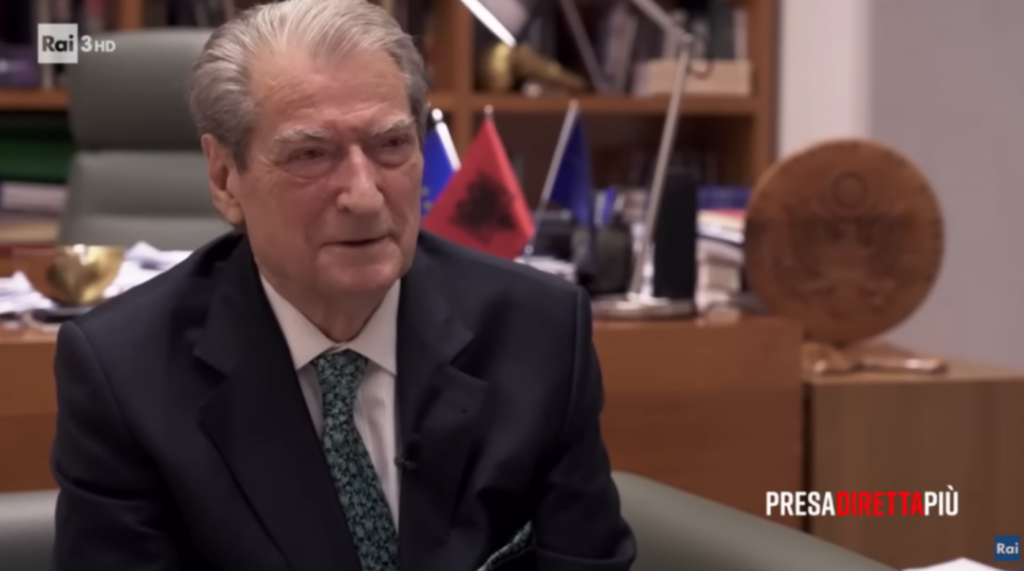
On the evening of April 1, 2026, Italian public television broadcast a documentary about Albania’s organised crime problem. Among the experts assembled to explain the phenomenon was Sali Berisha, former president, former prime minister, current leader of the Democratic Party, and a defendant before Albania’s Special Court against Corruption and Organised Crime.
RAI3 introduced him as “the first to denounce” that Albania had become a narco-state. He was given extended time on camera. He named the Troplini cartel, described Durrës port as a free corridor for cocaine, and claimed that criminal clans had fielded a list of twenty-eight parliamentary deputies in the last elections. No context was provided about who he is beyond his political title. No mention was made of the charges he faces. No disclosure was offered about the fact that the United States has barred him from its territory since 2021 on grounds of significant involvement in corruption, or that the United Kingdom followed with its own sanctions citing clear links to organised crime groups.
RAI3 aired all of this as expert testimony. That is the problem this article is about.
What the documentary got right
Before addressing the Berisha question, it is necessary to be clear about what PresaDiretta actually produced. The documentary, on its own merits, is a serious piece of work.
SPAK prosecutor Vladimir Mara spoke on camera about what years of investigation have uncovered: elements of organised crime that have built cooperative relationships with segments of state institutions, law enforcement officers, communal officials, prosecutors and judges. That is not a political allegation. That is an account from the official leading the prosecutions.
Economist Zef Preçi provided the quantitative architecture. Albania’s GDP runs at roughly 25 billion euros annually. In five or six years, approximately 4.7 billion euros have circulated outside banking channels. More than sixty companies now active in the construction sector have no prior history in construction and in several cases lack the capital to justify investments many times the size of their annual turnover. A company with an annual revenue of one million euros building a structure valued at fifty million is not a real estate transaction. It is a financial operation.
Investigative journalist Klodiana Lala provided the Durrës chapter. She named Xhevdet Troplini, known as Poja, described the contest for control of the port, the violence that accompanied it, the eventual consolidation under the clan, and the extension of influence into politics. She described the Ovital company and the Trodo Caffè chain, whose name fuses the surnames Troplini and Doçi: visible infrastructure for anyone willing to look. RAI3 journalists then entered that perimeter and documented the surveillance response. Their account was recorded, not reconstructed.
Lindita Çela offered the institutional portrait: two deputy prime ministers under investigation for corruption and money laundering, a mayor arrested on related charges, dozens of senior officials under active investigation, a wave of prosecutions that has not spared the highest levels of the current government.
This is substantive documentary journalism. It contains original reporting and named sources with direct institutional knowledge. It does not need rhetorical assistance. It does not need political colour. It certainly does not need Sali Berisha.
What Berisha is
To understand the problem with his inclusion, it is necessary to understand precisely what Berisha’s legal situation is in April 2026.
He is a defendant. SPAK, the same institution that features in the documentary as Albania’s primary weapon against organised crime, has formally charged him with passive corruption committed in collaboration with others. The allegation concerns procedures he approved as prime minister to enable the privatisation of the former Partizani sports complex in central Tirana, a transaction prosecutors say generated approximately 5.4 million euros in benefit for his son-in-law, Jamarbër Malltezi. Both men deny wrongdoing. His trial is proceeding. He is required to appear before SPAK twice monthly under an active court order.
He is also sanctioned by two Western governments. The United States designated him persona non grata in 2021, citing significant involvement in corruption and obstruction of justice, a designation that remained publicly listed as of last year. The United Kingdom followed with its own sanctions, citing clear links to organised crime groups, criminals, and corruption.
This is the man RAI3 assembled as an expert voice on Albanian organised crime.
The claim that required a question
Berisha told RAI3: “These criminals, these clans, in the last elections had a list of twenty-eight deputies. They are today the least known and most voted deputies in the history of this country.”
This is an extraordinary claim. It alleges direct cartel sponsorship of a specific number of sitting members of parliament. If it is true and documented, it is among the most significant revelations in Albanian political history. If it is not documented, it is a serious allegation against twenty-eight unnamed individuals, broadcast on a European public broadcaster without challenge.
RAI3 did not ask where the list came from. They did not ask whether it had been submitted to any prosecutor. They did not ask whether SPAK, which has been investigating the Troplini organisation for years, has any record of it.
The phrase “narco-regime” appears in virtually every speech Berisha delivers against Edi Rama. The twenty-eight deputies claim is a version of an allegation he has made in various forms at political rallies, in media interviews, in social media videos. Repetition is not evidence. It is amplification. Its deployment in an Italian documentary does not transform it into journalism.
The question RAI3 should have asked is not whether Albanian organised crime influences politics. Klodiana Lala answered that question with specificity and named sources. The question is whether Sali Berisha’s version of events, offered by a man under active prosecution by the institution the documentary celebrates, constitutes evidence of anything beyond his own political interests.
The editorial failure and its costs
Italian public television is not naive about Albania. RAI has covered the country for decades. PresaDiretta is a serious programme. It is not plausible that the production team was unaware of Berisha’s legal situation.
Which raises a harder question than carelessness: why was disclosure omitted?
One interpretation is editorial economy. Disclosing his status would have complicated the segment and muddied the narrative of a clear-speaking opposition voice denouncing a corrupt government. Berisha performs well on camera. He is precise, emphatic, and fluent in the language of institutional outrage. He gave the documentary a dramatic human presence that a SPAK prosecutor, necessarily careful in his public language, could not provide.
The cost of that choice is threefold.
First, it handed Berisha a legitimacy platform he cannot construct domestically. In Albania, his background is known. His audience applies the relevant discount. In Italy, he is introduced simply as the opposition leader who was first to sound the alarm. That gap between domestic perception and foreign presentation is the platform. He used it.
Second, it weakened the documentary’s evidentiary core. The Mara testimony, the Preçi data, the Lala reporting: these stand on their own and are not strengthened by Berisha’s addition. They are, however, made easier to dismiss. Anyone wishing to resist the documentary’s conclusions can now point to the inclusion of a politically motivated defendant as evidence of bias, and use that to discredit material that actually holds up.
Third, it confirmed a pattern. Albanian political actors have learned that foreign media, particularly Italian media with its long investment in Albanian criminal networks, can be instrumentalised. The interview required Berisha to do nothing but be available and articulate. RAI did the rest.
There is a principle in serious investigative journalism about the hierarchy of sources. A prosecutor who has spent years building a case has institutional standing and legal accountability. A journalist who has documented cartel infrastructure on the ground has evidential standing. An economist who has tracked financial anomalies through the national accounts has analytical standing.
An opposition politician who has been making the same allegations for electoral purposes, who faces prosecution by the same anti-corruption body, and who has been designated by two NATO allies as a corruption and organised crime risk, has none of those forms of standing. He has political standing, which is a different thing entirely and requires disclosure, contextualisation, and scrutiny of motive. None of those things was provided.
The structure that does not change
The documentary argues that Albanian organised crime has learned to operate through legitimate-seeming structures: money moving through construction companies with no construction history, influence moving through political figures who appear to represent voters while serving other interests, the machinery of legitimacy systematically occupied.
Berisha’s appearance in the documentary is a demonstration of the same principle applied to information. A man whose entire political positioning is built on the narco-state thesis was given an international legitimacy platform to deliver that thesis without disclosure of the interests behind it. The mechanism is different. The structure is not.
This is not an accusation against Berisha of the same crimes alleged against the Troplini clan. He did not infiltrate RAI3. He was invited. The vulnerability was editorial, not criminal. But the observation stands: when standards fail, they do not fail selectively. They fail structurally. The same logic that allows criminal networks to borrow the appearance of legitimacy also allows a compromised narrative to borrow the appearance of journalism. The documentary demonstrated both.
A note on what this piece is not
This is not a defence of Edi Rama or of the Albanian government’s record. The SPAK prosecutor who spoke on camera described deep penetration of state institutions by criminal networks. Parliament’s March 2026 vote to protect Belinda Balluku from arrest was, as this publication has documented, an institutional failure of the first order. The Preçi data is damning regardless of which party governs.
The argument here is narrower and procedural. When a documentary sets out to report on institutional corruption, it cannot simultaneously accept a politically compromised source as expert witness without undermining the institutional norms it purports to defend. If evidence matters, sourcing matters. If SPAK’s work deserves respect, then the disclosure standards that apply to a SPAK defendant deserve the same respect.
RAI3 set out to document how criminal networks borrow the appearance of legitimacy to operate. It succeeded. Then it reproduced the same mechanism in its own sourcing.
That is not hypocrisy. It is a reminder. When standards fail, they do not fail selectively. They fail structurally.
Ardit Rada writes on Albanian politics and institutions for the Tirana Examiner.