When a diplomatic statement about accountability arrives just before a parliamentary vote, its meaning changes — and so does its effect.
by Albatros Rexhaj (Tirana)
The United Kingdom is a genuine friend of Albania. British engagement with the justice reform has been substantive, its support for institutional development real, its interest in seeing SPAK succeed consistent and sincere. That record deserves acknowledgment — because the criticism that follows is offered in the same spirit.
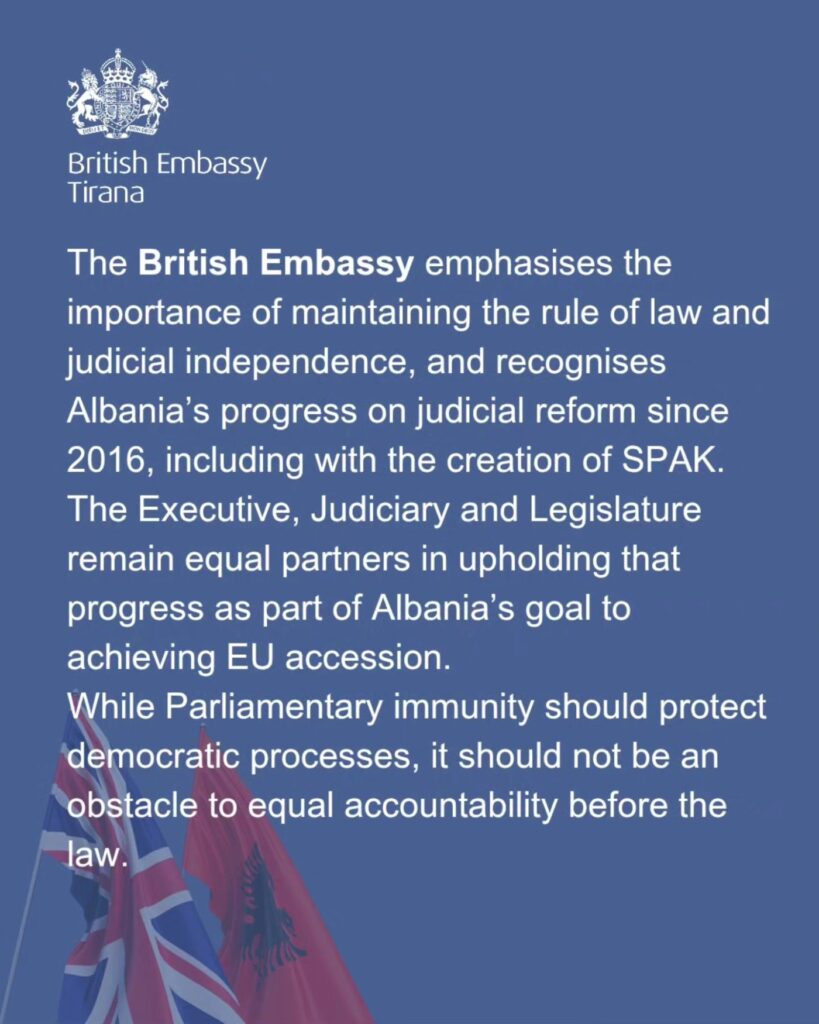
Minutes before Albania’s parliament convened to vote on SPAK’s request to arrest Deputy Belinda Balluku, the British Embassy in Tirana published a statement. It recognised Albania’s progress on judicial reform since 2016, affirmed the importance of rule of law and judicial independence, and concluded with a sentence that merits close reading: “While Parliamentary immunity should protect democratic processes, it should not be an obstacle to equal accountability before the law.”
The principle is unimpeachable. The moment of its expression is not.
Timing determines meaning in diplomatic statements. A statement issued after a decision comments on the outcome. A statement issued before one shapes the conditions under which that decision is made. The British Embassy published its views in the final minutes before parliament sat — not as a reflection on what had happened, but as a signal about what should. Whatever the intent, that is the function the timing assigned to it. Calling it imprudent is not a claim about diplomatic protocol. It is a claim about how communication works.
There is a second difficulty, more textured than the first.
The statement speaks in general terms and does not name Belinda Balluku. But general language, deployed at a specific moment in a specific proceeding, does not remain general in the minds of its readers — it settles, in context, on the case at hand. And in that case, the person at hand has not been charged, tried, or convicted. She is under investigation. The presumption of innocence is not a procedural technicality reserved for courts and prosecutors — it is a principle that should guide how public institutions, including embassies, speak about live cases involving unconvicted individuals. The embassy did not accuse her. But accountability language applied to a live proceeding has consequences for public perception that do not wait for intent to catch up. That is worth naming, not as bad faith, but as a reason for care.
The legal facts are straightforward. Balluku is no longer in government — she is a member of parliament, and the institutional risks that once attached to her executive role no longer exist. A vote declining to authorise arrest does not obstruct SPAK’s investigation, does not prevent charges from being filed, and does not lift the existing travel ban. Albania’s Code of Criminal Procedure is explicit on this point. The question before parliament was whether the legal threshold for upgrading a security measure to detention had been met — a procedural question, not a verdict on the justice reform.
Friends who watch Albania’s institutional development closely perform a real service. The right moment for this statement was after the vote — or better still, as part of a sustained conversation about whether Albania’s immunity framework is fit for purpose, which is both legitimate and necessary. Instead, it arrived in the final minutes before the session opened, in language that the circumstances made impossible to read as neutral.
Good values, badly timed, become something else. In this case they became pressure — and Albania deserves better from its friends.
Albatros Rexhaj writes on Balkan politics and institutional affairs.