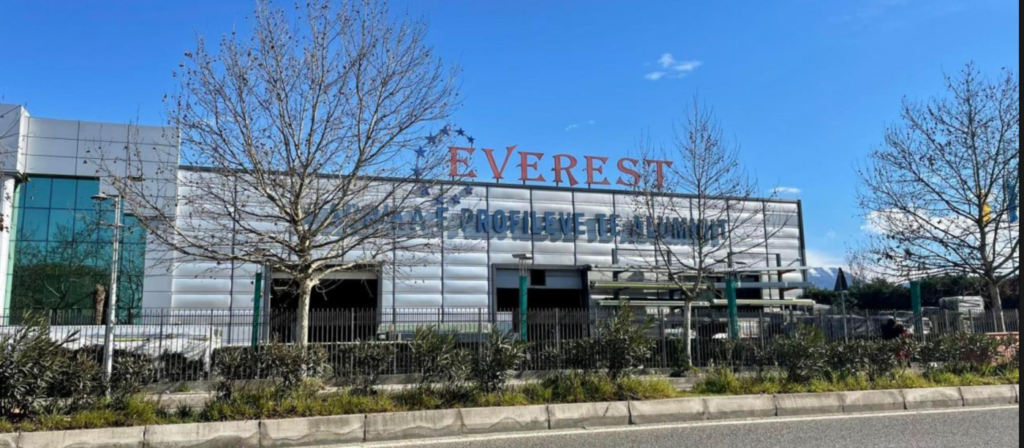
Everest employs around 700 workers and is expanding into the United States. As Albania moves toward EU integration, we ask CEO Sokol Çupi whether industrial growth is reinforcing institutions — or quietly outpacing them.
by Elis Zenelaj (Tirana)
Introduction
Everest Sh.p.k. began in 1997. Today it operates one of Albania’s largest aluminum production platforms, with turnover in the billions of lek, sustained export flows, and a growing footprint in the United States.
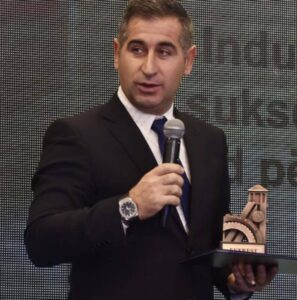
Sokol Çupi says the company employs approximately 700 people — placing it among the country’s largest private industrial employers.
In a small EU-aspirant economy, that scale matters.
For some, Everest represents industrial maturity.
For others, it raises a harder question: when capital scales quickly in a fragile institutional environment, who keeps pace — the regulator or the entrepreneur?
We asked him directly.
The Interview
Tirana Examiner:
Mr. Çupi, you’ve confirmed Everest employs roughly 700 workers. In Albania, that’s not just a company — that’s an economic actor with systemic weight. Do you feel that weight?
Sokol Çupi:
Of course I do. Seven hundred salaries go out every month. That means seven hundred households that depend on our stability. But I don’t see it as “systemic power.” I see it as operational responsibility.
Albania has too few companies of that size. If anything, we need more industrial employers at this level. Otherwise we remain dependent on imports and remittances.
Tirana Examiner:
Your annual turnover has reached into the billions of lek. In a market this small, that can look like concentration. How do you reassure regulators — in Tirana or Brussels — that Everest’s scale does not translate into structural dominance?
Sokol Çupi:
Look, aluminum manufacturing is not a café business. You need machinery, capital, supply chains, energy contracts, export relationships. Scale is built into the economics of the sector.
If someone claims dominance, they need to show abuse — pricing distortion, exclusion, barriers to entry. Those are measurable things. We operate in a competitive environment. Imports are open. Foreign systems enter Albania freely.
Scale in industry is often mistaken for control. It’s not the same thing.
Tirana Examiner:
Public procurement records show Everest has executed municipal projects. In transition economies, public contracts often trigger concerns about political proximity. How do you respond to that suspicion?
Sokol Çupi:
Any serious industrial firm will at some point participate in public tenders. Schools, parks, infrastructure — those projects require materials and systems.
But let’s be honest: public work is not where industrial margins are built. It’s a segment, not a foundation. Our survival depends on exports and private sector clients.
If procurement systems are transparent, the documentation speaks for itself. If they’re not, that’s a governance problem — not an industrial one.
Tirana Examiner:
You’ve expanded into the United States — with operational presence in New Jersey and Arizona. Is that ambition — or a hedge against Albania’s volatility?
Sokol Çupi:
It’s both realism and ambition. Albania’s market is too small to sustain serious manufacturing long term. If you don’t export, you stagnate.
The U.S. market forces discipline. It forces compliance, logistics precision, quality control. You cannot survive there with improvisation.
Does it diversify risk? Of course. Every industrial group diversifies geographically. That’s not distrust — that’s strategy.
Tirana Examiner:
Aluminum production is energy-intensive. Albania’s electricity supply remains volatile during dry years. How exposed are you to energy shocks?
Sokol Çupi:
Very exposed. Industry everywhere depends on stable energy pricing. In Albania, hydropower variability creates uncertainty. During dry periods, imports drive prices up.
We don’t receive preferential electricity. We pay market prices. But unpredictability affects planning.
If Albania wants a manufacturing base, energy policy must evolve — reliability, diversification, long-term contracts. Otherwise industry remains fragile.
Tirana Examiner:
Let’s address EU accession. If tomorrow Albania were subject to full EU-level competition audits, state-aid scrutiny, environmental inspections — would Everest withstand that intensity?
Sokol Çupi:
EU alignment is not something you prepare for at the last minute. If you export into Europe and the U.S., you already face external scrutiny.
Are we perfect? No industrial company is. Compliance evolves. But we understand that integration means tighter rules. That’s not a threat. It’s a framework.
Tirana Examiner:
Albania is losing young talent to emigration. With 700 employees, are you fighting a losing battle on workforce retention?
Sokol Çupi:
Retention is the hardest issue. Machinery can be financed. Human capital cannot be imported so easily.
We’ve raised wages over the years. We invest in training. But if young engineers believe their future is more stable in Germany, that’s not only about salary. It’s about institutional trust.
Industry alone cannot solve that.
Tirana Examiner:
Some in Brussels argue that Western Balkan capitalism is maturing faster than governance. Are companies like yours outpacing the state’s supervisory capacity?
Sokol Çupi:
Capital always moves faster than institutions. That’s historical reality, not Balkan exceptionalism.
The real question is whether institutions catch up. If they don’t, the imbalance becomes visible. If they do, industrial growth becomes sustainable.
Frankly, strong institutions benefit us. They create predictability. Without predictability, industrial investment slows.
Tirana Examiner:
Final question. Does Everest symbolize Albania’s arrival as an industrial economy — or its unresolved reform gap?
Sokol Çupi:
It symbolizes potential. But potential is not maturity.
Industrial growth shows what is possible. Institutional durability will decide whether it lasts.
Closing Reflection
Albania’s industrial story is still young.
A company that employs 700 people and exports into demanding international markets is not a symbol of imbalance — it is evidence of capacity.
The question now is not whether firms can grow.
They clearly can.
The question is whether growth and governance evolve together.
If they do, industrial scale will not threaten institutional maturity — it will reinforce it.
That is how economies move from transition to permanence.