When diplomatic language about “obstruction” meets constitutional procedure, the gap between narrative and law becomes visible.
by Albatros Rexhaj (Tirana)
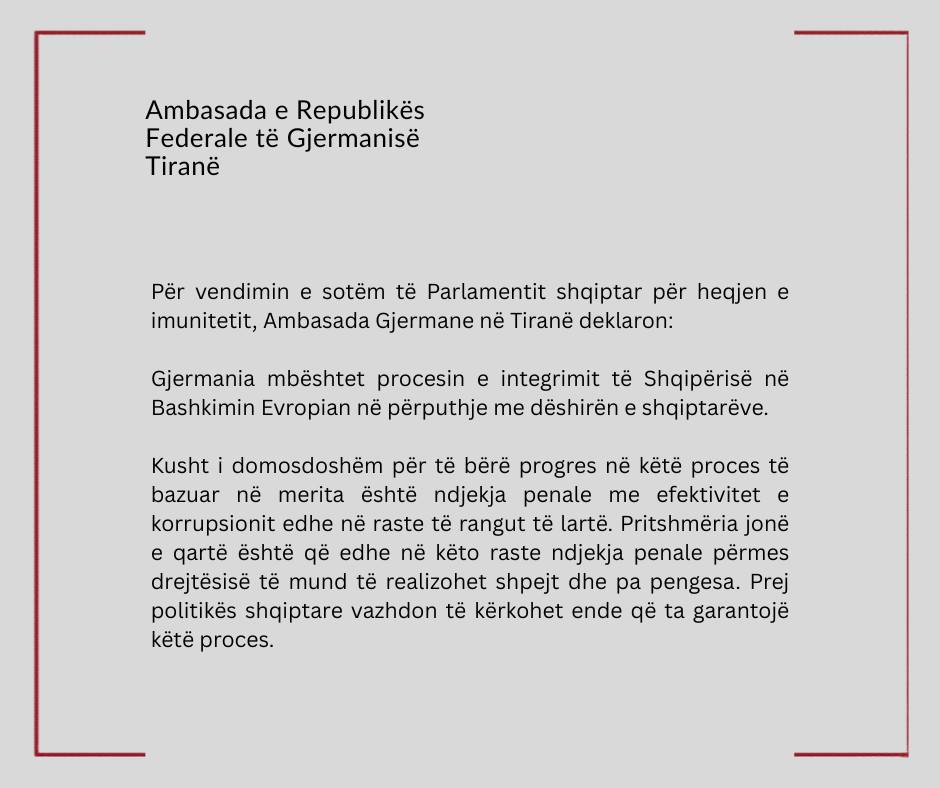
Narratives move faster than legal arguments. In the months surrounding SPAK’s request to arrest Deputy Belinda Balluku, one reading of events became dominant in the diplomatic conversation: that the case was a test of whether Albania’s ruling majority would shield its own from justice, and that any outcome short of arrest would constitute an assault on the judicial reform. It was a powerful narrative. It was also, legally, the wrong one. And on 12 March, the German Embassy in Tirana issued a statement that reflected it.
The statement is institutional in its address — it speaks to Albanian politics broadly, not to parliament specifically, and it does not mention Balluku or the vote by name. Its core sentence is this: it is Germany’s clear expectation that prosecution of corruption, including in high-level cases, should be able to proceed “quickly and without obstruction.” Albanian politics, it adds, “remains called upon” to guarantee this.
Read in isolation, that sentence expresses a principle. Read on the day of a specific parliamentary vote on a specific corruption case, it does something more precise. The word “obstruction” lands in a context that gives it a referent. “Remains called upon” implies a prior failure to deliver. The statement does not say the vote was wrong. It does not need to. The timing and the vocabulary do that work without the embassy having to claim it.
This matters because the legal picture is considerably more complicated than the statement’s framing suggests. Parliament did not block prosecution. It declined to authorise one specific coercive measure — the replacement of an existing travel ban with detention — concluding that the request did not justify lifting the procedural immunity required for arrest. SPAK’s investigation continues. The travel ban remains in force. Prosecutors retain the full authority to gather evidence, expand the investigation, add charges, and indict. Albania’s Code of Criminal Procedure is explicit: a parliamentary refusal to authorise arrest does not prevent prosecutors from proceeding against a deputy for the same acts. The door to prosecution was not closed. It was never parliament’s to close.
Parliament’s role in such proceedings is constitutionally narrow. It does not evaluate guilt. It does not assess the merits of the investigation. It decides only whether the extraordinary measure of arrest against a sitting deputy should be authorised. If that threshold was not met, declining to authorise is not obstruction — it is the system functioning as designed.
The deeper issue is how the language of obstruction came to attach so readily to a procedural constitutional outcome. As EU candidate states move deeper into accession processes, diplomatic missions increasingly treat individual judicial results as indicators of systemic political will — collapsing the distinction between institutional performance and case-by-case outcomes. When one side of a domestic dispute frames its position in the language of European values — reform, accountability, anti-corruption — it gains access to a register that diplomatic missions are predisposed to trust. The other side, making procedural and constitutional arguments, speaks a language harder to translate into the shorthand of accession politics. The result is not deliberate bias. It is structural asymmetry — and “obstruction” is what it sounds like when it speaks.
Germany’s concern for Albania’s anti-corruption architecture is genuine and valued. A more productive expression of it would engage that architecture directly — the legal threshold SPAK must meet to justify arrest, the design of parliamentary immunity for deputies no longer in executive office, the procedural reforms that would make future cases cleaner and less politically charged. These are conversations worth having, and Germany is well placed to lead them.
What those conversations cannot begin with is a word — obstruction — that arrived already shaped by one side of the argument.
Albatros Rexhaj writes on Balkan politics and institutional affairs.