The summoning of Edi Rama as a witness does not change the “Partizani” case; it tests whether the court will remain anchored in the evidence or drift into a political confrontation staged for the public by Sali Berisha. The law does not permit theater.
Renada Bici | Legal Desk
On 15 April, a session of Albania’s Special Anti-Corruption Court, GJKKO, opened in Tirana to handle procedural matters in one of the most consequential criminal trials the country has seen since the consolidation of its justice reform institutions. The defendant is Sali Berisha, former President of Albania from 1992 to 1997, former Prime Minister from 2005 to 2013, and current chairman of the Democratic Party. The charge is passive corruption, arising from the privatization of the Partizani sports complex in central Tirana during his government’s tenure.
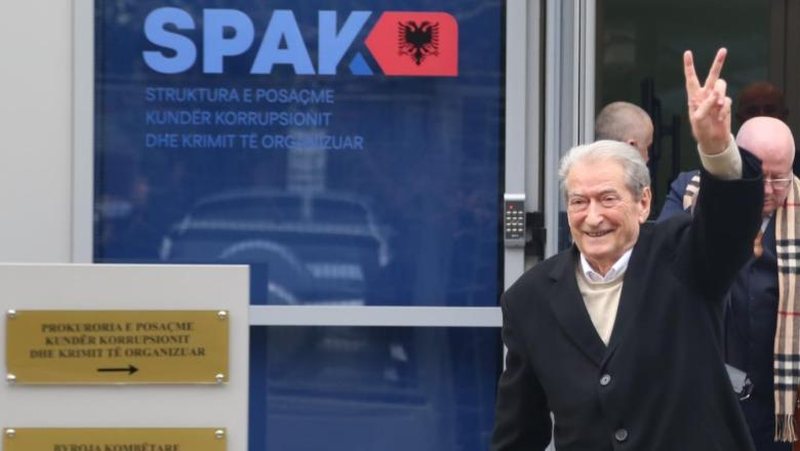
When the session ended, Berisha emerged not as a defendant who had secured a procedural concession but as a man who believed he had won something decisive. His public reaction to GJKKO’s decision to summon Prime Minister Edi Rama as a witness was not measured satisfaction. It was triumph. That distinction carries consequences for how the institution is perceived, and perception, in courts that depend on legitimacy to enforce their verdicts, is not separable from function.
The Partizani case has its origins in a transaction completed in 2008. The complex occupied a substantial plot in central Tirana, held under the administration of the Ministry of Defence. During Berisha’s government, the property was privatized and transferred to a group of claimants asserting historic ownership over the land. The price paid was approximately 100,000 dollars, a figure that, according to the Special Prosecution Against Corruption and Organised Crime (SPAK), fell below the market value of a single studio apartment in the same neighbourhood at the time.
On the site, a company called Homeplan subsequently built 17 residential towers, the complex known today as Magnet. SPAK’s investigation, laid out across a 500-page file, established that behind Homeplan stood Berisha’s son-in-law, Jamarbër Malltezi, who eventually held 35 percent of the company’s shares. The completed development has been valued at approximately 150 million euros. The prosecution’s case is that Berisha used his authority as prime minister to accelerate and facilitate the privatization in favour of his son-in-law’s commercial interests, in exchange for the financial benefits that Malltezi and his associates stood to receive.
The procedural architecture of the alleged scheme involved a cabinet decree issued by Berisha’s government in November 2007 establishing new criteria for the valuation and sale of state property; a subsequent ministerial order commissioning a valuation committee; and a privatization contract signed in 2008 specifying, in its fourth article, the reclassification of the land from a sports zone to a construction zone. Without that reclassification, the land could not have been developed commercially.
Berisha’s counter-argument centres on that reclassification. He has argued that it was Edi Rama, who served as Mayor of Tirana from 2000 to 2011, who signed the municipal decision converting the Partizani land from a sports zone to a construction area, and that Rama did so in breach of urban planning law. SPAK contests this framing directly: prosecutors point to the October 2007 privatization contract, which specified the zoning change as a contractual precondition, and to Berisha’s own government having issued the enabling decree. The prosecution’s position is that Berisha cannot attribute to Rama an effect that his own cabinet’s decisions made structurally possible.
On this disputed factual ground, Berisha and his lawyers requested that GJKKO summon Rama to testify under oath. The court granted the request on 15 April. SPAK did not object. The first witness session is scheduled for 30 April, when Taulant Balla, the socialist parliamentary group leader who filed the original criminal complaint against Berisha, is expected to appear first.
To understand why Berisha’s public celebration of this decision carries institutional weight, it is necessary to understand what the decision actually is under Albanian law, and what it is not.
The Albanian Code of Criminal Procedure is explicit about the scope and purpose of witness testimony. Article 153 defines the object and limits of testimony: a witness is heard on facts relevant to the charges and to the credibility of the parties. The scope is not unlimited. The presiding judge determines what questions fall within the object of the proceeding and may exclude questions that fall outside it. Article 157 establishes the corresponding witness obligations: appearance, identification, and truthful testimony on the matters put to them. Article 162 governs the taking of testimony from senior state officials, including members of government, and establishes that they are heard in the same manner as any other citizen. The office held neither expands nor contracts the permitted scope of questioning.
The decision to summon Rama is therefore a ruling on the admissibility of a proposed witness, made under Article 149, which requires the court to assess whether a proposed evidentiary act is relevant to establishing the facts of the case. The bench concluded that Rama’s knowledge of decisions made during his tenure as mayor, during the period when the territorial reclassification of the Partizani complex was proceeding, meets that threshold. That is the entirety of what the ruling means in law. It does not mean the court has accepted Berisha’s version of events. It means a witness has been found relevant and will be heard.
The courtroom conduct of that examination is governed by Articles 339 through 371, which regulate the taking of evidence during trial proceedings. Article 339 establishes that the presiding judge directs the hearing and ensures its orderly conduct. Article 340 gives the presiding judge authority to reject questions that are irrelevant, repetitive, or improper in character. The defence has the right to cross-examine Rama, but that right operates within the boundaries set by the charge under examination. Those boundaries are: the decisions made or authorised by Rama as Mayor of Tirana, in the specific period covered by the privatization process, as they relate to the territorial reclassification of the Partizani land. Rama will not be examined on his government’s relationship with SPAK, the political origins of Balla’s complaint, or any matter that falls outside the object of the proceeding as defined by the indictment. The law does not permit it. The presiding judge has both the authority and the legal obligation to enforce that boundary.
The problem is not what will happen inside the courtroom. The problem is what has already happened outside it.
When a defendant publicly announces, before the relevant session has occurred, that a procedural ruling constitutes a political victory, he does something specific and consequential: he transforms the court’s neutral institutional act into a narrative event with a predetermined meaning. Berisha made that transformation explicit. As journalist Flogert Muça reported his words on 15 April: “Kur të jemi me Ramën në ring, do shihni spektakël.” When we are in the ring with Rama, you will see a spectacle. The law produces the occasion; the defendant controls the meaning attributed to it.
This is not a novel tactic. Italy’s decades of Berlusconi-era trials demonstrated the same dynamic at scale: a defendant with media reach and narrative discipline can reshape public understanding of proceedings in ways that outlast the verdict itself. Romania’s anti-corruption courts faced analogous pressure during the prosecutions of senior politicians in the 2010s, where the institutional framing of proceedings by defendants and their allies created lasting reputational ambiguity around courts that had in fact operated correctly. The pattern is recognizable: the courtroom becomes a secondary theatre, and the primary theatre moves to press conferences, media briefings, and political communications.
What distinguishes Berisha’s position is that his narrative has a built-in advantage. He has argued from the beginning of proceedings that SPAK functions as an instrument of the Rama government. The summoning of Rama as a witness appears, in his telling, to validate that thesis: the court has called his adversary to account. That the court has done no such thing, that it has applied Article 149 to a question of evidentiary relevance, is not a correction that travels as fast or as far as the original claim.
This exposure for GJKKO is real, but it is not predetermined in its effect. Several countervailing possibilities exist that Berisha’s framing cannot fully control.
Courtroom discipline under Article 340 could render the session narrow and factual, producing testimony that contributes to the evidentiary record rather than to political theatre. If the presiding bench enforces the limits of relevance with visible consistency, confining the examination to municipal decisions on territorial reclassification in 2006 and 2007, the session may produce less spectacle than anticipated and more procedural clarity than Berisha’s narrative requires. Berisha’s strategy depends on a confrontation; a disciplined hearing denies him one.
Rama’s testimony could also produce outcomes that do not serve the defence. If his account of events as mayor either contradicts Berisha’s framing or fails to shift the evidentiary balance on the central charge, the political theatre that Berisha has promised will have delivered nothing legally useful. The spectacle could then rebound, associating Berisha’s strategy with the tactics of a defendant who cannot contest the facts and has chosen instead to contest the forum.
Public perception may also fragment rather than consolidate. Not all of Berisha’s electoral base reads these proceedings as a political contest. Some portion of it is watching to see whether the evidence holds. A session that produces credible, bounded testimony rather than dramatic confrontation may register differently across that audience than Berisha’s communications have assumed.
None of this is guaranteed. But the outcome is probabilistic, not closed. What Berisha has secured is an occasion. What he does with it, and what the bench permits, will determine whether that occasion serves his narrative or undermines it.
There is an irony embedded in the strategy that deserves acknowledgment. Berisha’s approach depends on GJKKO being sufficiently credible to serve as a stage. A court with no institutional weight is not a useful venue for political theatre; it is simply irrelevant. By choosing to perform his defence inside the institution rather than simply denouncing it from outside, Berisha implicitly concedes that GJKKO carries enough authority to make the performance meaningful. He is leveraging the court’s legitimacy to contest it.
That is the real question the public should hold in mind as the proceedings continue. Not what Rama will say on 30 April. Not whether the session will produce the confrontation Berisha has advertised. But whether, when the final verdict is delivered, the court that delivers it will be understood as having judged a case on its evidence, or as having provided the venue for a contest between two men who have spent decades at the centre of Albanian political life.
The answer will be written inside the courtroom, one question at a time, by whether the bench applies the law it is sworn to apply, with the authority the Code of Criminal Procedure gives it.
Renada Bici is a Tirana-based lawyer practicing in civil, criminal, and administrative law. She holds a law degree from the University of Tirana and has experience in both private legal practice and public administration. She writes for the Tirana Examiner Legal Desk.