GJKKO and the Legal Question It Has Declined to Answer
Legal Desk | Tirana Examiner
A court has someone suspended from a job she no longer holds. Two judicial panels have now declined to explain what that means. The question is whether this reflects a legal principle — or an institutional instinct the court cannot bring itself to name.
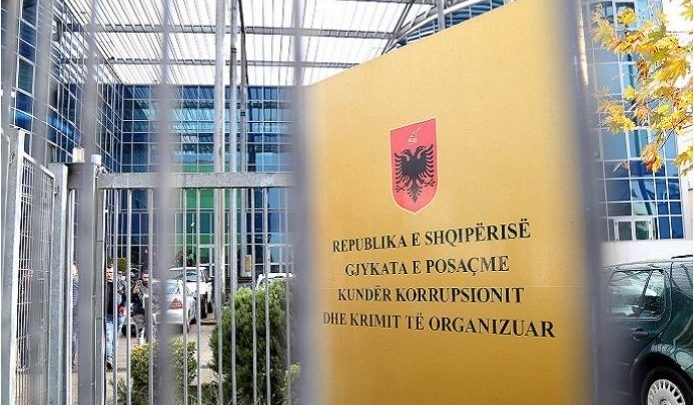
On March 13, the Special Court of First Instance for Corruption and Organized Crime rejected a request by former Deputy Prime Minister Belinda Balluku to formally revoke or declare lapsed the security measure suspending her from the exercise of public functions. The decision was issued by Judge Erion Çela — the same judge who originally imposed the measure in November 2025.
Four days earlier, the Special Appeals panel had reached the same result. During that session, the SPAK prosecutor acknowledged that Balluku had in fact been dismissed from office, then immediately argued that the first-instance decision should remain formally in place. Two courts, four days apart, declining to resolve a question both can plainly see.
The procedural argument available to GJKKO
There is a legitimate reading under which the refusal is not absurd. Albanian criminal procedure does not require a court to revoke a security measure simply because external circumstances have changed.
The measure was imposed under Article 242 of the Criminal Procedure Code as a precautionary instrument within an active criminal case. That criminal case remains open. The charges have not been withdrawn. The defendant has not been acquitted. A court that revisited its measures every time the executive made a personnel decision would itself risk appearing deferential to political power.
A more precise version of this argument turns on a distinction the court has not clearly invoked but could: the difference between revokimi — formal revocation requiring an affirmative judicial act — and shuarje — automatic lapse by operation of law when the conditions that gave rise to a measure no longer exist.
If the suspension has lapsed automatically because the underlying office no longer exists, GJKKO may be taking the position that no declaratory finding is required. The measure would simply be spent. There would be nothing left to act upon.
SPAK’s own position supports a version of this logic. Prosecutors acknowledged the dismissal but argued that the formal judicial record should remain intact. Their interest is coherent. The criminal investigation continues across nine tender procedures, and the findings that justified the original suspension remain relevant to what comes next. A court aligning with its own prosecutor is not, on its face, acting improperly.
Comparable precautionary suspensions exist in several European criminal procedure systems, but they are normally tied explicitly either to the office itself or to the defendant’s ability to exercise public authority. When the office disappears, courts typically clarify whether the measure lapses automatically or continues in a personal form. The absence of such clarification is what makes the current situation unusual.
Where the legal logic becomes unclear
GJKKO is not invoking the shuarje distinction. It is not explaining what legal principle governs a suspension measure once the office it attaches to has ceased to exist. It is simply rejecting the request — declining to formally resolve a question it created and that the defendant has now raised through proper procedure.
That silence cannot easily be explained as procedural caution.
A court that can impose a measure of this constitutional weight — one that survived a four-to-four split at the Constitutional Court and established the principle that ministers are subject to criminal procedure like any other citizen — carries a corresponding obligation to be legible about what that measure means when circumstances change.
SPAK’s interest in preserving the judicial record does not relieve GJKKO of that obligation. The criminal case and the security measure are not the same instrument. Treating them as interchangeable produces the current result: a formally active suspension from positions that no longer exist, maintained by a court that will not explain why it has not ended.
The institutional stakes
This matters beyond the Balluku case because of what GJKKO built over the past four months.
When the court imposed the original suspension in November 2025, the government challenged it as an unconstitutional intrusion into the functioning of the executive. Three institutions — the Presidency, the Parliament, and the Council of Ministers — aligned against it at the Constitutional Court. The argument, made with some force, was that Albanian constitutional law contains no mechanism allowing a court to suspend a sitting minister.
The Constitutional Court split four to four.
The measure survived not because a majority found it clearly lawful, but because a majority did not find it clearly unlawful.
What GJKKO obtained through that process was not a full vindication. It was a narrow and contested validation of a principle: that criminal procedure applies to high executive officials without exception. The authority of that principle depends entirely on how the court exercises it in the moments that follow — including moments that do not produce clean outcomes.
This is such a moment.
Balluku has been dismissed. Parliament has declined to authorize her arrest. The passport freeze remains in force. The criminal case continues. The suspension from office is, in this landscape, a formality without operative substance — and the prosecutor’s decision to acknowledge the dismissal before arguing for preservation of the record was a signal that the proceedings have entered terrain where institutional optics matter as much as legal positioning.
A court confident in the legitimacy of its prior decisions does not need to avoid formally acknowledging changed circumstances. It can close the suspension loop, note that the criminal proceedings and associated measures continue unaffected, and proceed.
The refusal to do so suggests something other than legal principle may be shaping the outcome: an institutional reluctance to produce any formal act that could be read, however unfairly, as retreat.
What the written reasoning must answer
When Judge Çela’s written decision is published, one question will determine whether the refusal was principled or merely defensive.
Does the reasoning articulate a specific legal basis for maintaining a measure defined by reference to positions that no longer exist — a reading of Article 242 that ties the suspension to the defendant rather than the office, or a procedural finding that shuarje requires a separate mechanism not yet properly invoked?
Or does it simply restate that the criminal case continues?
The latter would be true and insufficient.
Balluku’s request was not about whether she remains a defendant. It was about whether a measure defined by reference to positions she no longer holds retains legal force, and if so, on what basis.
A court that built its authority on the proposition that criminal procedure applies equally regardless of political rank owes a precise answer to a precise legal question.
Silence on that point is not institutional strength.
It is the appearance of it.
The Tirana Examiner Legal Desk covers Albanian judicial and constitutional affairs. This analysis is based on publicly available court communications and reporting from proceedings.