After months of military positioning and stalled nuclear negotiations, Washington concluded that deterrence required force — a decision with consequences stretching from the Gulf to Europe’s eastern flank.
By Elis Cali (Michigan)
The U.S.–Israeli strikes on Iran on Feb. 28 followed weeks of visible American force repositioning and months of faltering diplomacy over Tehran’s nuclear program and regional activities.
Iranian state media subsequently confirmed that Supreme Leader Ayatollah Ali Khamenei was killed in the strikes, a development that has triggered a 40-day mourning period and heightened regional tension. The episode marks the most consequential U.S. military action against Iran since the 1979 revolution and represents a significant shift from deterrence-by-sanctions toward direct force.
This account reconstructs the buildup, the diplomatic collapse, and why U.S. officials concluded that military action was necessary.
The Military Buildup
Beginning in January 2026, the Pentagon increased its force posture in the Middle East. Defense officials, speaking on condition of anonymity to discuss operational planning, said the deployments were designed to deter escalation and provide options if negotiations failed.
The repositioning included:
Two carrier strike groups operating in or near the region.
Additional tactical aircraft deployed to bases in the Gulf.
Reinforcement of air and missile defense systems protecting U.S. facilities.
Publicly available flight tracking and regional reporting showed increased U.S. air activity in the eastern Mediterranean and Gulf theaters during February.
Pentagon statements at the time described the deployments as precautionary and defensive. Officials declined to provide exact troop figures but characterized the posture as one of the most substantial in the region in years.
The buildup coincided with intelligence assessments indicating elevated tensions and the possibility of direct confrontation if talks collapsed.
The Nuclear Issue: Measurable Thresholds
According to the International Atomic Energy Agency’s most recent public reporting before the strike, Iran had been enriching uranium up to 60 percent purity — significantly above the 3.67 percent cap established under the 2015 nuclear agreement and closer to the 90 percent enrichment typically associated with weapons-grade material.
IAEA reports also noted expanded stockpiles of highly enriched uranium and limitations on monitoring access compared with earlier years.
While U.S. officials did not publicly assert that Iran had decided to build a nuclear weapon, several senior administration figures warned that Tehran was approaching a technical threshold that would shorten “breakout time” — the period required to produce sufficient fissile material for a device.
The administration’s view, according to officials briefed on internal deliberations, was that diplomacy was no longer reliably constraining that trajectory.
The Geneva Talks
Indirect negotiations resumed in Geneva in late February under Omani mediation. Participants included senior U.S. envoys and Iranian Foreign Minister Abbas Araqchi.
Both sides described the talks as serious but acknowledged that core disputes remained unresolved:
The scope of enrichment restrictions.
The sequencing and durability of sanctions relief.
Missile program limitations.
Broader regional activity, including support for allied armed groups.
No joint statement or interim agreement was reached.
In public remarks days before the strikes, Iranian officials reiterated that enrichment was a sovereign right and signaled resistance to additional constraints. U.S. officials, meanwhile, indicated that time for incremental extensions was narrowing.
The talks adjourned without breakthrough.
The Decision
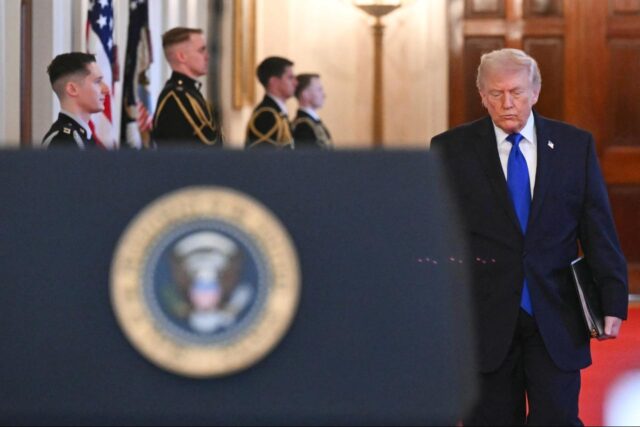
According to U.S. officials familiar with the deliberations, President Trump was presented with a range of options after the Geneva round ended. The assessment conveyed to him, one official said, was that a strike would carry significant escalation risk but could disrupt both nuclear and command infrastructure in a way that sanctions had not.
White House statements framed the operation as necessary to prevent further nuclear advancement and degrade Iran’s military capabilities.
Iran responded with missile and drone launches targeting Israeli and U.S. positions in the region, underscoring the immediate escalation risk.
Regional Implications
The Middle East’s security architecture is built around deterrence, proxy competition and energy flows.
The Strait of Hormuz — through which roughly 20 percent of globally traded oil passes — remains a critical vulnerability. Even limited conflict has historically contributed to energy price volatility.
Iran’s regional network includes armed groups in Lebanon, Iraq, Syria and Yemen. U.S. officials have long argued that these relationships allow Tehran to exert pressure beyond its borders while maintaining deniability.
Whether the strike meaningfully disrupts that network will depend on the durability of Iranian command structures during the leadership transition.
Implications for the Free World
The strike raises broader questions for international security norms.
For the United States and its allies, it reflects a determination that unresolved nuclear expansion combined with missile development and proxy activity crossed a strategic threshold.
For other governments, it introduces uncertainty about how pre-emptive or preventive force may shape future non-proliferation disputes.
European leaders have called for de-escalation and renewed diplomacy. Russia and China have criticized the strike. Markets responded with energy price volatility in the immediate aftermath.
Why It Matters for Europe and the Western Balkans
Although geographically distant from Iran, Southeastern Europe is not insulated from Middle Eastern instability.
Energy Exposure: European oil and gas prices are sensitive to disruptions in Gulf shipping lanes. Price volatility affects inflation and fiscal stability in Balkan economies.
NATO Allocation: Sustained U.S. engagement in the Middle East may require continued force presence there. Analysts note that resource prioritization debates could affect long-term defense posture decisions in Europe, including Southeast Europe.
Strategic Signaling: For smaller states dependent on alliance guarantees, U.S. willingness to act decisively against perceived nuclear threats carries implications for deterrence credibility elsewhere.
A Turning Point, Not a Conclusion
The Feb. 28 operation followed a clear sequence: military reinforcement, diplomatic effort, impasse, and force.
Whether it produces lasting strategic stability or prolonged confrontation remains uncertain.
For now, the immediate reality is escalation risk, leadership transition inside Iran, and a recalibration of deterrence dynamics that will shape policy from Washington to Brussels — and, indirectly, to the Western Balkans.