The Albanian prime minister presents new bronzes at Galerie Société and thirteen drawings at the Italian Embassy, then sits for a reverse interview with Fabrizio Bucci on Brussels, Ukraine, and Tirana’s ambition to become “a little Italy.”
The Newsroom
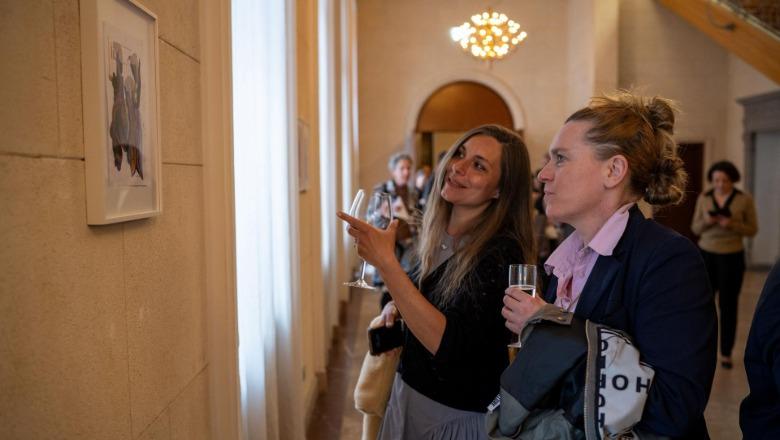
Edi Rama arrived in the German capital this week wearing the second of his two professional identities. The Albanian prime minister opened his first personal exhibition at Galerie Société, titled “Chrysalizing,” a presentation of new bronze sculptures that will remain on view through May 27. A parallel showing of thirteen of his drawings was inaugurated at the Italian Embassy in Berlin, where the conversational format inverted ordinary diplomatic protocol: Fabrizio Bucci, who served as Italy’s ambassador to Tirana until the end of January 2025 and now holds the same post in Berlin, took the role of interviewer, and Rama the role of subject.
Rama set the register early, with a line that quickly circulated as the evening’s headline. “I am the best artist in the world among prime ministers, and the best prime minister among artists,” he told the audience of diplomats and figures from Berlin’s art scene, before allowing Bucci to steer the conversation into terrain that was less self-deprecating and more politically substantive. Anecdotes from earlier chapters of Rama’s biography surfaced along the way, including a return to his years as a competitive basketball player, recounted with the same ironic register that framed the rest of the evening.
A neurotic blessing
The European Union absorbed the largest share of the exchange, and Rama spoke in two registers about it, the beneficiary’s and the critic’s, without softening the contradiction.
“The EU is a blessing for us,” he said. “Its role is very useful for institution-building, and it knows how to do it. It is the most neurotic possible process, but it works. Thanks to it, we have changed.”
The endorsement carried its own qualification. The European method, in Rama’s reading, remains too slow and too heavily weighted with procedural friction to keep pace with the political moment. He called for an acceleration that was less a complaint than a demand framed in terms of self-improvement.
“We have to do what we have to do, and we will move forward, because that is how we improve,” Rama said. “The good news is that we will never become a Germany, because we are not capable of that. But a ‘little Italy’?”
The line played for laughs in the room, but the substantive content matters in policy terms: Rama is publicly calibrating Albania’s accession horizon away from the unachievable Northern European benchmark and toward a Southern European one, less prescriptive, more attainable, and rhetorically closer to the Italian patron who hosted the event.
Ukraine as the point of inflection
Bucci pressed Rama on what had changed in Brussels’ strategic posture in recent years. The prime minister located the inflection point precisely in Russia’s full-scale invasion of Ukraine in February 2022, treating it as the moment European declaratory policy and operational policy began to converge.
“The EU has changed its fundamental position,” Rama said. “Before, they said the right words, but the actions did not follow. When the invasion came, they understood that all parties outside the bloc could lose.”
The framing is consistent with Rama’s broader diplomatic positioning: Albania as an early and unambiguous supporter of Ukraine, and the EU’s external action transformation as a vindication of the urgency Tirana and other accession-track capitals were already articulating before 2022.
From “hunger” to public space
Bucci then turned the conversation to Rama’s biographical arc, the trajectory from training as a painter and then teaching at the Academy of Fine Arts in Tirana, to Minister of Culture, to mayor of the capital from 2000 to 2011, and to prime minister from 2013. Rama returned, as he often does in Western European settings, to the multicolored façade programme that reshaped Tirana’s image in the post-communist period.
He framed that intervention in developmental rather than purely aesthetic terms. A population initially driven, in his words, only by “hunger,” and by purely private interests, gradually developed an appetite for the public sphere. The Tirana façades, in this reading, were not simply a paint job but a pedagogy in shared visual space, a precondition for the political maturation he attributes to the city since.
From façade to drawing to bronze
The genealogy of Rama’s current artistic practice runs through the Tirana façade programme itself. As mayor, he produced the colour schemes for the city’s communist-era buildings on A4 sheets, experimenting with ink pens to determine which palette would be applied to each block. That working process, originally a tool of urban governance, became the seed of a personal artistic vocabulary. Once Rama moved to the prime minister’s office, the same A4 format and the same ink pens migrated into government meetings, where they generated the stream-of-consciousness drawings that are now the documentary core of his exhibition record.
These mental landscapes, in the gallery’s formulation, “resist fixed reference or narrative.” They belong, in art-historical terms, to a tradition of mark-making in which the suspension of conscious control becomes a route of access to a different order of thought. The thirteen works displayed at the Italian Embassy this week are drawn from this long sequence.
Chrysalizing: from line to bronze
The Galerie Société exhibition, Rama’s first solo show at the gallery, occupies the ground floor and extends into the garden. The title, “Chrysalizing,” gestures at the suspended moment of transformation, the in-between state of the chrysalis. The technical process behind the works is itself unusual for a sitting head of government.
Rama’s drawings are translated into 3D-printed digital models, then hand-shaped by the artist, and finally cast in bronze, a material historically associated with commemoration and the consecration of state power. The result, on view in the gallery’s interior, is a series of biomorphic forms on pedestals that the curatorial text describes as belonging to “an unknown taxonomy, as if emerging from a deeper layer of the unconscious.”
The principal outdoor work rises more than two meters. Undulating shapes at the base extend upward and fragment into a multiplication of organic outgrowths, a branching structure the gallery reads as evoking networks of interconnection. A larger version of the same work will be installed along the Rhine at Clarastrasse, in Basel, as part of Art Basel Parcours in June 2026.
The Anri Sala conversation
The Berlin programme does not end with the openings. On Saturday, May 2, at 3:30 p.m., Rama will be joined by the Albanian artist Anri Sala for a public conversation at the Neue Nationalgalerie titled “On Intuition, Memory and Making,” moderated by the political scientist and art critic Natalia Gierowska. The event is part of Gallery Weekend Berlin Art Talks. The Italian Embassy also supported the participation of the Olevano Romano Marching Band in the broader programme, an element drawn from a work by the German artist Annika Kahrs currently on view at Hamburger Bahnhof.
A long exhibition record
Rama, born in 1964, has accumulated a dense exhibition record alongside three decades of public office. Recent solo presentations include “Edi Rama” at Marian Goodman Gallery in Paris in 2024, “Improvisations” at the Zappeion in Athens in 2023, “WELCOME” at Nuno Centeno in Porto in 2023, a 2020 show at Alfonso Artiaco in Naples, and “Work,” which traveled from Kunsthalle Rostock to Carlier Gebauer in Berlin and the Nevada Museum of Art. Earlier presentations include the New Museum in New York in 2016, two editions of the Venice Biennale in 2003 and 2017, the Tophane-i Amire Culture and Arts Center in Istanbul in 2015, the Musée d’Art Contemporain de Montréal in 2011, the Centre Pompidou in Paris in 2010, the Haus der Kunst in Munich in 2004, and the São Paulo Biennial in 1994.
For a sitting prime minister to maintain a parallel exhibition calendar at this level of institutional placement is, on its own terms, unusual. For that prime minister to be interviewed by his country’s former resident ambassador, in the embassy of that ambassador’s current posting, on questions ranging from accession methodology to Ukraine to civic culture, is the kind of staging that only a head of government with a credible second vocation can plausibly produce.