The Newsroom
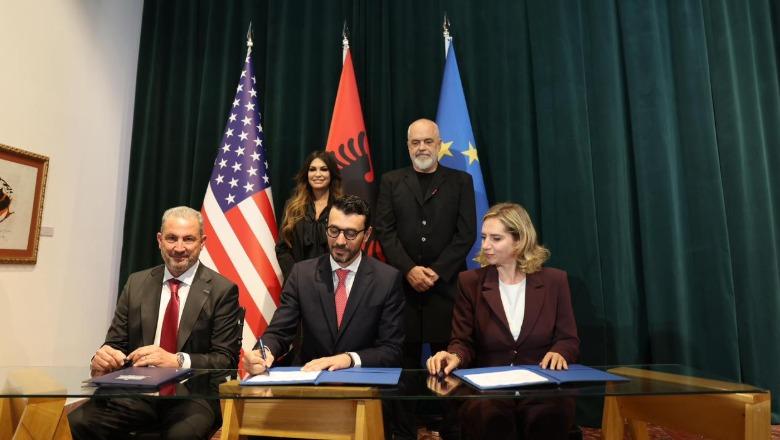
Albania signed a twenty-year liquefied natural gas agreement on Wednesday in Tirana, valued at six billion dollars across the term, structured around three counterparties: ALBGAZ on the Albanian state side, the Virginia-based producer Venture Global on the upstream supply side, and Aktor LNG USA, the trading vehicle of Greece’s Aktor Group, on the regional logistics side. The headline is straightforward. The structure beneath it is not.
The American principal at the signing was not the chargée at Embassy Tirana, Nancy VanHorn, though VanHorn was present. It was Ambassador Kimberly Guilfoyle, accredited to Athens, who flew in for the ceremony and was greeted by Prime Minister Edi Rama with an embrace. The choreography matters. Before any contract clause has been examined, it tells the reader that Washington is treating Southeast European energy as a regional dossier organised through Athens, with Tirana, Sofia, Sarajevo, Pristina, and downstream industrial buyers as nodes in a system whose operational centre sits on Greek soil.
What was signed
The publicly disclosed elements are these. A twenty-year supply commitment of US-origin LNG, valued at six billion dollars over the term. Construction of regasification infrastructure at Vlora capable of receiving cargoes shipped from the United States. Conversion of the existing Vlora thermal power plant from oil to gas. Roughly 250 MW of new generating capacity at the Vlora energy centre. Construction of a Fier to Vlora pipeline tying the new terminal into the national transmission grid and onward to regional networks. Positioning of Vlora as an export gateway into the Western Balkans gas market.
Per-annum offtake volumes were not disclosed at the signing. Earlier reporting indicates that Albania’s Ministry of Infrastructure and Energy signed a memorandum in February with Atlantic SEE LNG Trade in Washington, on the margins of the Transatlantic Summit on Security of Gas Supply, for up to one billion cubic metres per year. Wednesday’s announcement appears to convert that February memorandum into a binding contractual structure, with Venture Global slotted in as the upstream supplier and Aktor LNG as the operational counterparty.
Rama’s framing was time-bound. He stated that Albania aims to become a net energy exporter within his current mandate, and that “Vlora will be transformed into a critical point for energy in Southeast Europe.” Both claims are politically convenient. Both have substantive content that the next four years will test.
The supplier question
Venture Global is not a generic American LNG producer. It is a company whose contractual record with foundation buyers has become, over the last eighteen months, one of the most documented disputes in the history of the LNG industry.
Calcasieu Pass, the Louisiana facility from which most of Venture Global’s contracted volumes flow, declared full commercial operations only in April 2025, nearly three years after first cargo. During that interval, the company exported more than four hundred cargoes onto the spot market while declining to fulfil long-term contracts with foundation buyers, a posture it justified by claiming the plant remained in commissioning mode. Spot revenues from this period are estimated above twenty billion dollars. Seven major counterparties filed arbitration claims, including Shell, BP, Edison, Galp, Repsol, Orlen, and Unipec, with total claim values reported around 5.5 billion dollars.
The arbitral record is not uniform. BP won an award above one billion dollars in October 2025. Shell lost its arbitration in August 2025 and is now contesting the outcome in the New York Supreme Court, alleging Venture Global withheld material evidence concerning the timing of commercial operations. Other proceedings remain open.
This is the company that has just become Albania’s foundation supplier for two decades. The reputational record is not, on its own, an objection to the deal. Sovereign offtake structures with state guarantees and locked tariff regimes function differently from oil-major spot-market opportunism. But the pattern matters, because the legal posture Venture Global took toward Shell, BP, and the others was a textual reading of contractual definitions: what counts as commissioning, what counts as commercial operations, when the obligation to deliver under long-term terms attaches. The questions for ALBGAZ are first-order. How is force majeure defined in the Albanian contract. What does commercial operations mean for cargoes destined for Vlora. What happens if global spot prices spike and the supplier finds a textual basis to redirect volumes. What is the dispute resolution venue, and what are the remedies for non-delivery.
These questions will not be answered in the press release. They will be answered, eventually, in whatever portion of the contract Tirana chooses to publish.
The Greek vehicle
Aktor LNG USA is an operational extension of Atlantic SEE LNG Trade, the joint venture formed in late 2025 between Aktor Group (60 percent) and DEPA Trading (40 percent). Atlantic SEE has been the vehicle through which Greek-routed US LNG is being placed across Southeast Europe. In February in Washington, Atlantic SEE signed memoranda with Bulgaria’s Bulgargaz for 1.5 billion cubic metres per year, with Ukraine’s Naftogaz for one billion cubic metres per year, with Albania’s energy ministry for up to one billion cubic metres per year, and with Bosnian industrial buyers for half a billion cubic metres per year.
Aktor Group is the Greek infrastructure conglomerate that emerged from the 2023 sale of Ellaktor’s construction arm to Intrakat, which renamed itself Aktor in October 2024. Aktor’s CEO, Alexandros Exarchou, has spoken publicly at the Delphi Economic Forum about Greece functioning as an operational bridge between US strategic objectives and EU energy policy, and about what he characterises as the de facto establishment of a US energy hub on Greek soil. The framing is striking because it is not Washington’s framing. It is Athens describing its own role.
The Aktor name carries legacy baggage. In 2017 the construction company that preceded the current corporate structure was fined 38.5 million euros, then the largest cartel penalty in Greek history, for collusion in public works tenders running from 1989 to 2012. The current corporate vehicle is structurally and in ownership terms distinct from that period. The institutional name carries forward.
DEPA Trading provides the state-linked partner role and the wholesale market relationships Aktor on its own would not possess. The structure functions because it combines Aktor’s project execution capacity with DEPA’s institutional standing in Greek and EU gas markets.
The 2021 antecedent
This is not Albania’s first attempt at a US-anchored Vlora gas project. In March 2021, the Rama government signed a memorandum with ExxonMobil and Excelerate Energy covering the same Vlora thermal plant conversion and the same regasification ambition, framed at the time by Acting Assistant Secretary Philip Reeker as the foundation for Albanian energy independence. Excelerate began moving its FSRU vessel Excelsior toward Albanian deployment in 2022. By July 2022 the company had signed an offtake memorandum with Bulgaria’s Overgas for up to one billion cubic metres per year via the Vlora terminal and the proposed Fier-Vlora pipeline.
Five years on, the Vlora thermal plant is still idle, the FSRU is not deployed, the Fier-Vlora pipeline is not built, and the same physical infrastructure footprint is being announced again with different corporate principals. The reasons the 2021 framework did not deliver are not fully on the public record. What is observable is that none of the announced infrastructure was built and none of the announced offtake materialised.
Whether the 2026 iteration succeeds where the 2021 iteration stalled depends on questions the public announcement does not answer. Financing structure. Sovereign guarantees and their fiscal accounting. Regulatory permitting timelines. Whether Venture Global’s contractual posture toward sovereign offtakers materially differs from the pattern documented in the BP and Shell proceedings. The 2026 structure does appear better-anchored on the downstream side, because Atlantic SEE arrives with a portfolio of regional offtakers already in MoU form. Whether that translates into actually-built infrastructure on a four-year horizon is a different question.
The regional geometry
Vlora does not exist as a standalone hub. It is the southwestern node of an emerging multi-corridor architecture replacing the single-source Russian dependency that dominated Southeast European gas until 2022.
The eastern axis, Russia via TurkStream into Serbia and parts of Bosnia, still functions and remains Belgrade’s base supply. The Bulgarian-Serbian interconnector completed in 2023 has produced only marginal Azerbaijani volumes into Serbia, and Belgrade is reportedly close to signing another long-term arrangement with Gazprom. The western axis through Croatia’s Krk terminal feeds Bosnia’s new dual-entry route via the Southern Gas Interconnection, a project led by AAFS Infrastructure and Energy, another US-aligned vehicle. The Vertical Gas Corridor, repurposing the Trans-Balkan pipeline for reverse flow from Greece and Turkey northward, is targeted for full operational status by end-2026, with up to ten billion cubic metres per year of north-south transmission capacity.
Vlora becomes the Adriatic-side ingress point complementing Alexandroupolis on the Aegean side and Krk on the upper Adriatic. The system that emerges is not a single corridor replacing TurkStream. It is a redundant network in which no single node holds veto power over downstream supply. This is the gas-market analogue to what KSF integration into NATO frameworks is doing on the security side: redrawing the regional balance through redundant infrastructure rather than through diplomatic confrontation.
The strategic implication for Belgrade is straightforward. Serbia’s position as the only Western Balkans state still tied structurally to Russian gas via TurkStream becomes more isolated as Albania, Bosnia, North Macedonia, and Montenegro acquire access to non-Russian supply through multiple parallel routes. For Pristina, the Vlora hub creates the prospect of a Kosovo-Albania gas interconnection that would eliminate any future Serbian transit dependency before it can materialise.
The political clock and the diplomatic register
Rama’s net-exporter target carries a hard timeline. His current mandate runs through the parliamentary cycle expected to extend into 2029 if the government holds. Becoming a net energy exporter requires the Vlora regasification infrastructure to be operational, the 250 MW of new generation built and dispatching, the Fier-Vlora pipeline interconnected, and net export volumes to materialise. The 2021 project’s track record suggests the timeline is optimistic.
The other operative line in Rama’s remarks was diplomatic. He framed the agreement as a choice not to depend on actors who can compromise freedom and democracy, the cleanest open positioning he has taken against Russian energy presence in the region without naming Moscow. For Brussels readers, this lands as alignment with the EU’s 2027 phase-out targets. For Washington readers, it lands as willingness to be quoted on the side of the energy-dominance frame. The fact that the line was delivered in front of the Athens ambassador rather than in Brussels is itself a signal about how Tirana wants this season’s positioning to be read.
Guilfoyle’s framing covered the same ground from the other side. She described the deal as strengthening energy security and national security across the region, credited Trump as a champion of the agenda, and concluded that when Washington, Tirana, and Athens work together “this region becomes more connected, more secure, and more prosperous.” Her institutional references, to the National Energy Dominance Council and to Doug Burgum and Chris Wright, locate the deal inside the Trump administration’s domestic energy architecture rather than inside the older State Department framework that ran the 2021 ExxonMobil agreement. The change is procedural and significant. Energy dominance, not energy diversification, is now the operative US frame.
\
The Vlora agreement is consequential, contingent, and worth reading on three levels at once. As a contract, it commits Albania to a twenty-year supply relationship with a producer whose record on long-term obligations is being contested in arbitration on multiple fronts, which makes the not-yet-public terms the determining variable. As a piece of infrastructure, it revives a project that has been announced before and not delivered, with corporate principals better positioned on the downstream side but facing the same execution timeline that the 2021 iteration could not meet. As a piece of regional architecture, it slots Albania into a multi-corridor system whose centre of gravity sits in Athens and whose strategic logic is the redundant displacement of Russian gas across Southeast Europe. The first reading determines whether the deal protects Albanian consumers and the Albanian fisc. The second determines whether Vlora becomes a working hub by the end of Rama’s current mandate. The third is already a fact regardless of what happens in Vlora itself: Greece is now the operational centre of US energy strategy in the region, and Tirana has chosen to anchor itself inside that geometry. The embrace at the signing was not ornament. It was the relationship being placed on the record.