The May 14 parliamentary vote passed with 114 in favor and one abstention. The prime minister was in Aachen for the Charlemagne Prize; the opposition leader walked out before the count.
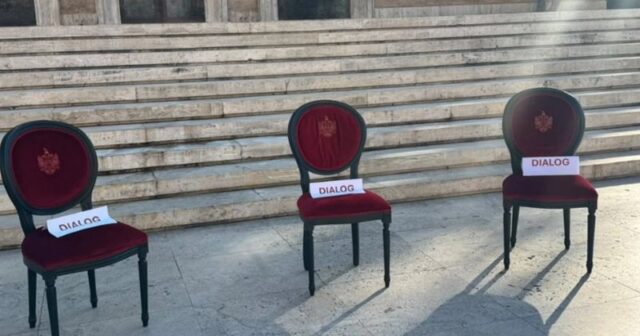
The headline image from the May 14 plenary in Tirana is a consensus secured around two empty seats. Prime Minister Edi Rama was in Aachen for the Karlspreis ceremony. Sali Berisha, leader of the Democratic Party, exited the chamber before the count. The joint Socialist-Democrat resolution on European accession passed with 114 votes in favor, one abstention (PD’s Bujar Leskaj), and Berisha’s pointed non-participation. The text, negotiated over weeks by a four-member working group with equal representation from both sides, formalizes Parliament’s role in monitoring accession negotiations and exercising oversight of the executive on reform implementation. Its adoption arrived in the same week as the country awaits the European Commission’s assessment of the Interim Benchmark Assessment Report (IBAR), the procedural pivot on which the credibility of the 2030 accession horizon now rests.
The architecture of the text
What was adopted is, in form, a parliamentary commitment to procedural seriousness. The resolution declares EU accession a strategic national objective, calls for the strengthening of Parliament’s legislative and oversight functions in the negotiating process, requires periodic reporting by the Council of Ministers, and obliges the government to accelerate reforms under the first cluster (“Fundamentals”). It demands transparency in public procurement, the broadening of opposition and civil society participation in decision-making, the acceleration of electoral reform along OSCE/ODIHR recommendations, support for the justice institutions in the fight against corruption and organized crime, and the protection of media freedom and resistance to disinformation.
Its most politically loaded clause is reciprocal. The majority commits to “ensuring conditions for the full participation of the opposition in parliamentary activity” in accordance with constitutional standards and the rules of procedure; the opposition commits to “ensuring full participation” on the same terms. Both sides commit to “the strengthening of political dialogue.” Read in context, this is a text addressed not to a domestic audience but to European chancelleries that have grown skeptical of Tirana’s institutional behavior under the present majority. The reciprocity formula is the diplomatic register, lifted into the resolution.
The working group and the path to consensus
The drafting was done by Erion Malaj and Romina Kuko for the Socialists, Edmond Haxhinasto and Albana Vokshi for the Democrats, with the support of Ilda Zhulali on the opposition staff and Holta Nika and Altin Fuga from the parliamentary directorate on integration. Vokshi claimed in her floor remarks that the final text reflected “over 90 percent” opposition contribution, a figure that doubles as an internal explanation for why PD signed and as an external signal of substantive engagement.
The narrative of how this consensus was built is contested. The opposition’s framing is that the majority reflected after weeks of pressure. The Socialist framing is that this is an act of statesmanship at a decisive moment. A parallel commentary by Edi Spahiu attributed the alignment to direct pressure from EU ambassadors, who pushed PD to join its votes with PS on the resolution. The most defensible reading is that all three are partially true: pressure from accredited diplomats made the failure to converge politically costly for both sides, and the working group then converged on a text in which the opposition’s institutional demands could be accommodated without forcing the government to acknowledge any specific failure. The reciprocity clause is the precise structural compromise: each side concedes only that it will behave as parliamentary norms already require it to behave.
The opposition’s dual posture
PD signed the text and continues to argue the process is blocked. Both positions were on the floor on the same day. Vokshi, immediately before the vote, declared the party “skeptical” that the government will implement the resolution clause by clause. Gazment Bardhi, leader of the parliamentary group, framed Rama’s defense of Deputy Prime Minister Belinda Balluku as the operative cause of the EU’s deepening conditionality on Albania: “Rama chose Balluku over the EU,” he told the chamber. “Rama did not pass Europe’s test, and today EU member states are imposing condition after condition, openly expressing their distrust of this government.” Jorida Tabaku, in a separate intervention, kept the focus on impunity, captured procurement, and the absence of genuine institutional independence as the real measure of European convergence.
This is the posture the opposition has now settled into: signing what can be signed, while pressing the argument that the accession trajectory is being throttled by the majority’s protection of a single minister. Whether that argument lands in Berlin and Brussels is a separate question from whether it organizes domestic opposition messaging. For domestic purposes, it does. For the European audience, the resolution itself is the louder signal, and the opposition knows it.
The boycott and the Balluku thread
Berisha was absent for the vote itself, having delivered an extended attack on the majority earlier in the session in which he charged that the integration process had been blocked because of Balluku’s protected immunity. His characterization of the majority as “the real enemies of integration” was the rhetorical apex of an intervention that also accused the government of presenting a report on accession built on “manipulation, censorship, and the concealment of truths,” and demanded that the Council of Ministers’ report be read aloud in the chamber. The decision not to lift the green card on the joint text, having delivered that intervention, is consistent: it allows the leader of the opposition to remain outside any consensus that could later be cited against him, while permitting his parliamentary group to demonstrate constructive engagement. The split signal is the strategy.
The Balluku thread also surfaced in Ulsi Manja’s reply from the rostrum, which was less an answer than a warning: were Berisha’s own file ever opened, Manja said, “all of Albania would smell it.” The exchange is a reminder of how much of Albania’s accession conversation now runs through unresolved questions of immunity, prosecutorial reach, and what the SPAK architecture is permitted to touch.
The foreign minister’s counter-frame
Foreign Minister Ferit Hoxha used the session to push back against the blocking narrative with a precision that reflects the audience he was addressing. The process, he told the chamber, has not been blocked or halted by any member state. Albania, as a candidate, is not party to internal Council deliberations and will be present at that table only as a member. He framed the 2030 accession target as “absolutely achievable” if the current rhythm is maintained, and pointed to the closing of technical negotiations in 2027 as the formal milestone now in view. The framing is the standard one used by the government for European audiences: rhythm and reform, not crisis and protection.
The gap between Hoxha’s frame and Bardhi’s is the real political content of the day. Both rest on selective readings of the same underlying procedural state. The IBAR has not yet been issued. Member states have raised concerns through diplomatic channels. The Balluku immunity vote has been received in European capitals as a signal about the government’s willingness to subordinate institutional priorities to political ones. None of this is in formal dispute; what is in dispute is how to characterize it.
Tafa, and the limits of the integration consensus
A parallel item on the day’s agenda underscored the boundaries of what consensus was on offer. Genta Tafa (Bungo) was sworn in as Commissioner for Protection from Discrimination, having been approved earlier in the day in the relevant committee with Socialist votes alone. Bardhi used the swearing-in to call her appointment a disgrace, charging that the candidate had discriminated against the north of the country and had been “used politically in the vetting process.” Ilir Meta, from the Party of Freedom, welcomed the integration resolution but described it as “very late,” consistent with the broader argument that Tirana’s accession trajectory has been throttled less by external skepticism than by the absence of internal political will.
The Tafa intervention and the Meta statement together draw the line: the bipartisan resolution on accession does not signal a broader institutional truce. It signals only that, on a text formulated for the European audience, and on a vote on which abstention would have been read in Brussels as obstruction, the parties found alignment.
The structural fact of the day is that Albania’s Parliament has now committed itself, on the record and with the signature of both political blocs, to a procedural architecture for the next phase of accession. That architecture is real. It will be invoked. The question it raises is the one the resolution itself does not answer: whether the conditions for that architecture to function (an opposition genuinely permitted to exercise oversight, a majority genuinely willing to be held accountable, an executive that responds to parliamentary scrutiny on substance rather than form) are present in the current configuration of Tirana’s institutional life. The 114 votes were a necessary act. They are not, on their own, a sufficient one. What was demonstrated on May 14 is that European pressure can still produce convergence around a text. What remains to be demonstrated is that the text can produce convergence around practice.
The Charlemagne Prize was awarded in Aachen on the same day. The prime minister was there to applaud it. The resolution that committed his government to European procedural standards passed in his absence, drafted in part by an opposition that does not believe he will honor it, and signed by a party leader who would not cast the vote in person. Read together, those three facts are the day’s real text.