The Newsroom
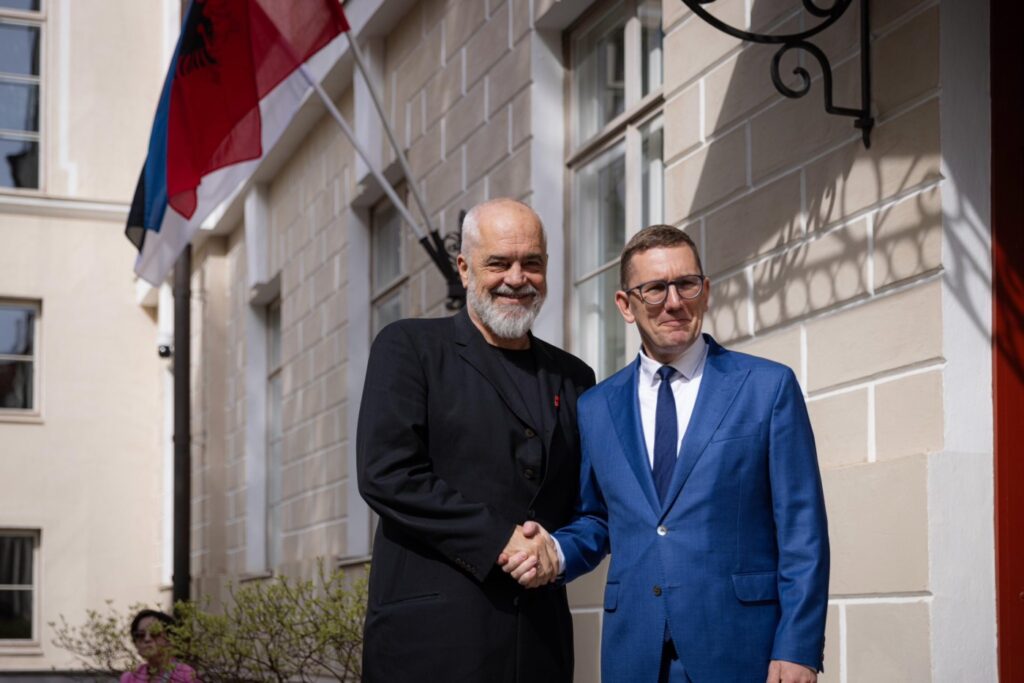
Tallinn was a deliberate choice. Prime Minister Edi Rama arrived in the Estonian capital on Friday for the Lennart Meri Conference, the annual gathering where European, transatlantic, and post-Soviet security thinking converges, this year under the motto “Fortune favors the bold.” The visit produced a joint statement with Estonian Prime Minister Kristen Michal, a meeting with President Alar Karis at Kadriorg, and a set of declarations that, read together, position Albania closer to the EU member states most aggressive on Russia containment and most credible on digital governance.
Michal’s language on enlargement was unambiguous and conditional. “Estonia strongly supports the enlargement of the European Union. We have supported Albania on its path to the EU and we will continue to do so,” he told reporters at the joint appearance, before delivering the operative sentence: “Continue moving forward with the reforms. If Albania fulfills its obligations, the EU will do the same.” The formulation matters. It is the merit-based framing Brussels prefers, and it places the burden squarely on Tirana to deliver the rule of law benchmarks now under review.
Rama answered with the line his diplomatic agenda has been built around since the IBAR was issued. “Thank you very much for continuing to support Albania. We look forward to moving to the next phase very soon and to beginning the closure of the negotiation chapters,” he said. The phrasing is significant. Chapter closure, not chapter opening, is the marker Tirana now uses publicly. It signals the level at which the Albanian government wants the accession conversation to proceed.
The security dimension was the more revealing thread. Michal called Albania “a very good ally in NATO.” Rama responded by naming what he framed as the shared posture binding Tirana to Tallinn: “an unshakeable refusal to allow foreign countries to undermine our democratic way of life.” The wording is diplomatic, but it is not neutral. In Baltic political language, the concept of defending the “democratic way of life” rarely refers only to military threats. It encompasses cyber operations, disinformation, political influence campaigns, and strategic corruption networks, the full spectrum of hybrid contestation that Estonian institutions have spent more than a decade building doctrine against. Delivered from a small NATO ally in the Western Balkans, inside the room where Lennart Meri is convened, it places Albania publicly inside that conceptual frame.
On technology, Rama set the bar explicitly, anchoring it to a date the Albanian government has been treating as a hard horizon. “We want to ensure that our journey toward 2030 turns into the same kind of innovation that has made Estonia a global brand. We have most of our services online, and we intend to move forward with AI,” he said. By tying Albania’s transformation explicitly to 2030, Rama again linked technological modernization to the political timetable of EU integration itself. Estonia, which has built its international identity around e-governance and digital state architecture, signaled readiness to assist. For Tirana, the bid is to convert Estonian capability into Albanian institutional reform rather than to import it cosmetically.
Rama also produced the visit’s headline-friendly moment, an invitation to Estonian tourists that carried a political signal underneath the joke. Welcoming the tripling of Estonian visitor numbers to Albania since 2023, he offered the line that will travel widest: “We have no sympathy for Putin there, so you will feel entirely at home.” It functioned as a tourism pitch and a public alignment statement at once, a distinction Tirana clearly wants on the record at a moment when other governments in the region remain ambiguous about Moscow.
The meeting with President Karis at Kadriorg followed the same axis. Two delegations sat across from each other with the agendas listed as security, foreign policy, and current geopolitical developments. That the Karis meeting focused explicitly on those three areas is itself revealing in the Estonian context, where Russian deterrence doctrine increasingly shapes statecraft across institutions, not only defense ministries. The Lennart Meri Conference, where Rama is scheduled to deliver remarks, is the venue at which those topics are not parallel tracks but a single conversation. Albania’s presence in that conversation, at the level of head of government, is itself part of the message.
What the visit did not produce is also worth noting. No timeline was offered for cluster opening or for the next intergovernmental conference. No specific commitment was made on the SPAK and judicial reform benchmarks now under examination in COELA. Michal’s conditionality remained intact. The Estonian endorsement is real, and it is useful, but it does not substitute for the German, French, and Dutch positions that will determine the pace of Albanian accession this year.
The analytical question, then, is whether Tirana can convert visible alignment with the EU’s most reform-credible members into actual movement on the chapters it now wants to close. Tallinn provided the platform. The work returns to Brussels, to Berlin, and to the reform desks in Tirana, where the next test arrives long before the conference photographs fade.