The European Democratic Party has put its letterhead at the disposal of an Albanian street. The institutions that speak for Europe in Tirana should say whether that is their position too.
Editorial Board
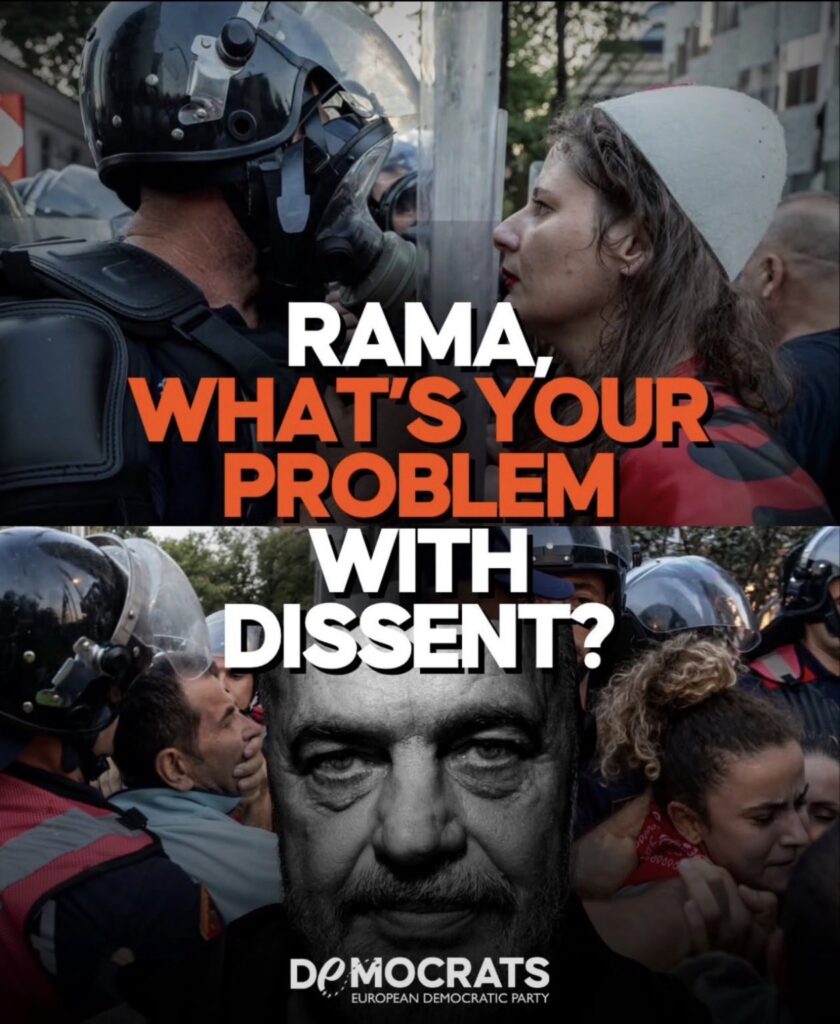
On Wednesday morning the European Democratic Party posted a picture. A woman in a plis stands nose to visor with a riot policeman. Under her, in orange capitals, a question addressed to the Prime Minister of Albania by name. Under the question, his face in black and white, where a poster puts its target. The caption speaks of detentions, of a “disproportionately harsh” police response, of people without visible uniforms intervening, and it closes the way a progress report closes: a country seeking to join the European Union must strengthen the rule of law, protect fundamental freedoms and guarantee the right to dissent, protest and speak freely.
The poster went up the morning after that street tried to keep the Albanian Parliament from opening its session.
The European Democratic Party is a European political party registered in Brussels and funded, like every registered one, from the European Parliament’s budget. Its delegation sits in Renew with ten members. It has member parties from the Basque Country to San Marino. It has none in Albania. Its Albanian connection, on the record of its own newsroom, is one member of parliament: Marjana Koçeku, twenty-five, elected on the Socialist Party’s closed list in Shkodër in May 2025, independent since 14 June, received by the party’s Secretary General Sandro Gozi in Brussels on 1 July, where the two recorded a video under the slogan “Albania is not for sale”, and seated with the opposition since Tuesday. The figure of 200 restricted accounts that opened last week’s exchange was hers. When the party says it has heard the voice of thousands of Albanians, this is the voice.
Party families have talked this way about Albania for decades. The EPP speaks for the Democratic Party; the Party of European Socialists spoke for Edi Rama when it suited him, and he was glad of it. But the EPP speaks through a member party that has to face Albanian voters afterwards, and so did the PES. This poster has no Albanian author who can be held to account for it. It has a Brussels letterhead and a Shkodër MP. Everything between them is a design studio.
The sentence about what a candidate country must do is not the Commission’s property; any MEP may say it. What the EDP did was put it on a poster, under a slogan and a face, in the visual grammar of the Albanian protest, on the one morning in a hundred when the protest had chosen the doors of Parliament as its object. The sentence is the Commission’s register. The poster is a campaign. Together they are an intervention in an Albanian confrontation, made in the voice of the process that decides Albania’s European future, by a party that plays no part in that process.
On 3 September, after the Prime Minister denied any hand in the Instagram restrictions, the same party wrote that it had never claimed his government was responsible and asked Meta to explain. Six days later the restrictions are back in the charge sheet as “a further concern for freedom of expression and access to information”, without a source, an attribution or a word about the disclaimer. A party that disowns an accusation on Thursday and re-files it on Wednesday is not weighing evidence. It is accumulating it.
The people “without visible uniforms” are new. Nothing we have read about Tuesday reports them, not the Shqiptarja live blogs, not Euronews Albania, not Koha Jonë. The Interior Ministry owes an account of Tuesday and has not given one, and if it shows plainclothes officers in the crowd, we will print it. The EDP did not wait. It put the allegation on the poster, on the day a story about men “outside any clear chain of accountability” would be most useful to the people at the doors.
The Prime Minister answered within the hour. The facts in his reply were the facts we reported on Tuesday night: the eggs, the blocked cars, a woman MP with thirty years in women’s rights mocked on her way to work. The register was his own. A head of government who answers “what is your problem with dissent” with “lazy democrats” and a clown has handed the poster back its slogan. He was free to do it. It was a gift.
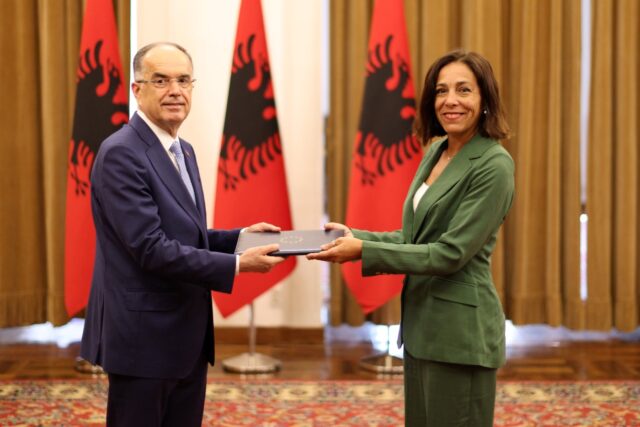
We are not writing to the EDP. We are writing to the Commission, the Council and the EU Delegation in Tirana, which has a new ambassador in her first weeks and a poster on her desk that she did not commission.
The Union’s enlargement policy is merit-based; the word is the Commission’s, not ours. A merit-based process is not served by a European party campaigning in its register, against a candidate government, on the word of one MP and a claim it had already withdrawn, on the morning that government’s Parliament was blockaded. Either the institutions say the poster is not the Union’s position, or Tirana will read the silence the way Tirana reads silence.
Nobody is asking for a party to be quiet. Ten seats are European seats; we wrote that last week and it stands.
The ask is smaller and more uncomfortable. It is that the Union take back its own sentence.