The Editorial Board |Tirana
There is a simple rule in serious politics. When a political leader’s supporters commit violence at events he has personally called and personally chaired, he is responsible. Not metaphorically. Not in the soft register of reputational damage. Responsible.
Over the last three months, Sali Berisha has called seven national protests. At every single one of them, the same thing has happened. Masked men in hoods have positioned themselves behind placards, waited for a signal from him, and thrown Molotov cocktails. Police officers have been injured in waves, with injury counts running, according to police reporting at the time, from roughly ten in January to sixteen in early February, and with five officers hospitalised on the twenty-second of March and five again on Friday. During one protest in February, Molotov cocktails were thrown at the Namazgja Mosque during Ramadan prayers. On the twenty-second of March, incendiaries reached institutional and diplomatic perimeters in the centre of Tirana. The same uniformed faces going into the Trauma Hospital week after week. The same incendiary devices, built to the same specification, thrown at the same buildings.
This is not a series of incidents. This is a programme.
The programme has two conditions for success. The first is escalation. Each protest must raise the stakes, each confrontation must deliver harder imagery, each Molotov must land closer to a target that will make the next day’s foreign correspondent file a sharper dispatch. The second condition is denial. The violence must be carried out by the same movement that insists it does not carry out violence. The chairman of the Democratic Party, having given the signal with the national flag, must then inform the country that the flames came from the rooftop of the Prime Ministry and that the Molotov throwers were agents of the state.
Both conditions were met on Friday night, as they have been on every previous occasion. What was missing was the third condition, which the programme requires but cannot control: the operation must succeed. Because the new director general of the State Police, Skënder Hita, chose to intercept the arsenal before it could be deployed, forty-five of the Molotov cocktails produced for the evening entered police custody without ever being thrown. Eleven members of the opposition, including four caught with a bag of incendiaries on their person, were arrested. The choreographed evening ended not with a burning institution but with a leader in a hospital lobby advancing claims so untethered from the visible record that they amount to the deliberate construction of a counter narrative after the fact.
This is where the deflection becomes its own kind of evidence. Within hours of a volley of Molotovs being thrown at the Prime Ministry, in full view of drone footage, television cameras, and the public, the chairman of the Democratic Party told the country that the Molotovs had been thrown by the police. From the roof. Onto protesters. Onto the officers themselves. He told the country, in the same late night address, that the chemical spray used by officers to disperse the fire group was “bear spray,” and that it was a substance potentially lethal in patients with cardiac or respiratory conditions. There is no publicly documented use of bear spray by the Albanian State Police. No footage, no medical report, no procurement record, no independent account has surfaced to support the claim. It is not a mistake corrected by a better briefing. It is an assertion made in the full knowledge that evidence for it does not exist.
These are not denials. These are claims unsupported by any available evidence, and they move in a specific direction. Both position the state as the agent of a violence capable of killing. A rooftop Molotov that injured a police officer. A chemical agent that could stop the heart of an asthmatic. Stood at a hospital entrance, having run a movement that threw incendiaries at institutions all evening, the chairman described a night in which the police had attempted to kill citizens. The facts he used to support this account have not been produced. The account itself is not accidental. A leader in command of his movement does not invent this account. A leader afraid of what his own movement has produced, and preparing the narrative ground for whatever the next protest produces, does.
Every protest since January has produced the same sequence: the violence, the immediate denial that the violence was ours, the reframing of the police response as the real aggression, the promise that the next protest will be stronger. And every protest has produced something else, which is the element the Democratic Party leadership cannot engineer and cannot explain away. The crowds are getting smaller.
This matters more than anything else in the current situation. If Sali Berisha’s account of Albania were even partially true, a captured state, a narco regime, a government holding its citizens in terror, a justice system bent to protect the corrupt, then the natural outcome of seven protests in three months would be a mobilisation of hundreds of thousands. Not because Albanians are naive, but because Albanians are not. They know how to read a regime when they see one. They took the streets in 1990. They would take them again if there were a regime to take them against. The fact that the drone footage from the seventh protest showed a column thinner than the third, and the third thinner than the first, is the simplest and most devastating refutation of the chairman’s diagnosis. If the country believed him, the country would be there. The country is not there.
The strategy of the party has adjusted to this failure without acknowledging it. As the genuine supporters have drifted away, the reliance on the fire group has intensified. This is the masked unit that travels with the march, stationed behind placards, equipped with pre-assembled incendiaries, waiting for the signal. Its composition is now the subject of an allegation from the Interior Minister that merits serious investigation and public answers. Besfort Lamallari said on Friday night that the opposition “does not hesitate to use minors to burn things and to cover its own failure.” This allegation must be tested in the courts and answered openly. If it is established in evidence, the Democratic Party has passed from political violence into the recruitment of children for political violence, and the transition has happened in full view of a leadership that has not once, across seven protests, issued an unconditional condemnation of what is being done in its name.
That absence is not accidental. It is the architecture. A party that wanted peaceful mass protest would distance itself from the fire group, name it, disavow it, hand over the organisers, and rebuild around civic argument. A party that wants what the fire group produces does the opposite. It shields the group, it refuses to condemn the method, it treats every arrest as persecution, it names police commanders as criminals, it threatens them by name from the podium of a sitting member of parliament. On Friday night, the party’s secretary general Flamur Noka stood at the microphone and announced that Director General Skënder Hita and three further senior officers would henceforth be “considered by the opposition as members of the criminal organisation that runs the State Police,” and that the Prime Minister would meet “the end of the Ayatollah of Iran.” These are not the words of a movement seeking the democratic withdrawal of a government. These are the words of a movement whose logic of escalation risks making an incident the point.
And here the piece must say what decorum usually prefers to leave implied. The steady escalation of the violence, the allegation of minors used in its delivery, the refusal to disavow the method even as the crowds shrink, the naming of individual officers for personal threat, and the advance construction of a police force described as capable of killing with rooftop firebombs and lethal sprays, all point toward a strategy that risks producing a casualty. A martyr. A body. A dead protester, young, filmed, on a night the world is already watching. The seven protest sequence does not require this outcome to be wanted in order to increase its probability. It requires only that nothing in the conduct of the leadership is structured to prevent it. And nothing is. Every observable choice of the last three months has raised the probability rather than lowered it. The invented spray and the invented rooftop Molotov function, whether or not this was their intended purpose, as a draft script. If a death occurs, the assignment of blame is already prepared.
This is the darkest thing that can be responsibly said about a political party in peacetime, and it should not be said lightly. But the pattern is now long enough, the choices of the leadership are consistent enough, and the advance framing of the police as a killer of citizens is specific enough that honest analysis cannot avoid it. When a leader calls seven consecutive protests, and each of them is structured around a volley of incendiaries, and the crowds shrink while the tactics sharpen, and the denials become not merely more defensive but more elaborately fabricated, and minors are allegedly being handed the bottles, the reading that best fits the evidence is not incompetence. It is not even desperation in the simple sense, although desperation is a factor. It is the calculated pursuit of an event the leadership cannot organise but can make more likely with every choice it makes.
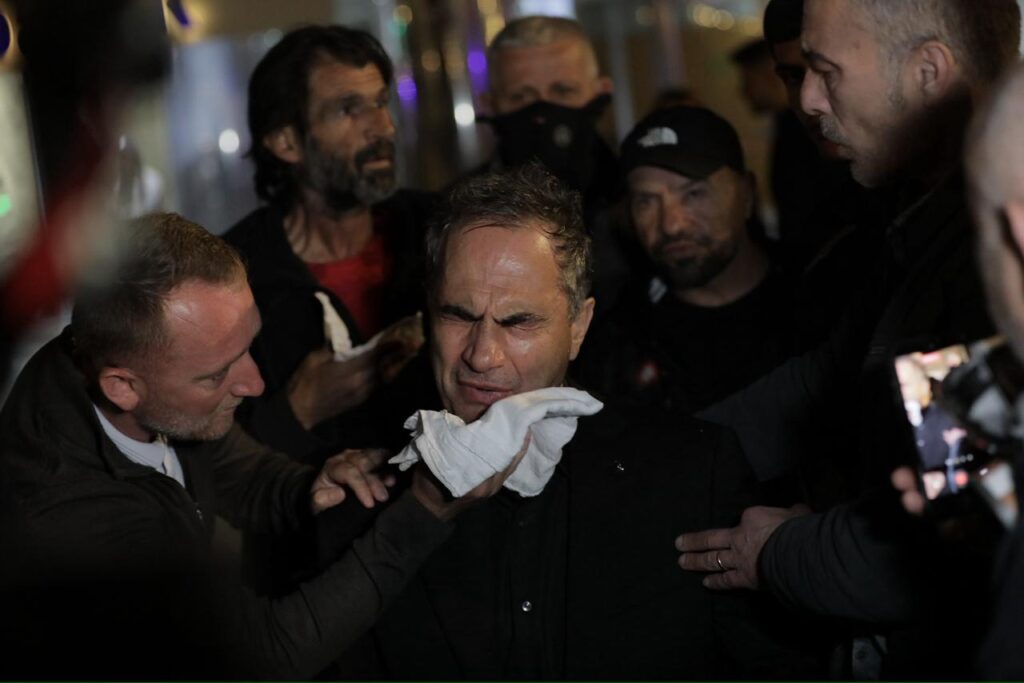
On Friday night, the calculation failed. A police command structure that was not there three weeks ago intercepted the arsenal before it could produce the image the evening required. Nobody died. Five officers were injured, two Democratic Party figures were taken to hospital, eleven militants were arrested, and the leader returned to party headquarters to promise that the next protest would be stronger. It will be. That is the programme. And the country, and its partners abroad, should now be clear eyed about what the programme raises the probability of.
There is a version of opposition politics that Albania urgently needs. An opposition that holds the government accountable, that articulates a policy alternative, that develops leaders of stature and judgement, that earns the confidence of voters on the argument. That opposition is not what Friday night produced. What Friday night produced was a chairman in a hospital lobby advancing a rooftop Molotov and a lethal spray for which no evidence has been offered, a secretary general threatening named officers from a microphone, a fire group dispersing under water cannon with a bag of incendiaries that did not reach their target, and a shrinking column of supporters who have now watched the same film seven times.
The opposition Albania needs will not arrive until this one stops.
The Tirana Examiner Editorial Board. Clarity in a Capital of Rumors.
READ ALSO: Seventh PD protest ends in two and a half hours as police seize forty-five Molotovs and arrest eleven – Tirana Examiner