Skënder Hita’s first test as State Police chief produces the first protest in the recent sequence to be stopped before wider escalation. Five officers hospitalised. Berisha responds with unsupported claims; the Interior Minister responds from the ward.
The Newsroom | Tirana
The Democratic Party’s seventh national protest in three months ended on Friday evening after two and a half hours, with police reporting the recovery of forty-five unexploded Molotov cocktails, the detention of more than twenty protesters, and a brief incendiary volley at the façade of the Prime Ministry that did not escalate into the pattern of earlier demonstrations. By Saturday morning, eleven militants had been formally arrested. It was the first public test of Skënder Hita, appointed director general of the State Police at the end of March.
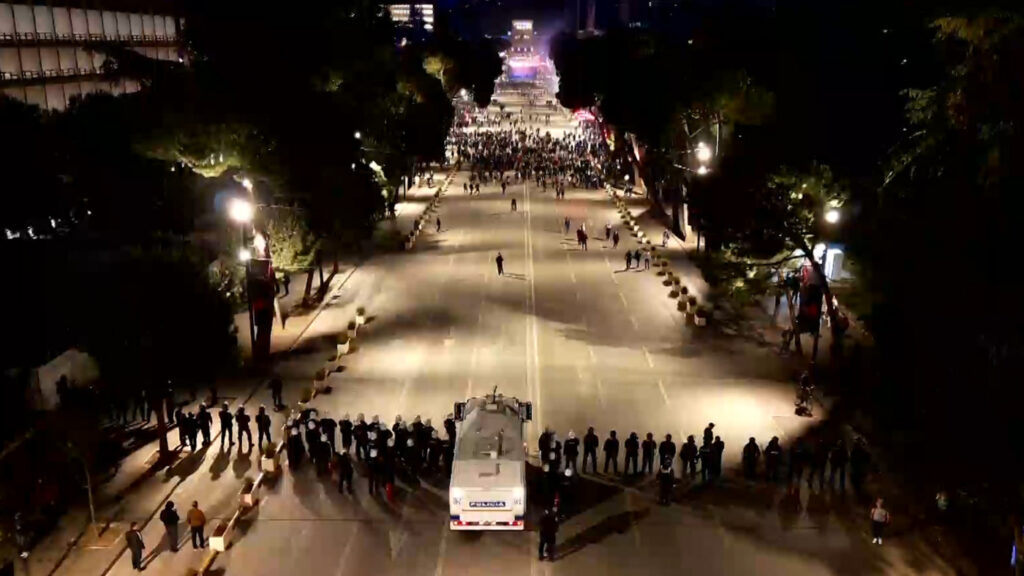
The operational build-up had been visible for hours. One thousand five hundred officers were deployed across central Tirana. Hita took to the field personally, instructing his commanders on site rather than directing from headquarters. At the rear entrance of the Prime Ministry, police vehicles were being checked from below with inspection mirrors before being allowed into the compound. The approach to Parliament was pre-closed with a cordon at the Lana Bridge, a water cannon positioned beside it.
Berisha left party headquarters shortly after half past seven in the evening, flanked by a small escort of deputies. Drone footage circulated from the scene showed a column whose bulk consisted of elected officials rather than supporters, and a crowd noticeably smaller than the protest of 22 March. He spoke for roughly an hour from a podium on Dëshmorët e Kombit Boulevard, attacking the Prime Minister, declaring the opposition to be “in the last kilometre”, and drawing a lesson from the recent Hungarian election, which he framed as a case for mandatory voting in Albania.
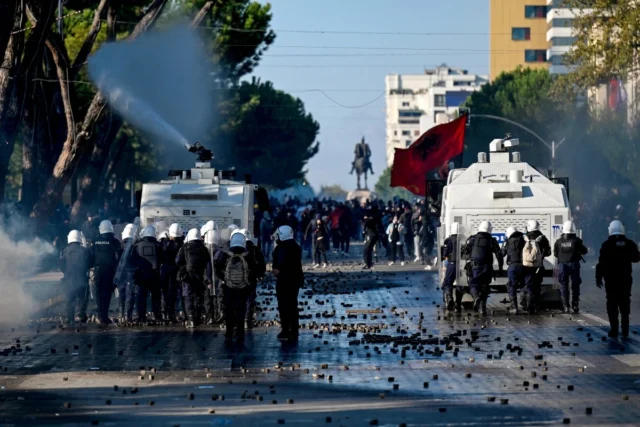
Shortly before a quarter to nine, Berisha closed his address by waving the national flag, a gesture that has repeatedly preceded Molotov volleys in these protests. The fire group, positioned behind placards with faces masked under black hoods, threw a volley of incendiaries at the façade of the Prime Ministry.
The police response began within seconds. Water cannon, tear gas and chemical spray were deployed against the front of the column. One of the first militants was detained as the volley ended. Over the following minutes, officers moved through the crowd collecting the remainder of the arsenal. Police reported the recovery of forty-five Molotov cocktails that had not been thrown, and intercepted a bag of incendiaries carried by four protesters detained at the scene. A group of militants attempted to redeploy toward Parliament but was stopped at the Lana Bridge cordon, where Democratic Party secretary general Flamur Noka confronted the police line and failed to breach it.
The casualties, reported by the Trauma Hospital in Tirana, fell on both sides. Five police officers received medical attention, one of them transported to the hospital. On the opposition side, Democratic MP Luçiano Boçi and National Council member Aulon Kalaja, a journalist and former parliamentary candidate, were hospitalised after exposure to crowd control agents. Deputies Flamur Noka and Klevis Balliu were sprayed and treated at the scene, Balliu leaving the protest in tears.
The political reaction from the Democratic Party leadership began on the esplanade and continued, late into the evening, from the Trauma Hospital. Berisha told supporters the police had used “bear spray,” which he described as potentially lethal to patients with cardiac or respiratory vulnerability. He then advanced a more ambitious claim, stating that Molotov cocktails had been thrown not by his militants but by police officers positioned on the roof of the Prime Ministry, and that one of the officers subsequently reported injured had been struck in the head “by a Molotov bottle thrown from the rooftop.” No publicly available footage or evidence has so far substantiated those claims.
The sharper escalation came from the party’s secretary general. Speaking from the protest, Flamur Noka named Skënder Hita and three further senior police officers by name and announced that each “will be considered by the opposition as a member of the criminal organisation that runs the State Police.” He extended the same construction to the Prime Minister, promising that Edi Rama would meet “the end of the Ayatollah of Iran, the end of Rama and his gang.” The statements were delivered at a public political gathering by a sitting member of parliament and the party’s second ranking official.
Government response was tightly framed and visible. Interior Minister Besfort Lamallari visited the Trauma Hospital and the QSUT late on Friday evening to see the five injured officers, accompanied by Director General of the State Police Skënder Hita. “The hand raised against people in uniform is raised against the law, against the citizen, and against the state itself,” Lamallari wrote in a social media post alongside footage of the visit. “Molotov attacks against officers of the State Police are not protest. They are crime, and they will receive the response they deserve.” Earlier in the evening, he had praised the operation as a “professional reaction” and described the Molotov throwers as having been used by the opposition as “cannon fodder” in a design intended to “burn the city, blacken the country in the eyes of the world, and endanger the lives of police officers.” He added that the opposition “does not hesitate to use minors to burn things and to cover its own failure.” Government Secretary General Taulant Balla focused on the choreography, calling the use of the national flag as the signal for a Molotov volley a “seal of shame.” Neither statement addressed Noka’s threats directly.
Berisha closed the evening from Democratic Party headquarters with his usual promise: the next protest would be stronger. The same promise has been made at the close of earlier demonstrations in this sequence. The date of the eighth protest has not yet been announced.