Albania had already condemned Mladić when he died, and its prime minister spoke before he was buried. Tuesday’s statement did something different: it placed Tirana formally inside the European response to what Serbia did at the funeral.
The Newsroom (Tirana)
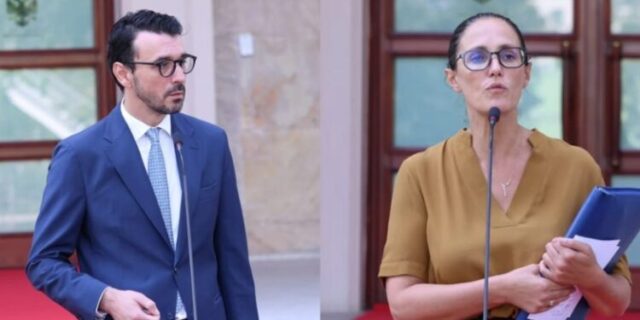
Albania’s minister for Europe and foreign affairs, Ferit Hoxha, on Tuesday evening joined the European Union and its leaders in condemning the glorification of Ratko Mladić at his funeral in Serbia.
“Albania condemns the glorification of Ratko Mladić, a convicted war criminal who died while serving a life sentence for genocide, crimes against humanity and war crimes,” Hoxha wrote. “We join the European Union, its leaders and all those who have rightly condemned the manner in which he was honoured and commemorated in Serbia.”
The timing matters. But not because Albania had been silent.
It had not.
On 27 August, the day Mladić died in the United Nations detention unit in The Hague, Hoxha called him a “brutal murderer”, recalled his convictions for genocide, war crimes and crimes against humanity, and said death could neither erase guilt nor rewrite the historical record.
He named the places.
“Srebrenica, Sarajevo, Kosova and all the victims of the wars in the former Yugoslavia deserve neither oblivion nor revisionism,” Hoxha wrote. The verdicts remained, the facts remained, and so did the responsibility to prevent “such monsters and their policies” from returning. He ended with the same words that appear in Tuesday’s statement: Never Again.
So Tuesday was not Albania’s first judgment on Mladić. It was a judgment on what happened after his death.
Between the two came the prime minister.
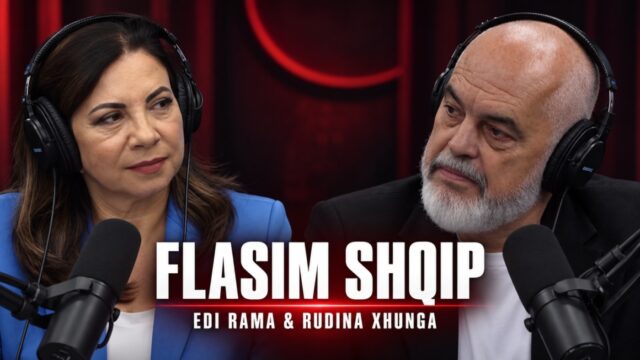
On Saturday, two days before the funeral, Edi Rama used his appearance at the Cernobbio forum in Italy to address the honours being prepared in Serbia.
“You cannot have a state funeral for a butcher,” Rama said. [GAP: verbatim against the Cernobbio thread]
He was not arguing for Serbia to be pushed away from Europe. Serbia should remain at the table, he said, precisely so that Europe can tell it that such things are incompatible with belonging there.
Then came the funeral.
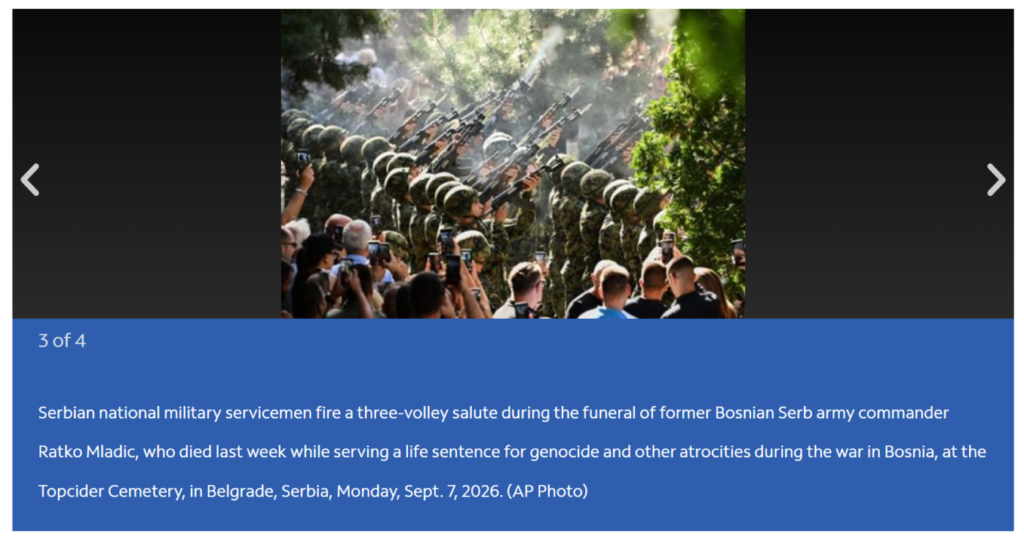
On 3 September a Serbian government aircraft brought the body from The Hague to Belgrade, with Serbia’s justice minister, Nenad Vujić, aboard, and soldiers of the Serbian Armed Forces carried the coffin, draped in the flags of Serbia and Republika Srpska, off the plane; on Saturday a commemoration was held at the Army House in the city centre, with Vujić in attendance and officials of Republika Srpska on the platform; and on Monday, after Patriarch Porfirije had led the liturgy at St Luke’s church before a front row that held five Serbian government ministers, for defence, justice, culture and public investments and one without portfolio, an honour unit of the Serbian Armed Forces placed the coffin on a gun carriage, escorted it to the grave at Topčider and fired a salute over it. Serbia’s president stayed away. His son did not.
Reactions arrived through Monday and Tuesday.
Bosnia and Herzegovina went furthest. Foreign Minister Elmedin Konaković expelled two officials of the Serbian embassy in Sarajevo, gave them 48 hours to leave, announced the withdrawal of most Bosnian embassy personnel from Belgrade and said Bosnia would not sign the regional memorandum on good-neighbourly relations due in Montenegro on 1 October.
Member-state reactions had begun before the funeral and continued after it. Belgium’s Maxime Prévot called the honours shameful. Austria’s foreign minister, Beate Meinl-Reisinger, described a burial staged as a festive occasion, with many official Serbian representatives present. The Netherlands’ Tom Berendsen said honours bestowed by the state were incompatible with European values; Lithuania’s Kęstutis Budrys, Portugal’s foreign ministry and Sweden’s foreign minister followed. [GAP: Austrian, Lithuanian and Portuguese wording against the original posts] Croatia’s prime minister, Andrej Plenković, said on Monday night that it was wrong for the Commission’s response to remain at spokesperson level and called for senior EU officials to speak.
On Tuesday morning, the response moved to the top of the European Union.
European Commission President Ursula von der Leyen and European Council President António Costa issued matching statements. The images from Belgrade, they said, were “shocking”. The elements of official support and the presence of senior Serbian officials were “deeply regrettable”. They represented a failure to confront a dark chapter of recent European history and contradicted the values underpinning Serbia’s path towards the European Union.
Read against that sequence, what Tuesday’s statement added was one sentence. Albania’s condemnation of Mladić was twelve days old. Its position that glorification, genocide denial and revisionism are incompatible with European values was already on the record. The sentence was: “We join the European Union, its leaders and all those who have rightly condemned.”
Why that sentence carries weight, Belgrade demonstrated the same day. Serbia’s foreign minister, Marko Đurić, answered Konaković’s measures not on the funeral but on the man: Konaković, he said, was a hypocrite who had grown up politically in a milieu that celebrated Rasim Delić. That is the standard reply to a neighbour’s complaint, and it works. A complaint from Sarajevo becomes a Sarajevo–Belgrade quarrel. Relations between Albania and Serbia carry enough history for the same reduction, and Kosovo adds another layer to it. That does not make Albania’s position less legitimate; it changes the environment in which the position is received.
There is no public evidence that Tirana deliberately delayed its second statement for that reason, and it would be wrong to present such a calculation as established fact.
But the sequence produced a result nonetheless.
Albania had established its own position when Mladić died. Its prime minister had condemned the planned honours before the burial. Once the presidents of the European Commission and European Council had spoken about what actually occurred in Belgrade, Tirana issued another statement and placed itself alongside them.
By Tuesday evening this could no longer plausibly be treated simply as an Albanian complaint against Serbia.
The criticism now came from the institutions whose political standards Serbia has committed itself to meet through its pursuit of membership of the European Union. Albania, itself negotiating membership and aligning its foreign policy with the Union, joined that position explicitly.
That is what changed on Tuesday.
Not Albania’s view of Ratko Mladić.
The company in which Albania stated it.