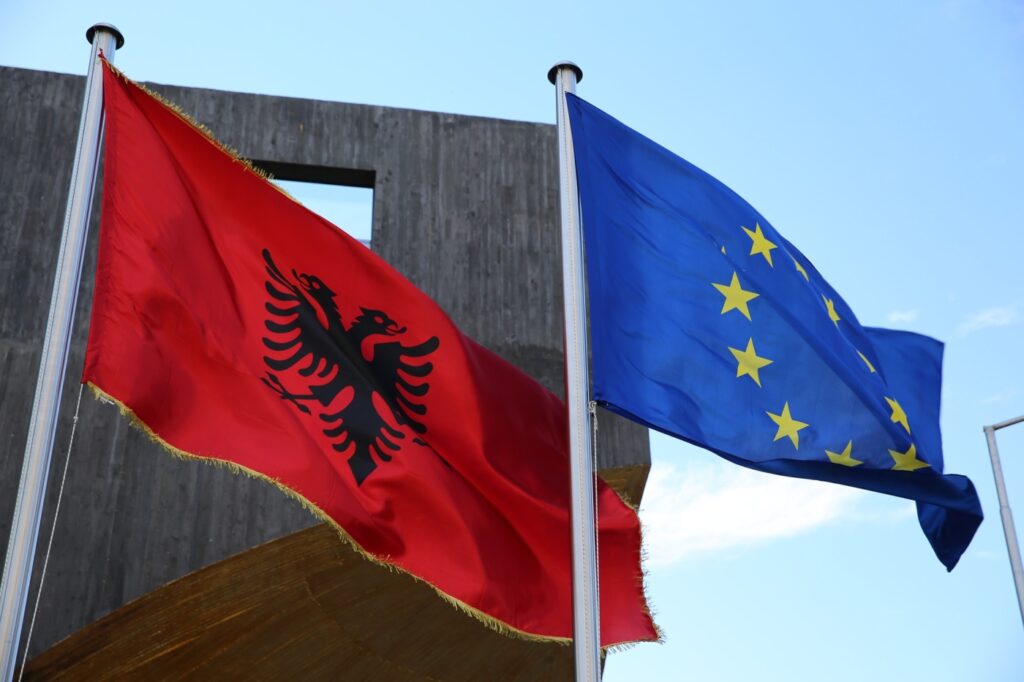
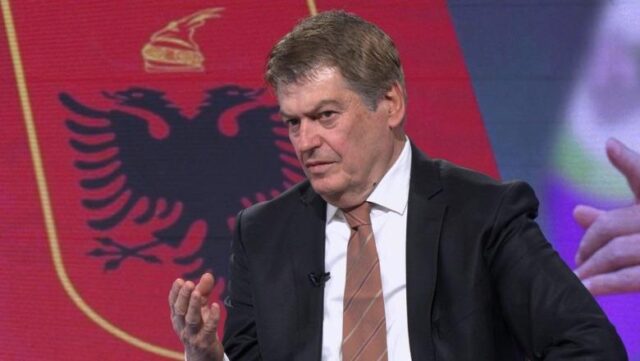
Prime Minister leads forum on accession negotiations as government unveils social contract proposal for youth.
by Aurel Cara (Tirana)
Prime Minister Edi Rama convened a public forum with students and young people this week to address the progress of Albania’s European Union accession negotiations, presenting what he described not as an aspiration but as an executable roadmap with a target of full membership by 2030.
The event brought together Rama, Foreign Minister Ferit Hoxha, and Chief Negotiator Majlinda Dhuka in a structured dialogue with young Albanians. It is part of what officials described as an ongoing effort to integrate youth into the accession process itself, rather than treating them as passive beneficiaries of its outcome.
“The stars have aligned”
Rama opened his remarks by drawing a sharp distinction between political rhetoric and institutional planning. “It is not a dream that we have had and are telling people about, but a plan we have on the table,” he said. He described a two-phase structure to accession: a technical phase driven by Albania’s own pace in opening and closing negotiating chapters, and a political phase dependent on the consensus of EU member states.
The European Commission, he said, has set an internal ambition of concluding technical negotiations by the end of 2027, after which it would present its findings to the European Council. “The Commission will tell the European Council: with these people we have no more business, with these people we have closed negotiations. Then the political process begins.”
Rama was direct about the asymmetry of leverage in each phase. “The first phase is largely in our hands. The second phase is largely in their hands.” He argued, however, that current conditions are unusually favorable. “The stars have aligned and both sides have the same interest. We want to join, they want to expand.”
He placed this moment in explicit historical contrast with Albania’s past standing in European circles. Albania had been proposed by the Commission for the opening of negotiations three times and rejected each time, he noted, because a single member state exercised a veto. “What did it have against Albania? Nothing, but it had a problem created with Albanians, a political one.” The door, he argued, is now open, but it is not permanently open. “What matters is that we do not become the reason for it to close. We must do the maximum in these years ahead where the door is clearly and fully open.”
The practical stakes of membership
Rama grounded the case for accession in concrete, everyday terms rather than geopolitical abstractions. He addressed directly the perception among many young Albanians that freedom of movement already makes EU membership a formality.
“The moment you decide to cross the border without a visa, you are a foreigner. The instant you step through the door of a university, you are not a European student, you are a foreign student. And as such you are treated differently.” He described how membership would eliminate tuition premiums paid by Albanian students at European universities and remove the distinction in labor market access. “You can look for work in any city across all of Europe as a local. No one anywhere in those cities will look at you and say: ‘Where are you from? Here you are in the EU.'”
He also offered a broader historical framing. “Never before has Albania had the smile of fate as it does today. Never has fate smiled upon Albania in the sense of the possible future of its people to be free and equal before the law.” He described accession not as a guarantee of paradise but as “the sure road toward a reality where for the first time Albanians will be safer and better protected from whatever twists and turns of history may work against them.”
Hoxha: “The most important exam in Albania’s history”
Foreign Minister Ferit Hoxha reinforced the government’s framing that the negotiations are proceeding on schedule and that the process is collaborative rather than adversarial. He used the metaphor of a three-party tango to describe the dynamic between Albania, the European Commission, and the 27 member states. “We are ourselves that do our homework, that are credible, and the second is the European Commission. We work with them from morning to night.”
Hoxha rejected the premise of a question from the audience about obstacles slowing the process. “Absolutely nothing has slowed down. We are moving at the pace we set together with the European Commission.” He characterized the current moment as one of historic consequence. “We are at the moment when we must sit the most important exam in Albania’s history.”
He also addressed youth directly on the nature of the process itself. “We do not want to speak for you, we want to speak with you.” He argued that EU integration is not a bureaucratic milestone but a cultural and civic transformation. “EU integration is a process of remaking ourselves. It falls to all of us to be involved because it affects all of us. Once it was a dream. Today we have made it a project and we want to turn it into a result.”
Dhuka proposes “social contract” with Albanian youth
Chief Negotiator Majlinda Dhuka used the occasion to announce the outlines of a proposed social contract framed around three pillars. The first would embed young people in the 600 ongoing European transformation initiatives Albania is currently implementing. The second would position youth as developers of opportunity, encompassing innovation and civic participation. The third would designate young people as “European ambassadors,” amplifying accession messaging within families, educational institutions, and social media communities.
“We need your voice, in families, in lecture halls, on social networks, for your communities,” Dhuka said. She closed with a pitch for youth-led cultural momentum: “Let’s turn Albania 2030 in the EU into a trend.”
On emigration: no alternative, no apology
One of the more candid moments of the event came when Rama addressed the ongoing emigration of young Albanians. He acknowledged plainly that it cannot be stopped and that stopping it would not be desirable in a free society.
“What can you tell a 20-year-old who has the whole world in front of him on his phone? He is in the reality of a village and says he wants to go and prove himself in Europe, the US, or Australia. Do you tell him no, stay in your country? No, that is a lie. He is within his rights.” He acknowledged that some who leave will not return, framing this as an accepted consequence of political freedom rather than a policy failure. “As long as we have chosen to be an open country, and thank God no longer as in the old days when we could not leave Albania, we have accepted the challenge that people move.”
A generational argument
Throughout the event, the government’s messaging converged on a single generational proposition: that the cohort now in university will be the one to experience full EU membership as a lived condition rather than a political promise. Rama gestured at the gender composition of the room, noting that the majority of those present were young women, and offering his view that societal progress would, in large part, come from them.
Hoxha summarized the event’s animating logic in direct terms. “You are the generation that will enjoy the EU. You will be the beneficiaries and you must also be the contributors. Joining the EU is a mindset, and the mindset must change because it is a system of values that begins with each one of us.”