Governance failures and regime closure are different conditions. Conflating them is not stricter analysis — it is less accurate analysis.
by Albatros Rexhaj
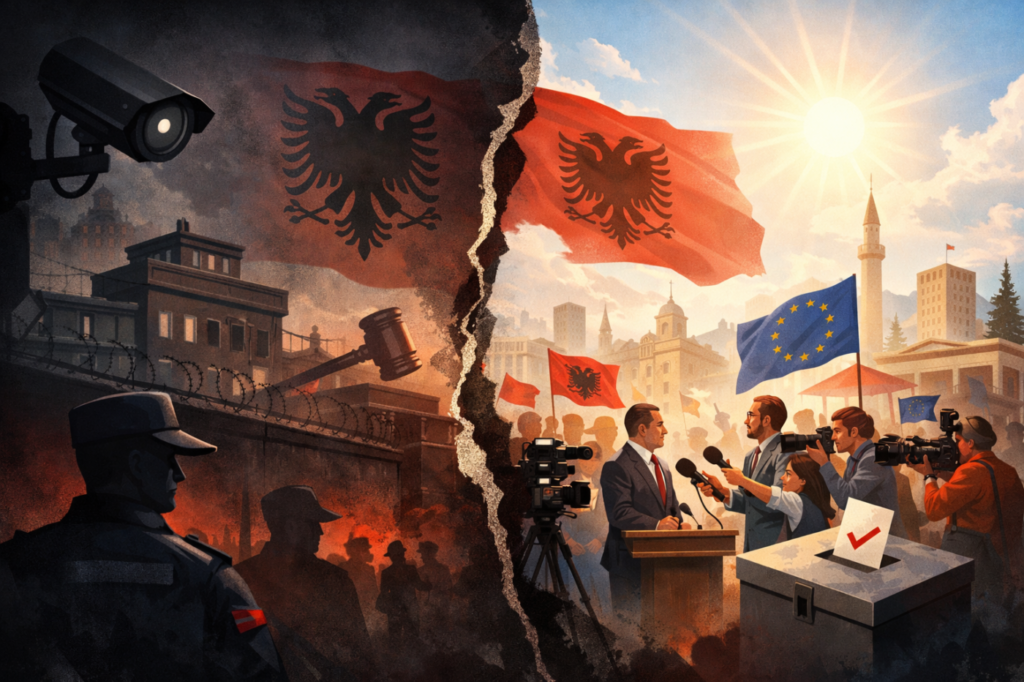
There is a version of Albania that circulates in reports, briefings, and second-hand conversations. In that version, democratic institutions are hollow, the playing field is fundamentally closed, and the country sits at the edge of autocracy.
There is also the Albania that exists.
The gap between the two is now wide enough to matter — not as a point of national pride, but as a question of analytical accuracy with direct policy consequences.
The basic test
Autocracy has a defining characteristic: it removes uncertainty from political life. It does this through a predictable set of mechanisms — suppression of opposition, control of information, closure of the space in which citizens can openly contest power. These are not abstract criteria. They are observable conditions — either present or they are not.
Apply that test to Albania.
Start with information control — the dimension V-Dem measures as freedom of expression and a core input into both its electoral and liberal component scores. Prime-time television is saturated with political debate. Government officials are challenged directly and aggressively by journalists and commentators. Critical coverage is not episodic — it is the default register of Albanian political media. No television station has been shut down for its editorial position. No news portal has been closed for its political line. No journalist is imprisoned for investigative reporting. No commentary, however hostile to the government, triggers state closure.
The digital space amplifies this further. The media landscape is fragmented, privately owned, and intensely competitive — not because the state permits competition as a concession, but because it lacks the architecture of control that would be required to suppress it. Dozens of outlets and platforms publish openly critical content daily, without interruption and without legal consequence.
This does not mean the media environment is clean. It is not. Economic pressures shape editorial lines. Ownership structures concentrate influence in ways that raise legitimate questions. The boundary between journalism and political positioning is frequently blurred. Self-censorship — the anticipatory adjustment of editorial judgment to avoid friction with powerful interests — is a real and documented phenomenon in Albanian media. V-Dem captures these pressures, and it is right to do so.
But what it cannot do — and what its scoring does not distinguish — is the difference between a media environment shaped by market distortions and political economy pressures, and one shaped by state control. These are not points on a continuum. They are structurally different conditions. Soft pressure and structural influence are categorically different from the censorship mechanisms that define autocratic information control. Conflating them does not strengthen the critique of Albanian media. It weakens it, by evacuating the category of autocracy of its analytical content.
The political space
The same test applies to electoral quality — the component V-Dem weighs most heavily in its composite index. Opposition parties in Albania organize freely, campaign publicly, and compete in elections. In the May 2025 parliamentary elections, the opposition coalition secured 51 of 140 seats with over a third of the national vote — a genuine contest, observed and certified as competitive by international monitors, however uneven the playing field.
V-Dem’s electoral quality indicators register what international observers also documented: misuse of state resources, incumbent advantages, pressure on public sector workers, and unbalanced media coverage of smaller parties. These findings are accurate. The playing field is not level. Albanian elections are contested but not always on equal terms.
But here the analytical distinction is critical. V-Dem’s electoral quality score measures the conditions surrounding elections — the environment in which they take place, the fairness of access, the integrity of administration. What it does not separately weight is the outcome that matters most for regime classification: whether elections remain genuinely uncertain. In Albania, they do. The structural capacity to remove an incumbent exists. The possibility that the government loses is real, not theatrical. An uneven playing field is a democratic deficit. A predetermined outcome is the threshold of autocracy. Albania has the first problem. It does not have the second.
What autocracy actually requires
Autocracy is not defined by institutional weakness. It is not defined by corruption, by politicized appointments, or by institutions that fall short of European standards. These are serious governance failures, and Albania has them. But they describe a system that functions badly, not one that has been closed.
This is where V-Dem’s treatment of rule of law and checks and balances requires the sharpest scrutiny. Both are genuine components of democratic quality and both are legitimately weak in Albania. The judiciary operates under documented political pressures. The vetting process — however necessary and however supported by international partners — has created a prolonged period of institutional vacancy and reduced judicial capacity. Legislative oversight of the executive is inconsistent. These are real findings.
But rule of law weakness and the absence of rule of law are different conditions. Checks and balances that function imperfectly are different from checks and balances that have been deliberately dismantled. V-Dem’s composite scoring pulls both toward the same threshold. A judiciary under reform pressure — externally monitored, internationally supported, and structurally independent in its mandate even where compromised in its practice — is not the same as a judiciary that has been captured and weaponized by an executive seeking to eliminate political competition. Albania has the former. The latter is what autocracy requires.
The same applies to civil liberties — the fifth component feeding into the LDI. No Albanian opposition leader has been jailed for political activity. No citizen faces criminal sanction for expressing dissent. No civil society organization has been forcibly dissolved for its political positions. Freedom of assembly is exercised regularly and without systematic state repression. These are not marginal observations. They are the operative markers of whether civil liberties retain functional meaning — and in Albania, they do, imperfectly and unevenly, but meaningfully.
V-Dem’s civil liberties indicators are sensitive to the quality of legal protection, the consistency of enforcement, and the degree of institutional guarantee. Albania scores poorly on all three. But scoring poorly on the institutional architecture of civil liberties protection is not the same as the absence of civil liberties in practice. The gap between weak institutional protection and actual suppression is precisely the gap V-Dem’s composite scoring cannot represent — because it averages across both dimensions and produces a single number that collapses the distinction.
The analytical error at the heart of the traveling narrative is a category substitution: governance quality is read as regime type. A country with deficient institutions is classified alongside countries where opposition is imprisoned, media is state-controlled, and elections are administered to confirm rather than contest power. That classification does not survive contact with observable Albanian reality.
The EU divergence
The distance between the traveling narrative and observable reality is legible in a concrete institutional fact. The same Albania that analytical frameworks place at the edge of autocracy has, in the judgment of the European Union, met the conditions required to open accession chapters and advance rule-of-law negotiations under the formal enlargement process. In March 2024, Albania opened its first intergovernmental conference under the revised enlargement methodology. Screening processes are underway across multiple clusters.
The EU enlargement process is not a democracy certification. It is a reform assessment, and it identifies Albania’s institutional deficits — on rule of law, judicial independence, civil liberties, and electoral integrity — with precision and without diplomatic softening. But its continued forward movement reflects an institutional judgment that Albania’s political system remains sufficiently open to make reform the operative policy tool. That judgment is incompatible with a classification of autocracy. It is entirely compatible with a classification of a flawed democracy under reform pressure.
That divergence between analytical classification and institutional judgment is not incidental. It reflects the difference between an instrument designed to measure variation across 179 countries over long time horizons and an institution making calibrated assessments about a specific country at a specific moment. Both produce imperfect outputs. But when the gap between them is this wide, the burden of explanation falls on the instrument, not the institution.
What serious analysis requires
Albania deserves scrutiny. Its judicial sector operates under pressures that compromise independence. Its media environment is shaped by ownership structures that distort editorial judgment. Its public administration falls short of European standards. Its electoral process gives incumbents advantages that genuine democratic competition should not permit. Its civil liberties protections are institutionally weak even where functionally present. None of that should be minimized, and none of it is minimized here.
But scrutiny loses its value when it stops describing reality and starts replacing it. The five components that feed the LDI — electoral quality, rule of law, judicial independence, checks and balances, civil liberties — each capture something real about Albania’s democratic deficits. What they do not capture, individually or in combination, is the structural question that regime classification actually requires: whether the system remains open or has been closed. On that question, the observable evidence is unambiguous. Albania’s system remains open. Contested, distorted, uneven, and institutionally fragile — but open.
A narrative that places Albania in the same analytical category as systems where political opposition is criminalized, information is state-controlled, and electoral outcomes are predetermined is not a stricter form of accountability. It is a less accurate one.
An autocracy without censorship, without imprisoned journalists, without silenced opposition, and without controlled elections is not an autocracy. It is a democracy with deficits — and that distinction is not a conclusion. It is the starting point of serious analysis.
READ ALSO: The Instrument Is the Problem: V-Dem’s Methodology and the Misclassification of Albania