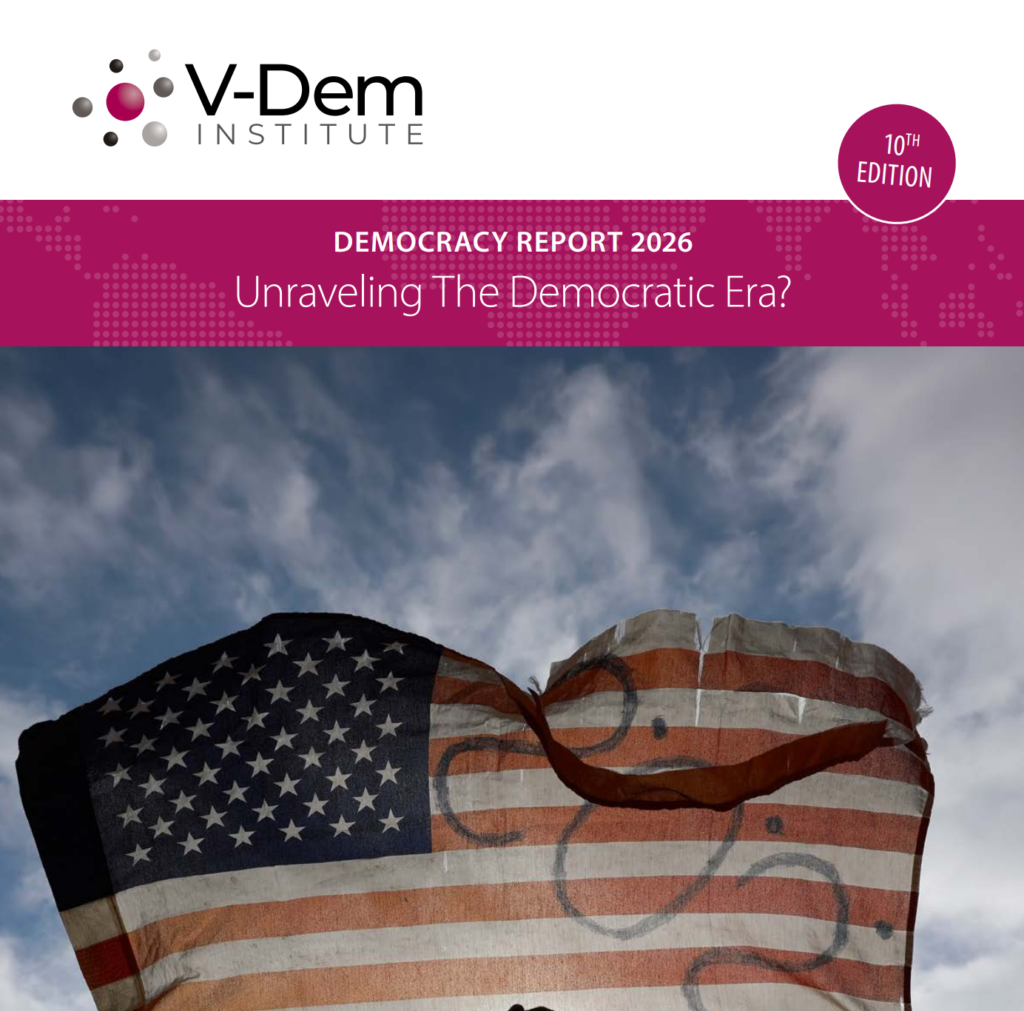
The V-Dem Institute’s Democracy Report 2026 places Albania at the threshold of electoral autocracy. That classification is already traveling — into diplomatic cables, policy briefs, and the background assumptions of officials who shape Albania’s EU accession environment. This piece does not dispute that Albania has serious institutional problems. It disputes whether the instrument producing that classification is designed to measure what it is being used to decide. The methodology deserves scrutiny. We are applying it.
by the Editorial Board
The V-Dem Institute’s Democracy Report 2026 places Albania at the threshold of electoral autocracy. That classification is already traveling — into diplomatic cables, policy briefs, and the background assumptions of officials who shape Albania’s EU accession environment. This piece does not dispute that Albania has institutional problems. It disputes whether the instrument producing that classification is designed to measure what it is being used to decide. The methodology deserves scrutiny. We are applying it.
Every measurement system embeds assumptions. The question is whether those assumptions are visible, whether they are appropriate to the object being measured, and whether the outputs they produce are honest about their own limits. On all three counts, the Varieties of Democracy Institute’s methodology fails Albania — not because its researchers are careless, but because the instrument was not designed to handle what Albania actually is.
This is not an argument that Albania is a consolidated democracy. It is an argument that V-Dem’s methodology systematically conflates regime type with governance quality — and that this conflation, applied to hybrid systems in small transitional polities, produces categorical errors with real political consequences. Albania is the clearest available case study of that error in the European context.
The threshold problem
V-Dem’s Regimes of the World typology divides political systems into four categories: Liberal Democracy, Electoral Democracy, Electoral Autocracy, and Closed Autocracy. These categories are derived from continuous indices and then hardened into labels at fixed breakpoints. The breakpoints are, by the Institute’s own admission, arbitrary. The 2026 report’s co-principal investigators — Coppedge, Gerring, Knutsen, and Teorell — state this directly: the categorical boundaries mean that countries grouped together as Electoral Autocracies may be quite dissimilar, while countries on opposite sides of a threshold may be nearly identical in practice.
Albania is placed at the threshold of electoral autocracy, with confidence intervals extending into electoral democracy. V-Dem’s own notation records this as EA+ — a classification whose uncertainty range reaches into the higher category. This is not a firm finding. It is a probabilistic estimate straddling a line whose position is itself a methodological choice.
When that estimate exits the academic apparatus and enters a policy environment — an EU progress report, a Western embassy assessment, a press briefing — the qualifier disappears. EA+ becomes Electoral Autocracy. The difference between categories is marginal statistically and enormous politically. The uncertainty that made the classification intellectually defensible is the first casualty of its public life.
This is not incidental. It is structural to the model. V-Dem’s system has no mechanism to prevent a grey zone classification from functioning as a categorical verdict once it leaves the dataset. The Institute publishes the uncertainty ranges. Nobody reads them.
The maximalist democracy problem
V-Dem does not measure whether a country is a democracy. It measures how well a country performs across five dimensions: electoral, liberal, egalitarian, participatory, and deliberative. The Liberal Democracy Index — the figure most cited in policy contexts — combines electoral quality with judicial independence, legislative constraints on the executive, and civil liberties protections. This is a maximalist conception of democracy, and it is legitimate for academic purposes.
But it produces a category error when applied to regime classification. V-Dem collapses the distinction between regime type and governance quality. A country can hold genuinely competitive elections, sustain organized opposition, permit political turnover, and guarantee the structural contestability of power — and still score poorly on the LDI because its courts are politicized, its media landscape is distorted by ownership pressures, and its public administration lacks impartiality. Under V-Dem’s framework, all of those institutional deficits flow directly into the regime classification. A governance quality problem becomes a regime type verdict.
The consequence is a systematic compression of hybrid systems. Countries that differ fundamentally in their political structure — those where power remains contestable and those where it is not — are pulled toward the same threshold if they share institutional deficiencies. In such a system, deterioration in governance quality can simulate regime closure. The model does not distinguish between the two because it was not designed to — and cannot do so without altering its underlying architecture.
Albania is precisely this case. Its electoral process, for all its documented imperfections, remains competitive. Opposition parties organize, campaign, and win — including at the municipal level, where they hold major urban centers. Power has changed hands at the national level. The defining condition of democracy — that political authority is contestable and that incumbents can be removed — is structurally intact. None of that saves Albania from proximity to an autocracy classification once its institutional quality scores drag the composite index toward the threshold.
It is a design choice producing outputs the model was not built to support. V-Dem measures governance quality across multiple dimensions. It presents the result as a regime classification. Those are different things, and conflating them does analytical violence to both.
The expert aggregation problem
V-Dem’s scores are not direct observations of political conditions. They are outputs of a Bayesian measurement model that aggregates, weights, and calibrates assessments provided by country experts. For large, heavily studied countries with deep expert pools, this produces reasonable estimates. For small countries like Albania, it produces something more fragile.
The Albanian expert pool is necessarily narrow. V-Dem does not publish the composition of its country-specific coder panels — itself a transparency problem, since users cannot evaluate the diversity or independence of the people whose judgments generate the scores. What can be said structurally is this: in a country of fewer than three million people with a concentrated academic and civil society sector, the experts available to V-Dem are not a random sample of informed observers. They are a specific community — internationally networked, institutionally connected, sharing methodological training shaped by deficit-detection frameworks.
This is not a problem of individual bias. It is a problem of shared epistemic frameworks. When experts converge not merely in opinion but in their underlying assumptions about where democratic quality fails and what its absence looks like, the averaging procedure amplifies rather than corrects the convergence. The Bayesian model smooths individual divergences. It cannot dissolve collective ones. The result is scores that reflect the dominant perspective of a particular expert community — rigorously aggregated, but not necessarily representative of the full range of defensible readings of Albanian political conditions.
The model dependency problem
V-Dem’s scores are not observations. They are model outputs. The Institute recalculates its entire dataset annually, meaning that a country’s score for 2015 as published in the 2020 report may differ from its score for 2015 as published in the 2026 report. Historical classifications are not fixed. They are continuously revised as the model is updated, new experts are added, and calibration procedures change.
This is described as a feature, and scientifically it is: it reflects genuine improvement in the underlying data. But it has a consequence that policy users never absorb. A country’s democratic trajectory — whether it is improving or deteriorating, at what rate, since when — is partly a function of which version of the model generated the scores. The trend line is real. Its precise shape is constructed.
For Albania, this matters because the threshold classification is not the product of a single dramatic deterioration. It is the cumulative output of a model processing years of expert assessments across dozens of indicators, recalibrated annually, producing a composite score that approaches a boundary whose position was itself chosen. Small shifts in any component of that chain — a change in the expert panel, a recalibration of a sub-index, a methodological update to the Bayesian priors — can move a country across the line between democracy and autocracy. The classification presents as a finding. It is, in fact, a calculation.
What the methodology cannot see
V-Dem’s framework has a systematic blind spot: it cannot distinguish between a democracy that is weakly institutionalized and an autocracy that retains competitive forms. These are different political phenomena with different trajectories, different vulnerabilities, and different appropriate policy responses. Albania belongs to the first category. V-Dem’s methodology places it near the second, not because its researchers are wrong about the institutional weaknesses, but because the instrument has no mechanism to separate institutional quality from regime type. Once the composite score approaches the threshold, the classification follows mechanically.
The Institute’s own co-principal investigators identify this problem in terms that should give every policy reader pause. They argue explicitly for disaggregated analysis, country-equal weighting, and attention to the components and subcomponents of democracy rather than the aggregated indices. They note that the LDI scores for 175 of 179 countries in the 2025 dataset did not change in a statistically significant manner. They warn against over-interpretation of categorical movements. This is the most technically authoritative voice in the V-Dem project telling its own readers that the headline classifications require more caution than they typically receive.
That warning does not reach the policy tables where Albania’s EU accession trajectory is discussed. The EA classification does.
The verdict
Albania is a weakly institutionalized democracy. V-Dem’s methodology reads it as something else because it is not designed to distinguish weakness from closure. That is not a political disagreement. It is a categorical error.
The instrument was designed to measure variation in democratic quality across a wide range of political systems over long time horizons. It is being used to produce regime-type verdicts with direct policy consequences for countries navigating sensitive geopolitical junctures. For that purpose, it is the wrong tool, not because its data is unreliable, but because its architecture cannot perform the discrimination the policy use case demands.
V-Dem is right that Albania’s institutions are under strain. Its judicial sector is contested. Its media environment is distorted. Its public administration falls short of European standards. These are real findings and they warrant serious attention. But a country where the opposition campaigns freely, wins municipal governments, and retains the structural capacity to contest national power is not an autocracy by any defensible definition. It is a democracy with serious institutional deficits, a distinction V-Dem’s composite scoring cannot make, and that its classification system therefore erases.
The same Albania that V-Dem places at the edge of autocracy is simultaneously deemed sufficiently democratic by the European Union to open accession chapters and advance rule-of-law negotiations, a divergence that underscores the difference between analytical classification and institutional judgment.
Fragility is not failure and no instrument that cannot distinguish the two should be producing regime verdicts.
READ ALSO: Autocracy Without Censorship? The Albania That Exists and the Narrative That Travels