Klea Ukaj (Michigan, USA)
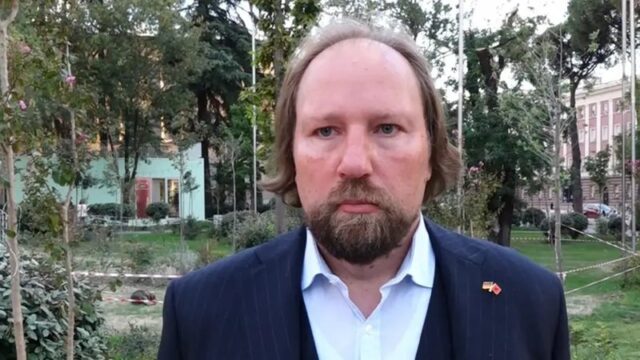
A protester was injured at Zvërnec on the thirtieth of May, during a demonstration against construction on the coast near Vlorë. What followed on the Albanian side was neither silence nor denial. Within hours the State Police withdrew the inaccurate account its local directorate had first given, apologized for it in writing, and corrected the record. It suspended the director of the Vlorë police and opened a disciplinary inquiry into the entire chain of command beneath him. It arrested the private guard who had struck and dragged the protester, and placed two others under prosecution. The Ombudsman opened a separate inquiry of his own. The prime minister congratulated the police and reserved his contempt for the developer’s security men, the hired muscle he said the state would not tolerate. By any measure the institutions moved, and they moved quickly, and they moved against their own.
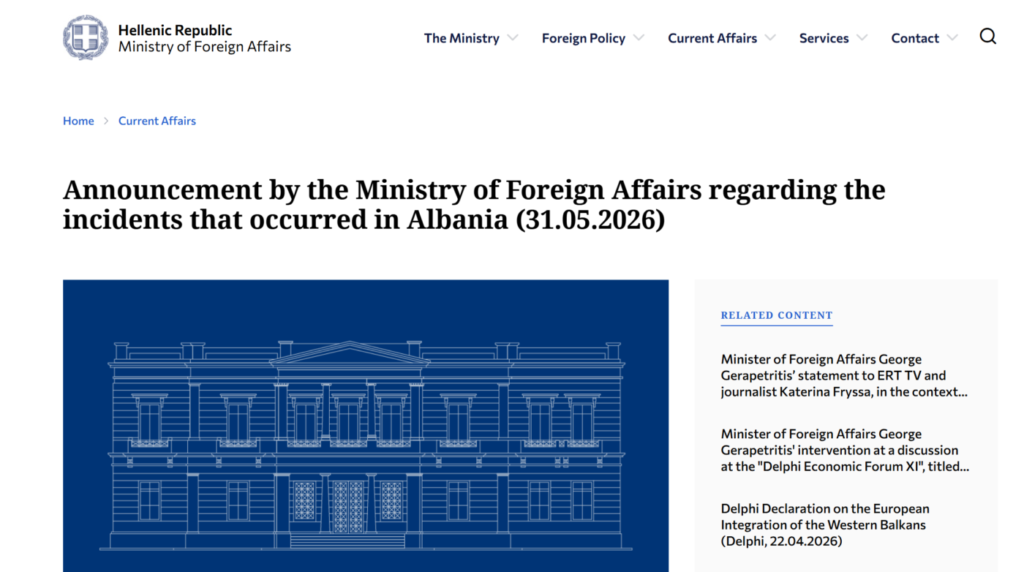
It was into this, a day later, that Athens spoke. The Greek Foreign Ministry expressed strong concern, noted that one of the injured was a Greek citizen, said its embassy had arranged consular and medical assistance, and asked the Albanian side for full clarification of the incident and the assignment of responsibility. Each of these requests was reasonable. Each had also, by the hour it was made, already been met. The clarification had been issued. The responsibility had been assigned, in arrests and suspensions and an open disciplinary file. A government may always speak for an injured citizen, and Greece was within its rights to do so. Yet a demand is a curious thing to issue for something already done, and beneath its courtesy the statement carried the shape of an alarm sounded after the danger had passed.
What makes the timing more striking still is that the line between the two capitals was never cut. Albania’s own Ministry for Europe and Foreign Affairs expressed its regret, set out the arrests and the inquiry, affirmed that the protection of human rights remains a foundational value of the Albanian state, and observed that the authorities of both countries had been in continuous contact at several levels. It reaffirmed Albania’s commitment to the relationship with Greece, on the ground of mutual respect and the European values the two profess together. Two governments were already in conversation. One had already accounted for itself. There was, in plain terms, nothing that called for raising one’s voice.
And yet the voice was raised, and it travelled. Opposition parties in Athens took up the incident in the course of a single evening, and some carried it toward Brussels and the vocabulary of accession, asking that Albania’s European path be made to turn upon it. This belongs to a longer habit, and it is worth naming once and without heat. Greece has, for years, treated occasions such as this as openings to widen the claim of minority territory in Albania, letting the boundary of its concern drift outward with each new event. A single injured man, a property quarrel on a distant shore, becomes by degrees a question of a nation’s rights, and then a condition upon a nation’s future. The enlargement is the purpose. The incident is only the occasion.
Stripped of all that has been added to it, the matter at Zvërnec is a plain one. Residents, and those who would defend the lagoon at their backs, stood against a private resort planned on a protected stretch of the Narta wetlands, and called it the sale of a coast that ought not to be sold. It is a dispute of Albanian law, on Albanian ground, moving through Albanian institutions and, where it must, Albanian courts. The man who was hurt holds both Albanian and Greek citizenship, which is to say that on the soil where he was struck he is a citizen of the country that moved at once to defend him. Albania did not need to be instructed to protect its own. It had already begun.
There is a difference between a concern and a lever, and it is measured in what one does once the wrong has been admitted. Albania admitted the wrong within the day and set about repairing it in open view. A friend, seeing as much, says as much. The harder voices in Athens chose instead to hold the wound open a little longer, for an open wound can be carried further than a healed one, as far as Brussels if it is carried carefully. But the facts had already closed it. And a matter already answered does not become a question again because someone, late and loudly, has chosen to ask.