For more than half a century, Beqir Balluku’s desk stayed away from the office of the Minister of Defence. The dictatorship had fallen, but the fear that had removed the desk had survived. Until Ermal Nufi found it in a corridor.
Albatros Rexhaj
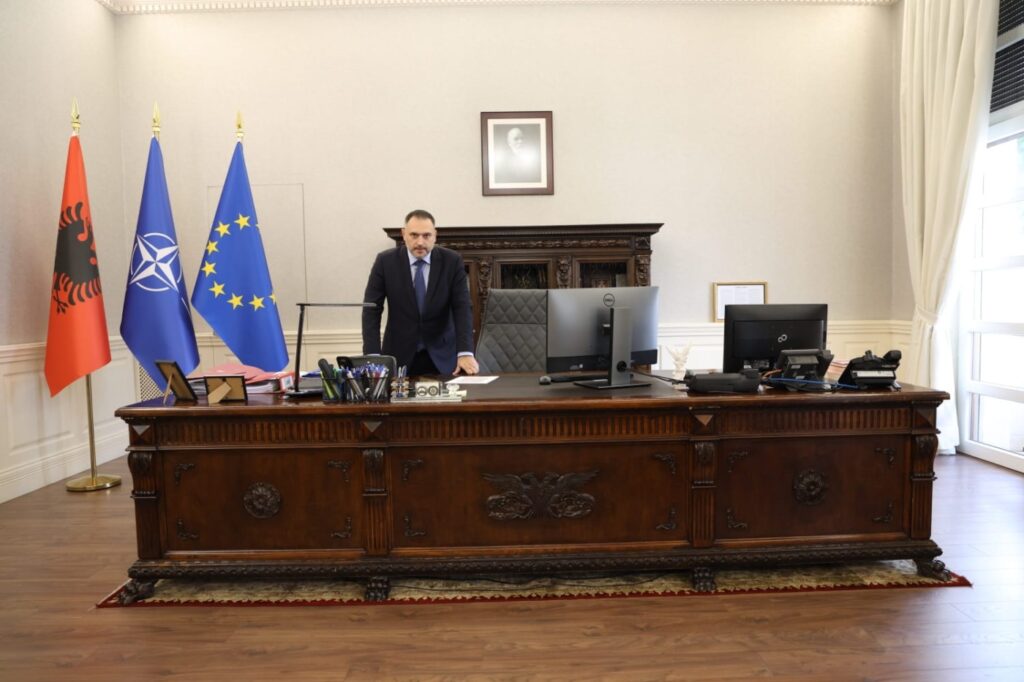
In a corridor of the Ministry of Defence, among objects that had long since lost their value in the eyes of those who decided their fate, stood a large desk of dark wood. Carved legs, hand-worked ornaments and a double-headed eagle on the front. A piece of furniture that, even without knowing its history, you understood had not been made for an ordinary office.
It had been left there to be thrown away.
Ermal Nufi, the Minister of Defence, saw it by chance. The workmanship, the material and the size caught his attention. He asked about it.
Albania’s defence ministers had once worked at it. The last to use it was Beqir Balluku. After his arrest and execution, the desk was removed from the office. For decades it sat in other rooms of the Ministry, until it ended up in that corridor.
The reason for its removal, as the minister himself told me after I interviewed him, had been superstition. The ministers who came after Balluku did not want to sit at the desk of a man who had ended up in front of a firing squad.
It sounds like folklore, one of those stories that circulate in institutions and that people pass on with a smile. Until you ask who Beqir Balluku was.
He had been Minister of Defence for more than two decades. He was one of the most powerful men of the communist regime, part of the system he had helped build and of its machinery of violence. He was no innocent who had strayed by chance into the court of the dictatorship.
Balluku was respected in the army. His authority also rested on his relationship with the officers, on his experience and on his knowledge of the military structures.
In the early 1970s, leaders of the Albanian army took part in drafting a defence concept that gave more weight to manoeuvre and mobility than to rigid reliance on defensive positions. It was an attempt to bring professional thinking into a doctrine determined, above all, by the political will of Enver Hoxha.
The documents entered history as the Black Theses (Tezat e Zeza).
I believe part of the explanation for Balluku’s fate has to be sought here.
An army that modernises raises the prestige of the man who leads it. And prestige born of the respect of military men is a kind of authority a dictator cannot fully control. You can appoint a minister, you can dismiss him, but you cannot dictate whom people respect.
For Enver Hoxha, such a minister could become a threat even without having any plan to overthrow him.
In the summer of 1974 Balluku came under political attack. In December he was arrested. On 5 November 1975 he was executed together with Petrit Dume and Hito Çako, accused of a military plot for which no convincing evidence has been presented.
Then it was their memory’s turn.
Dictatorships have a particular relationship with memory. Once they have removed the man, they want to remove him from history too, from the photographs, from the walls, from conversations. And sometimes even from the objects he used.
Balluku’s desk was left without an owner.
Removing it did not change the fate of the men who inherited the post.
Mehmet Shehu, who took over the Ministry of Defence after Balluku, was found dead in December 1981 and declared an enemy of the party. Kadri Hazbiu, who succeeded Shehu at that ministry, was arrested and shot in September 1983.
Two more men of extraordinary power, swallowed by the same system they had served.
Fate was not hidden in the wood.
Enver Hoxha died. The dictatorship fell. Albania became a pluralist republic, changed its alliances and joined NATO. Other people sat in the office of the Minister of Defence, from different parties and different generations.
The desk stayed outside.
We do not know whether each of them knew the story, or how many truly believed in its curse. But a decision born in the dictatorship’s atmosphere of fear had survived without any further need for the dictator.
This is how fear is inherited, in silence. It stops asking for explanations and turns into habit. People keep doing something because that is how they found it, until one day nobody remembers why.
When he heard the story of the desk, Ermal Nufi stopped it from being thrown away. He asked only that it be cleaned, with no restoration that would erase the marks of time, and returned to the minister’s office.
Along with the office, a minister inherits the history of the institution, with the achievements, the mistakes, the injustices and the crimes committed in its name. He has no obligation to defend his predecessors. He has an obligation not to erase them from history.
Beqir Balluku still carries the responsibility he bore as part of the regime. The returned desk says only that he was there, and that his end has ceased to be a reason to hide him.
Today the desk is back in the office of the Minister of Defence.
On it are computers, telephones, documents and the ordinary objects of a working day. To one side stand the Albanian flag, the NATO flag and the flag of the European Union.
On its front is the same double-headed eagle it had when Beqir Balluku worked at it.