By Ilir Demalia (Tirana)
“Anarchy is more dangerous than absolute monarchy,” we were taught by Thomas Hobbes, who was against the Monarchy. In the civil war between Parliament and the royalists, 1642 to 1651, the country fell into the state of nature and nobody knew who was who.
Political freedom and the right to protest are not a right to impose the will of a minority on the majority of citizens. When the state does not guarantee order, security and the functioning of institutions, it cannot claim to be exercising its constitutional authority.
The Constitution of Albania, in Article 47, guarantees the right to peaceful and unarmed assembly. This right is inalienable and cannot be restricted for political reasons. But the Constitution gives no one the right to replace the law with the force of the crowd, nor to use protest as an instrument for taking in the street what has not been won through institutions and democratic processes.
Protest is a right of the citizen, not an alternative power over the state.
In a parliamentary republic, governments are changed through elections and constitutional mechanisms, not through attacks on institutions, the burning of public property or attempts to paralyse the life of the city. The opposition has the right and the duty to oppose the government, to demand its departure and to organise protests. But it has no right to rule over the law, to take public space hostage or to create a parallel authority in the street.
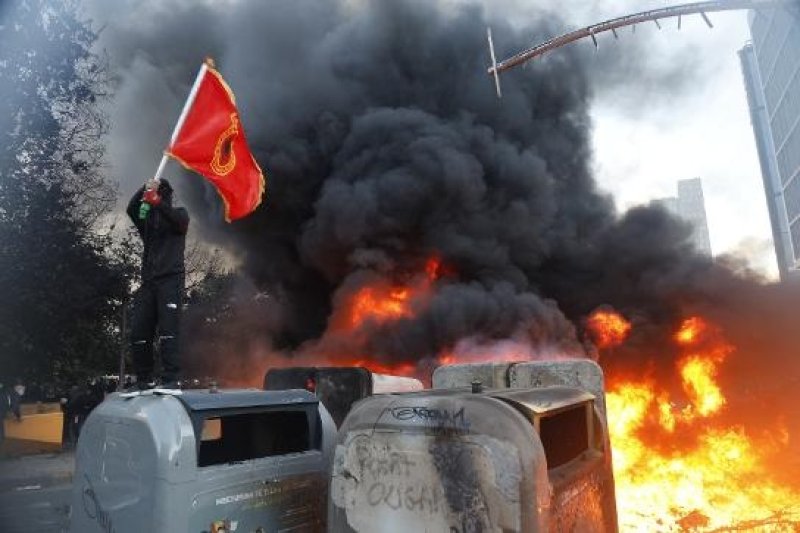
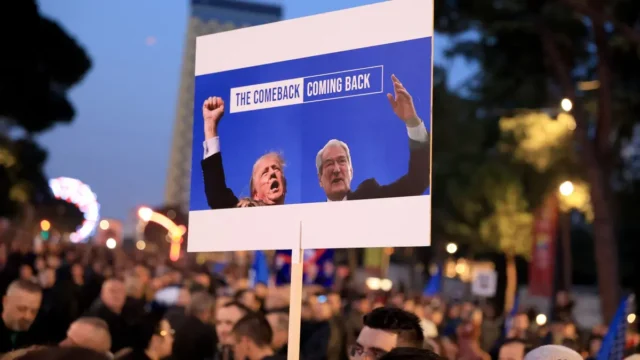
The state cannot stand by as a spectator in the face of violence. It cannot withdraw from its duty to protect institutions, citizens and public property merely because the violations are committed under the national flag, or the flags of Kosovo and the KLA. Why these last are brought along, together with the white felt caps, to the protest of the flamingos I do not know; the flamingos themselves migrated and went far away from the stones of the boulevard, the Molotovs of the “shqup” and the hoodies of the provinces, which burned and smashed Tirana with a barbarian’s hatred of civility.
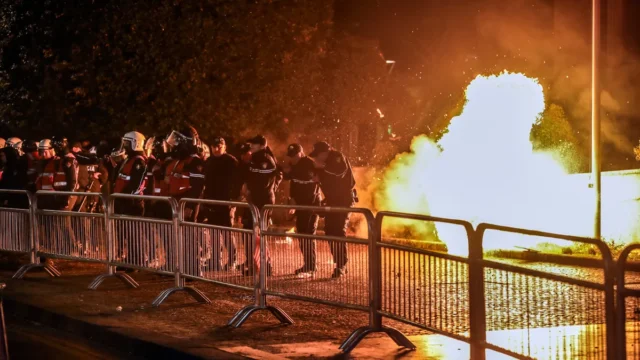
Throwing stones at the police, attacks on institutions, arson and the destruction of property are not political acts. They are actions that must be investigated and receive the corresponding legal response.
There can be no political tolerance for breaking the law, and no selectivity in applying it. Those who commit acts of violence must bear individual responsibility, regardless of their political convictions or their position in a protest.
But the authority of the state also has limits: the police must act on the basis of the law, with proportionality and without harming peaceful protesters. The strength of the state is measured not by the violence it exercises but by its ability to guarantee the law and the security of all.
A major problem of Albanian politics is the tendency to treat destabilisation as an instrument of political competition. When lost electoral trust is made up for with pressure in the street, when political language feeds confrontation and when violence is justified as civic revolt, then the very meaning of democratic institutions is called into question.
The media should be a fourth estate, not the power of owners who sit in the antechambers of prime ministers, and of journalists acting as their owners’ shakedown men, who now shriek from the protest podiums, then play the reporter on the same spot, and in the evening play the analyst on the television panels. Where does this happen in the democratic world with a free media? The media has not only failed to rise to its task; on the contrary, it has manipulated and disinformed in favour of the monstrosity in the street.
It must distinguish protest from vandalism, criticism from incitement and information from propaganda. The normalisation of violence as political spectacle does not serve democracy; it weakens trust in institutions and in society itself.
Albania is a society that has emerged from dictatorship and has not yet built a culture of statehood, civic responsibility and respect for institutions. We cannot build democracy by treating the state as an enemy and every institution as an object to be attacked. Criticism of the government is legitimate; the destruction of the constitutional authority of the state is not a political alternative.
The state is not the property of the government, but neither is the street the property of the opposition. The state is the constitutional organisation of all citizens, and the law must be above everyone.
Democracy needs opposition, protest, debate and political change. But it also needs a state that is not intimidated, is not paralysed and does not negotiate the application of the law with anyone.
Because when the state retreats before violence, democracy does not win. Arbitrary force wins. And when force takes the place of law, all citizens lose.