The Delegation asked the Albanian state for investigation, transparency and accountability at 12:55 on Wednesday. Two days later it has not applied one of them to itself.
by Ardit Rada (Tirana)
On Tuesday night Tirana burned. By 12:55 on Wednesday the EU Delegation had its text ready: it deplored the violence, asked for a full and transparent investigation, and reminded the Albanian state that those responsible must be held to account. It reissued the text as an official statement at 14:00. Within fifteen hours of the first molotov, the Union had told Albania what accountability looks like.
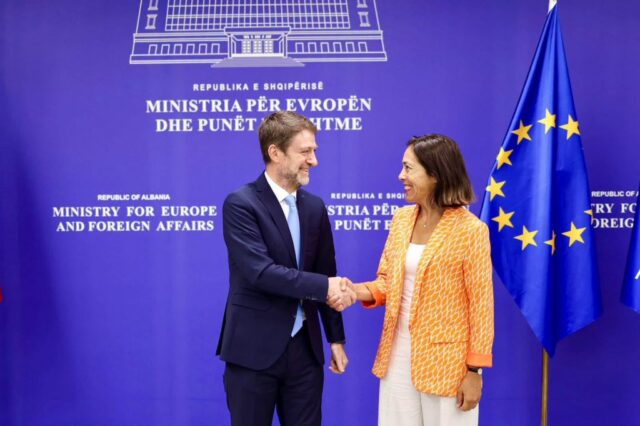
Two minutes before that reissue, at 13:58, Jorida Tabaku published four photographs of herself alone with the ambassador, under two flags, with a text that placed Sofia Moreira de Sousa on her way from the arrested protesters to “a meeting”, singular, carrying a clear message, and four paragraphs of Tabaku’s programme written so that the reader hears them in the ambassador’s voice. By evening it was on every portal as Europe taking a side.
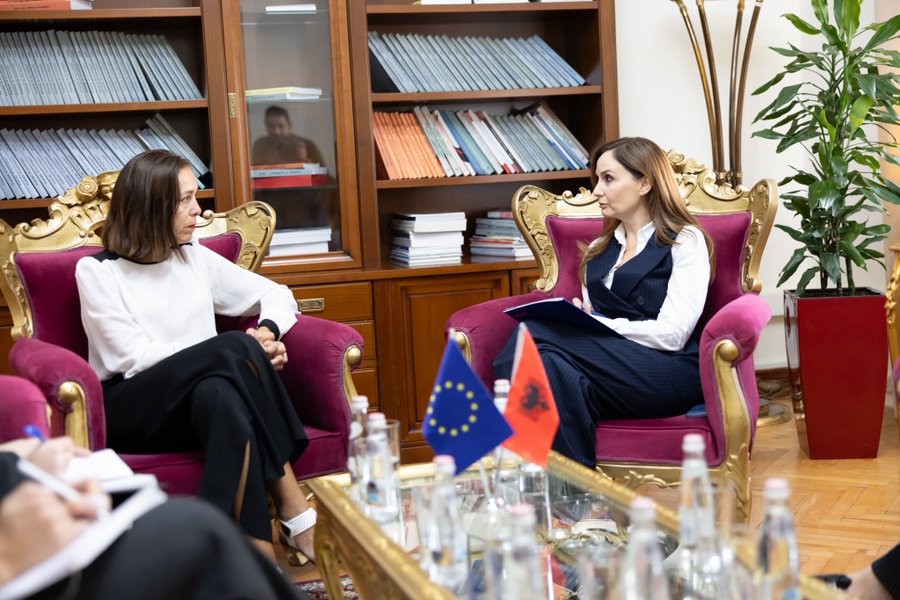
The true version was also published that day. At 18:52 the committee chair, Iris Luarasi, posted the room as it was: the committee receiving the ambassador, the media law on the table, and in the wide photograph, seated beside the ambassador in the same pinstripe waistcoat, Jorida Tabaku. One visit, one committee, two deputies. One cropped the room to herself. The correction stood in public from 18:52 on Wednesday. Tabaku found time to edit her post at 14:47. The Delegation has not found time to correct it.
This publication went after the ambassador for that, and for nothing else. Not for sitting with the opposition, which is her job. For letting her office become the backdrop to a partisan text, and then, with the correction in hand, saying nothing while her face carried a false message through a city on fire.
The Staff Regulations that govern her post ask two things of every EU official: to act impartially, and to avoid any action that could call that impartiality into question or reflect on the office. Four photographs of the Union’s representative alone with one party’s deputy, under the Union’s flag, carrying that party’s text as a message from Europe, published on the day the Union was lecturing the state on accountability, and left uncorrected for two days: that is the appearance the regulations speak of, whatever she intended. The Delegation’s silence turned it from a misfortune into a position.
The Delegation asked the state for three things at 12:55. It owed itself the same three.
Full investigation. By Wednesday evening the Delegation knew what its ambassador’s afternoon had actually been; one sentence would have closed the matter that night.
Transparency. The Commission’s annual reports grade Albania on strategic communication and on how its institutions handle information manipulation. Brussels pays for a service whose single lesson to governments is that a false frame left standing becomes the fact, and that the remedy is a prompt public denial from the institution concerned. On Thursday the Delegation issued a second statement. It addressed the protesters. It said nothing about the meeting, the photographs or the frame.
Accountability. The Commission’s code of administrative conduct tells every official who discovers an error affecting the public to correct it. Chapter 23 of Albania’s talks is, in large part, Europe teaching Albania that an institution answers for what is said in its name. For two days the Union’s name was used in Tirana to license a street fight, and the Union’s representative decided that nothing needed to be said. In the Union’s own administrative vocabulary a known error left uncorrected is maladministration, and maladministration has an address.
That address is not one woman. Sofia Moreira de Sousa presented her credentials six weeks ago. She did not write the 12:55 text alone, she did not choose alone which meetings her calendar carried on 14 October, and she did not decide alone, on Wednesday night, Thursday and Friday, that the correction sitting on a committee chair’s Facebook page was none of the Delegation’s business. Those are the decisions of a building: a political section, a press office, local advisers who have served three or four ambassadors and explain Tirana to each new one. This publication warned her, the week she arrived, that capture begins inside the Delegation’s own walls, with inherited staff and inherited explanations. Wednesday afternoon is what that looks like in practice. A head of mission six weeks in office is handed a statement that addresses only the state, a schedule that puts her in the opposition’s photograph, and a silence that nobody in the building thinks needs breaking.
So the demand is not that the ambassador apologise. It is that the Delegation be looked at, all of it, by the people whose job that is. The External Action Service inspects its delegations. Let it inspect this one, now, and let the inspection answer the questions a Tirana reader can already pose from the public record. Who drafted the text of 12:55 and who cleared it. Who arranged the ambassador’s 14 October and in what capacity she was told she was meeting Jorida Tabaku. Who in the Delegation saw Tabaku’s post, and when. Who saw Luarasi’s, and when. Who decided, and on whose advice, that no correction would be issued on Wednesday, Thursday or Friday. Whether anyone in the building had contact with the opposition about the meeting, the photographs or the text before or after publication. And whether the political section’s reporting to Brussels from 13 to 16 October described the violence, the looting and the rumour campaign as this publication and every camera in the city recorded them, or as the Delegation’s two statements suggest it saw them.
Those questions go to the Secretary-General of the EEAS, to the High Representative, and to the Commissioner for Enlargement, under whose authority the Delegation speaks. They are the questions the Union would put to an Albanian ministry that had done the same, and it would expect answers in writing, within a deadline, published.
A head of mission who knows the record is false and keeps quiet has chosen the version she can live with, or the building has chosen it for her. Either way, the standard asked of Albania at 12:55 did not stop applying to the Union at 18:52.
Europe tells Albania that credibility is built by owning mistakes quickly. The Delegation set the clock itself on Wednesday afternoon. It has been running since.