In a week of talking, Veliaj’s lawyer attacked the signature on the Nesti Angoni submission and never its content. Read as a prosecutor reads it, that leaves the file standing. The court letter that followed asks a judge to investigate a threat the defence has not called empty. SPAK has reason to look at both.
By Renada Bici, Legal Desk
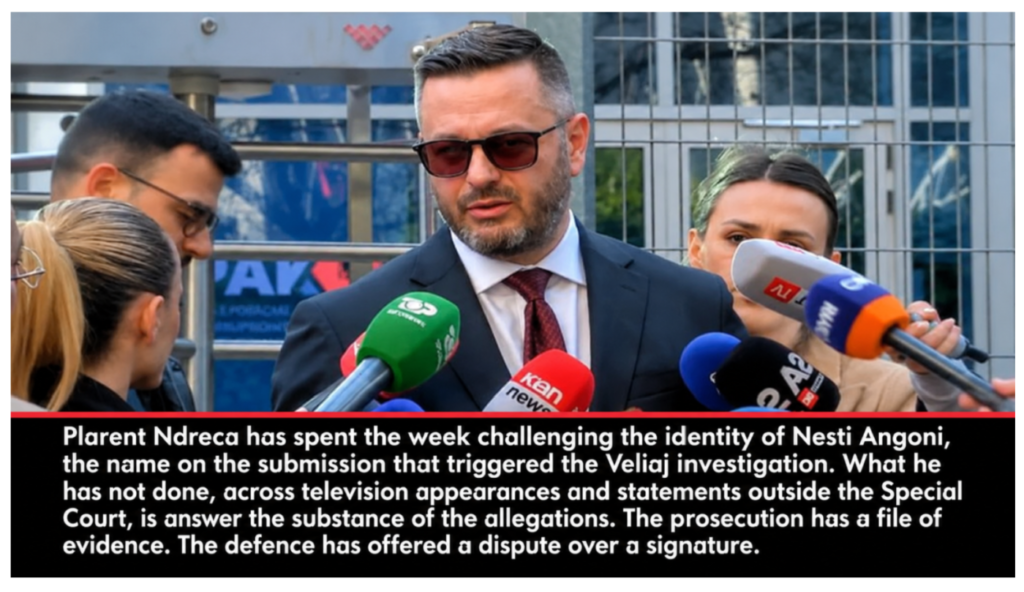
A prosecutor does not read the week the way a television studio reads it. He reads it for what it adds to the file, what it takes away, and what it obliges him to do. On that reading the most important thing Plarent Ndreca did this week is the thing nobody noticed. On the Opinion programme on Monday night, in the letter he carried to the Special Court on Tuesday, in his statement to reporters outside the court and on the Zonë e Lirë programme that evening, Veliaj’s lawyer contested who wrote the Nesti Angoni submission, and not one fact the submission alleged.
The signature, not the sentence
Proceeding no. 27/2024 began with a report deposited at SPAK in July 2023, signed “Nesti Angoni”, alleging financial relationships between the mayor, his wife and construction companies that had business with the municipality. SPAK confirmed in December 2024 that the signatory is not in the civil registry. From that fact Tirana has reasoned backwards to an author, Sali Berisha since February 2025 and Veliaj’s own lawyer since Monday: the Prime Minister wrote it.
A prosecutor’s answer is in his own file. Article 280 of the Code of Criminal Procedure lets him take knowledge of an offence from any notification; it does not ask him to vet the notifier’s biography, it asks the judicial police to verify the content. SPAK’s statement of 27 December 2024 records that sequence: the investigators of the National Bureau of Investigation, “after verifying the data and administering documentary evidence” (“pas verifikimit të të dhënave dhe administrimit të provave dokumentare”), referred the matter on 8 February 2024, and the proceeding was registered on their referral. The unsigned letter is not the basis of the case. The signed referral is.
The defence has already put the denouncer to the courts. In 2025 it asked the Special Court to declare SPAK’s investigative acts invalid, arguing among other grounds that the report came from an anonymous person whose identity had never been verified. The Special Court rejected the motion on 1 September 2025, the Special Appeal Court upheld the rejection on 20 October, and the Supreme Court declined to hear a further appeal in February 2026. A preliminary hearing judge then sent thirty defendants to trial on 9 February 2026; the Supreme Court kept the detention in May; the Constitutional Court declined the complaint against it in July. The defence’s own count of the file is 60,000 pages, 1,078 exhibits and 190 witnesses.
Who wrote “Nesti Angoni” is a question for the forgery complaint Veliaj has filed, which the Supreme Court has sent to the Tirana court, and for nobody else. For the author of the letter to matter at this trial, the verification that followed the letter would have to be compromised: the judicial police, the prosecutors, the preliminary judge and three reviewing courts. Interference elsewhere, in a prison transfer, in a ministerial visit, is a different allegation with a different forum, and it does not touch an exhibit. The defence has argued political motive before each of those instances and lost each time; in Strasbourg terms that is an Article 18 claim, and the Grand Chamber in Merabishvili v Georgia put the burden on the applicant to show that an ulterior purpose predominated. A prosecutor is content to see the argument made again, on television, because it does not touch a single exhibit.
What he needs from the defence is an answer to what the letter said and the judicial police confirmed: were the nine permits issued to the companies named in the indictment, did public money reach the organisations named in it, were the organisations the wife’s. The last time the defence addressed any of that was February 2025, when Veliaj called the payments “sponsorship of cultural activities for Tirana”. It has not returned to the subject. It has litigated the glass cage, the USB stick, the live broadcast, the detention regime and the denouncer. This week, with the largest audience it has had in twenty-one months, it chose the denouncer again.
Silence in a studio is not an admission in law, and a prosecutor does not need one. He needs the facts unanswered when he stands up to close, and after this week they are. An authorship defence leaves the content where the indictment put it: alleged, and unanswered. That is the week’s largest fact, and the lawyer produced it himself.
The prosecutor also notes the contradiction in the defence’s posture. When the Constitutional Court restored Veliaj as mayor on 3 November 2025, his international counsel called it a victory for the rule of law. Rama said that day that the news ought to be “that I haven’t captured the Constitutional Court”. The defence now needs the same court, in the same case, to be read as part of a system working for the Prime Minister. A court cannot be independent when it rules for the client and captured when it rules against him. The prosecutor keeps that sentence.
What the defence filed on Tuesday
The second thing the defence produced this week is a document, drafted by counsel for a judge and read into the record at the defendant’s request. In Fier, it says, the Minister of Justice told Veliaj that “prosecutors were getting ready to add other charges, the gravest being undermining the constitutional order for backing, organising and financing the Flamingo and student protests” (“prokurorët po bëheshin gati të më shtojnë akuza të tjera, ku më e rënda do qe ajo e prishjes së rendit kushtetues”). The letter asks the court for “a full investigation”. The court answered that it is for the competent bodies to verify his claims. For charges, the competent body is SPAK.
A prosecutor separates what this document does.
First, it notifies him, in a form that satisfies Article 280, of statements that may describe an offence, and the Minister’s denial means there are three readings, not two. If Toni Gogu knew what prosecutors were preparing, someone breached the secrecy of the investigation and the executive has been inside the file. If Gogu knew nothing and used SPAK’s name to frighten a prisoner, a Minister of Justice invented a prosecution for leverage. If Gogu is telling the truth and said no such thing, then Veliaj invented the threat and had his lawyer carry the invention to a court; a false accusation against a public official made to a judge can itself be an offence, if its elements are met, and that is for the prosecutor to assess. All three readings are matters for him, not for a talk show, and the defence has put them on paper.
The third reading is the one the defence should have feared most, because an invented threat tells a prosecutor what the man who invented it is afraid of. Whoever composed the line chose “undermining the constitutional order for backing, organising and financing the protests”. It proves no role in the protests. It tells the prosecutor which charge the defendant chose to put in the Minister’s mouth, and why that charge rather than another is a question he is entitled to ask.
Second, in all three readings the document does something the defence did not think through. It tells the court that the executive claims grounds exist for a further charge, and it does not tell the court that there are none. A lawyer who believed the threat was empty would have written one line: there is nothing to charge, let them try. Ndreca asked a court to investigate the threat instead. That does not establish that any such charge has a foundation; a threat proves nothing about the thing threatened. It establishes that the defence treats the possibility as real enough to demand an investigation rather than to laugh it off, and a prosecutor reads that choice for what it is. Veliaj denies financing anything, and he is presumed innocent. The record now also holds his own description, to a judge, of the case he fears.
The prosecutor reads the two versions side by side. The note Veliaj published on Monday has “100 years in 313 and 302”, two Tirana prisons. The letter read to the court on Tuesday has no figure. Why it disappeared is not known; what is known is that the figure offered to a Facebook audience was not offered to a judge, and that the Criminal Code’s ceiling on a fixed term of imprisonment is thirty-five years. Two versions of one conversation, from one side, inside twenty-four hours. The prosecutor marks the difference as material for cross-examination and moves on.
What a prosecutor must now do
SPAK is under no obligation to announce what it contemplates. It is under an obligation to assess what has been placed before it, and what has been placed before it is this: a defendant has told a court that a minister described the prosecution’s intentions to him; the minister denies it; the two accounts cannot both be true, and whichever is false raises matters a prosecutor is bound to assess, concerning either a minister’s conduct or a defendant’s statement to a court, and both versions concern the prosecution’s own integrity. SPAK chose, in December 2024, to explain publicly how this file began. This publication asks it to make the same choice now: has anyone outside the prosecution been told what it intends in no. 27/2024, and does any proceeding, registered or contemplated, concern the financing of the Tirana protests.
The prosecutor should also expect the complaint Ndreca says he is weighing, and he should welcome it. A blackmail complaint against the Minister makes Veliaj the complainant and the principal witness. He will have to give, under the rules of the Code and not on a Facebook page, a full account of the Fier conversation: who said what, in what order, what was asked, what was answered. Every line of it is evidence in the trial already running. A lawyer does not usually volunteer his client as the star witness in a proceeding whose founding premise is that the prosecution has more.
The lawyer’s own record
None of this is a question of tone. Ndreca is a former Socialist MP who calls himself Veliaj’s “political adviser”, told Fevziu he has been in politics to defend the Socialist Party and remains its representative, and said on Tuesday that the case “is no longer legal, it is political” (“nuk është më juridike por është politike”). He endorsed the portal Hashtag.al’s text of the meeting, with its few minutes and its unlogged entry, then gave ninety minutes in the director’s office on air. He says there are witnesses to Rama asking Veliaj to hand the municipality to Arbër Hajdari, and names none. He says he holds communications with the Prime Minister that support the note, and produces none. Asked whether the conversation was recorded: “I don’t have that proof yet, he maybe” (“Nuk e kam ende atë provë, ai mbase”). He and his co-counsel have been fined for boycotting hearings, and the court has had to assign his client a lawyer of its own. A prosecutor reads all of it as a lawyer announcing that he will not contest the facts, and prepares accordingly.
The reading and the record
Tirana will keep its reading: the Prime Minister wrote the denouncer, the prosecution followed, the courts obeyed, and a second denouncer is being written now. Both ends of Albanian politics believe it, and belief shared by enemies passes for proof in this city.
The record says something smaller and harder. An unsigned letter was verified by judicial police, referred under their names, built into a file by prosecutors and sent to trial by a judge; the defence’s challenge to the investigation on the ground of the author’s anonymity was rejected by three courts; and in a week of unlimited airtime the defence did not dispute one thing the letter said. It then told the Special Court, in writing, that the state claims grounds for more, and did not say there are none. This publication puts the questions where the Code puts them. To SPAK: who, if anyone, has been told what you intend. To the Minister of Justice: what did you say in Fier about what prosecutors were preparing, and on what basis. To Plarent Ndreca: is the content of the Angoni submission true or false; and if the threat was empty, say so to the court.
A defence that argues the signature and not the sentence has done the prosecution’s work for it. That is the week, read by a prosecutor.
Renada Bici is a Tirana-based lawyer practicing in civil, criminal, and administrative law. She holds a law degree from the University of Tirana and has experience in both private legal practice and public administration. She writes for the Tirana Examiner Legal Desk.