By Mero Baze (Tirana)
Two big lies are being spread about the protests in Tirana, which have by now degenerated. The first is that the protests were peaceful at the start. The second is that the physical violence of the autumn, provoked in mid-October, was the result of peaceful protests being ignored.
The first lie is the more dangerous one, because it tries to mask the philosophy of violence on which the protest was built by its originators, its ideologues and its public supporters.
The highest level of violence against Albanian society came in the protests of June and July, until that very violence shrank and debased them.
The violence of a protest is not only smashed windows or burned banks and mobile phone shops.
The violence a protest inflicts on society is the attempt to impose itself through the public lynching of those who oppose it, through discrediting them, through campaigns to destroy the businesses and professional reputations of public figures, and through lists in the style of fletërrufe [the public denunciation posters of the communist era], which were stuck on the trees of Tirana against artists, journalists and public figures who did not join the protest.
This kind of fascism was led by specific names. At their head, without doubt, was Fatos Lubonja, together with Gjergj Erebara, Andi Bushati, Ermal Hasimja and an assortment of failures sidelined by society, who thought they were now imposing themselves on it in the name of the people. Most of them were tasting this adrenaline for the first time. Lubonja was tasting it for the second, since he did the same thing in 1997 [the year of Albania’s armed unrest after the collapse of the pyramid schemes].
Just as after 1997, he is now trying to wash his hands of responsibility for what he has done, by pinning it on the so-called “fascism” inside the protest.
But what is the fascism of the protest, and how do the statements of its leaders and supporters illustrate it?
The first fascist trait of the protest was that the government and Prime Minister Edi Rama were not targeted as rivals or political opponents, but as enemies of the nation. That is exactly what fascism does: it aims to eliminate the opponent, not to defeat him through elections or other democratic and legitimate means.
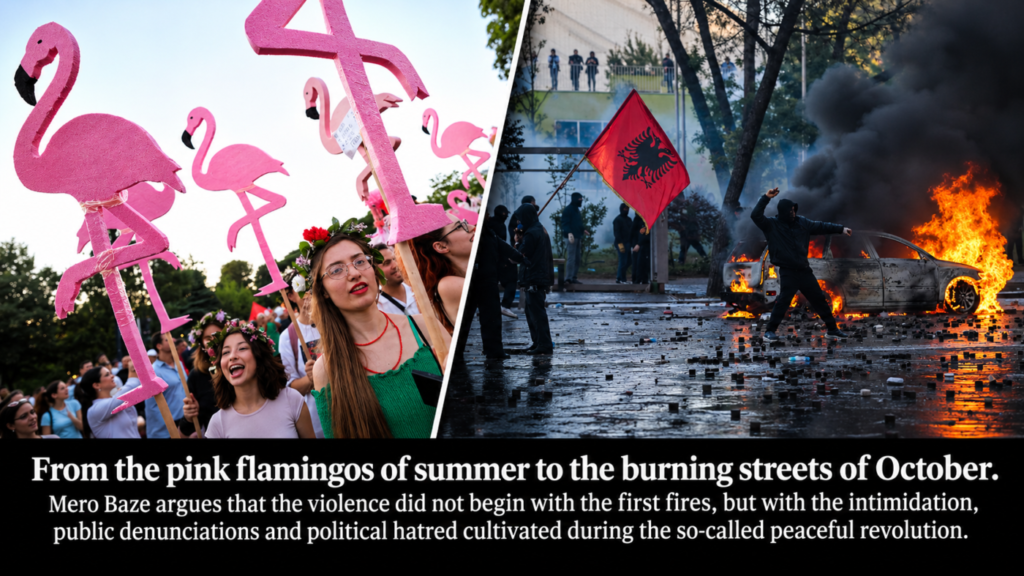
Edi Rama was labelled a “çifut” [a derogatory Albanian word for Jew] (my apologies to Jews for using this term) and was presented as the man selling Albania to Trump and the Jews in order to wipe the country out. Fatos Lubonja listened to these vile chants with a smile, holding a pink flamingo in his hand, pleased that his day had finally come to put people before the firing squad too.
The second element of fascism in the protests was that public violence, the language of social media and public lynching during the June and July protests were treated by their leaders as acceptable instruments for imposing political will, frightening opponents and destroying the existing order.
Dozens of fletërrufe were posted against journalists, while their portraits were waved at the protests by people paid by the organisers. Frightened journalists have asked me to take down even news reports about their mistreatment at the protests, because they felt in danger. Dozens of artists saw their photographs nailed to the trees of the boulevard, presented as enemies to be boycotted and isolated only because they had not come to the protest. You will not find a single statement by Gjergj Erebara, Andi Bushati or Ermal Hasimja that expressly distances itself from the public lynching of journalists and other figures who did not join the protest.
A horde of women in headscarves and of children indoctrinated in the mosques of Skopje, together with Albin Kurti’s militants, flooded the protest stage in Tirana. It was a kind of jihad led by ideologues of political Islam such as Abdilaqim Mehmeti, who, after profiting from Soros in Macedonia for 20 years, now discovered that Edi Rama was selling the homeland to the “jahudi” [the Islamic-register word for Jews] and that Abdilaqim had to come and save it. He strolled along the boulevard with Fatos Lubonja to show off the power of political Islam as the new fascism.
Just as fascism systematically uses propaganda, historical myths, collective emotions and the demonisation of opponents to mobilise the masses, the protest’s headquarters used the song from a film about the Vlora War [the 1920 war that drove Italian forces out of Vlora] to show that Edi Rama was selling Albania. But they did not even know how to sing it.
In the song, the fighters wish that, if they go, they may not come back, for they will live on because freedom lives. The protesters sang it as a wish that they should come back.
So they wanted to be heroes, but also to stay alive after the war and savour their own history. The heroes of the Vlora War never saw the memorials raised to them. These flamingo people want the memorials, and want to be there to look at them.
The slogan “Albania of the Albanians” was taken from Balli Kombëtar [the anti-communist nationalist movement of the Second World War]. It has been lifted out of context, since Balli Kombëtar used it against the communists, whom it accused of having Mugoša and Popović [the Yugoslav communist emissaries] as their masters. Beyond that, it is today the most anti-Albanian slogan possible. If our neighbours adopt it from our fascist flamingos, it turns against Albanians as a political force everywhere in the Balkans.
By this slogan, Abdilaqim Mehmeti is no longer a citizen of North Macedonia, because that country must belong only to Macedonians. Bosnia might take him, since he is half Bosniak, or Albania, since he is one quarter Albanian.
Just as fascism aims to subjugate the media, education, culture, business and the economy as a whole, the flamingos joined in July in one of the most anti-Albanian campaigns in recent history, calling for the tourism industry to be wrecked through negative reviews of Albanian hotels and lies about their standards.
At the head of this campaign stood Gjergj Erebara, Ermal Hasimja, Andi Bushati, Fatos Lubonja and other originators of the protest. They championed the campaign as a patriotic act, as the foot soldiers of fascism do.
Fatos Lubonja backed it in the WhatsApp groups of the “revolution”. Erebara publicly exulted at the attacks on Gjergj Luca [a hotel and restaurant owner]. Ermal Hasimja went off to the Swiss mountains as a tourist while supporting the destruction of tourism businesses in Albania. As for Andi Bushati, it is well known: without smoke and flames he cannot contain himself.
The fascism of the “peaceful revolution” was the bed in which October’s violence was sown and born.
The philosophy of the protests rested on frightening society, on aggression against those who refused to join, and on treating dissent as national treason. Besides being a typically fascist philosophy, it had another great fault: it was being put into practice by mediocre, failed and bad fascists.
Just as our communism was among the worst in the world because of the communist leaders we had, so too was the fascism of their descendants.
That is why fascism in the protests was not born in October and November. October and November were when the tree planted by the so-called “peaceful revolution” of spring and summer came up.
All the hatred, malice and mediocrity invested in those months was naturally going to erupt in its ugliest form, in this month’s violence, which burned Tirana, destroyed institutions and turned the protest into a sewer into which all the scum of Albanian society drained.
But neither Lubonja nor anyone else can wash their hands of the fascism they themselves sowed. They are simply failed fascists.
Three decades of Albanian political journalism run through Mero Baze. Voice of America and Radio Free Europe carried his work in the 1990s, before Tema, the paper he started in 1999 and still publishes and edits. His criticism of those in power has cost him government pressure, threats and physical attacks, and through changes of government his column has remained one of the most closely read in the country. Several non-fiction books carry his name.