Albania’s Defence Minister on an industry that has not started, a recording that proves nothing, a court case, a summit, Kosovo, Turkey and the war already under way in Europe
Tirana Examiner Newsroom
Albania does not produce a single cartridge today, its Defence Minister says, and the last weapon made in the country left the line in 1999 or 2002. The arms-trafficking charges circulating in Parliament and on the talk shows, Ermal Nufi says, describe an industry that has not yet started.
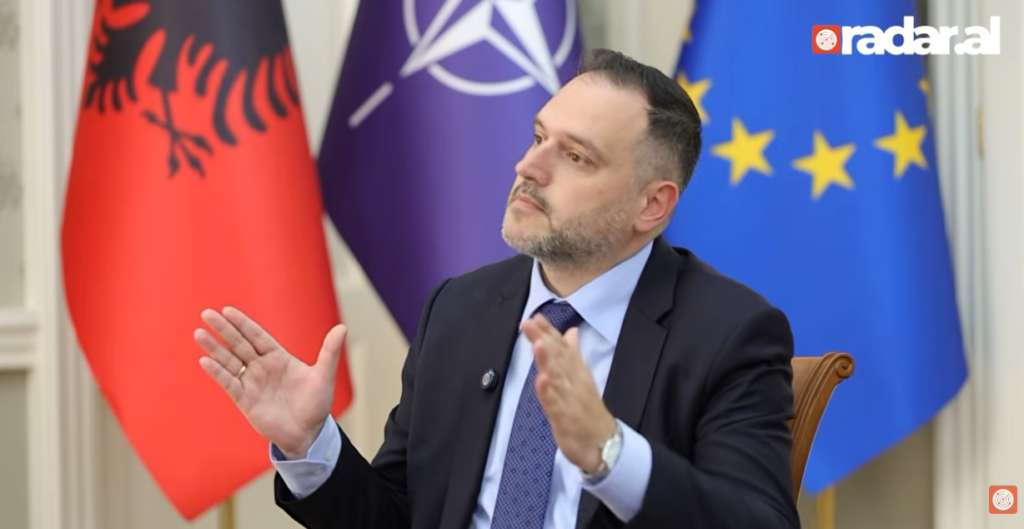
Nufi was speaking in the first edition of Hard Talk podcast on the Radar.al media platform, hosted by Albatros Rexhaj, main political commentator of this publication, and aired on Sunday at noon. Over an hour he answered on the alleged trafficking scandal, on the Yeffet recording, on the opposition’s challenge to the defence agreement with Washington, on the purchases for the NATO summit, on Kosovo, on Turkey, and on whether Albania is ready for a wider war in Europe.
An industry that has not started
Asked whether Albania makes anything at all, a cartridge, a rocket, Nufi answered without hedging: “Today we do not currently produce cartridges.” Nor pistols, nor automatic rifles. The last weapon was produced “either in 1999 or in 2002”, in Poliçan and Gramsh. What exists now is assembly of fortified vehicles and the legal and industrial groundwork laid since the new defence-industry laws entered into force: six commercial cooperations through the state company KAYO, and ammunition production lines ordered in 2025 that have not yet begun work.
If nothing is produced, Rexhaj asked, what is being trafficked? “The biggest trafficking taking place in Albania today is the trafficking of words,” Nufi said. Half a sentence is taken and a fable built on it.
The example was his own statement to Parliament on 24 April, in which he said that one of the ministry’s commercial partners would produce weapons under current patents, “combat proven” in the field, rather than old patents out of the game. The term is standard in the trade: a weapon that someone has used in a war, corrected after what failed, so that when an Albanian soldier picks it up, or Albania hands it to Kosovo facing Serbia, it does not fail. That phrase, Nufi said, was pulled out of context to lend credibility to an audio recording. Anyone who understands how a weapon is made, imported and exported “understands that for Albania to traffic arms is impossible”.
Production, he said, is not the only problem. Patents belong to others and must be bought from a French, German, Turkish or American maker, and everything must meet NATO standards, “the cornerstone” without which no production makes sense. Raw materials are the larger obstacle: most must be imported, and every country in Europe has the same shortage. No state produces “from A to Z”; the Italian-French SAMP/T and the Italian-Turkish Bayraktar programme are co-productions. The claim that Albania made something which then ended up in Africa rests on a production that does not exist.
Asked why the campaign started before the first line runs, Nufi described a method. There is a circle, he said, whose modus operandi is to throw mud on a thing before it begins. Two options are open, a foreign hand or possibly a domestic one, and the aim is the same: that the Republic of Albania and its Defence Ministry never acquire their own capacity and remain dependent on purchase, so that at a given moment, as Covid showed, a border closes and nothing arrives. Depots across the Alliance have been emptied into Ukraine. What the eastern bloc replaces in three or four months takes NATO procedures eighteen to twenty months. In a conflict, “it is fatal”.
“Matters of national security are not matters of one governing party,” he said, and all red lines have been broken. He invited parliamentary control by the opposition, by anyone holding a security clearance, a commission, the Special Prosecution, an indictment. What he rejected is the other thing: “these are fairy tales, fantasies, with malicious aims not only against the government but against the Republic, against the good name of this country”.
Rexhaj asked how the charge plays at the NATO table, where a stain on a biography ends a conversation. Nufi said his counterparts have information enough, including about states that could be accused of trafficking, and know Albania does not do it. “I sit at those tables with my head held high.”
Signature and stamp
The recording at the centre of the accusations got no credibility from him at all. Rexhaj put the question plainly: Roni Yeffet’s business interests are his own affair, and people at a table say what they like; did he hold any official mandate to speak for the state? “First, nobody has authorisation to speak in the name of the Ministry of Defence except those who are legal institutions and hold the legal and constitutional powers to speak for a state institution,” Nufi said. Anyone else speaks for himself, not for the Government, and the Government, the Ministry and its officials speak only through the written act.
A position is official from the moment it carries a signature and a stamp. “That is the document that has value, that is the position that has value, that is the document that brings consequences.” Conversations up and down the table may be worth something or nothing; what counts is the conclusion. The Yeffet recording, by that test, is worth nothing.
Rexhaj placed the question inside a national habit. Stories of hidden hands, world control, the Masons, circulate everywhere, he said, but Albanians have a special passion for them, and Yeffet sits at the centre of the one now running. Nufi did not take the bait on the man. People sit at a table and talk, he said; some say they have spoken to Trump and to Putin and told each of them what to do, sometimes to impress, sometimes to deceive, and businessmen have made a way of life of it. What he will answer for is the ministry’s paper.
The nickname that came out of the recording, “Ermal Raketa”, Ermal the Rocket, he received with evident pleasure. It says something true about his character, he said: he is impatient by nature and wants things done fast, and the habit of taking a job and baking it, and baking it again, strikes him as obstruction, a sign that people do not want to do the thing and have their reasons, usually the way deals have always been done. He wishes the state had a different rhythm.
It speaks about them
The Democratic Party’s challenge to the Albania–United States defence agreement at the Constitutional Court was “a political and strategic mistake, and a national one”, Nufi said. The agreement, as he described it, is the loan and forgiveness arrangement with Washington that allowed Albania to buy capabilities it has never had, of the latest generation, part of a series of national-security purchases now under way. The opposition took the ratified agreement to the Court.
Suppose the judges rule the agreement unconstitutional, Rexhaj asked. Does Albania return the money to the United States, hand back the equipment it has bought, tell NATO not to come?
Nufi said he has had no communication with the opposition on the matter. What he has said in public, and said again after learning of the filing, is this: “When it comes to defence, specifically national security, it is the one field that should have no political wings.” Defence in every country in the world is bipartisan. When the enemy comes, he does not ask which party you belong to.
The surprise, he said, was the party that did it. On the strategic alliance with the United States, Albania has never had a doubt as a state. The Democratic Party declares itself a party of the right, and a party of the right is first of all sovereignist and invests in defence; its doctrine is to split the bread, keep a little for yourself and send the rest to the army. That is how it works everywhere else. Whether a party that takes a defence agreement to court is still a party of the right, he left as a question. “The fact that they took it to the Constitutional Court speaks about them, not about us.”
He expects the Court to weigh the facts and circumstances, the reason and logic of the agreement, and the procedures the government followed in Parliament, which he described as black on white, leaving no ground for the challenge. Rexhaj then played devil’s advocate. Albania is a country of wiretaps and videos. What if a foreign power arrives at the judges’ doors with a file on each of them, and the Court rules the agreement void? Nufi did not dispute the premise. “Of course there is a plan B, but I will not say how it would happen.” He added that he is convinced it will not be needed.
Rexhaj had credited Sali Berisha with a historic merit nobody can take from him, Albania’s entry into NATO during his mandate, and called former Defence Minister Fatmir Mediu a patriot. The opposition, he said, knows how military procurement works. Nufi’s answer to why it now speaks as it does was the one he gave on the trafficking charges: all red lines have been broken, and national security has been made the subject of a party quarrel. On the agreement with Washington, the Democratic Party chose the side of the quarrel.
Only the army knows what the army has
Some of the defence purchases now under attack as an alleged trafficking scandal are the security preparations for the NATO summit Albania will host. Asked whether the purchases are part of the noise of the past weeks, Nufi answered: “A part are, the other part not.”
Rexhaj framed the question as a host-state obligation: when a country receives a NATO summit it must take security steps, which means buying what it does not have, to guarantee the safety of the people in the room, first of all the President of the United States. Nufi said the government is advancing on several fronts at once. The American agreement was one. Talks with other parties are under way to bring into the country the motorised equipment and systems a summit requires, and the Alliance itself organises part of the security around its summits.
What he would not do is list what has been bought. Military procurement, he said, is not public procurement, and the two laws are different: the military procurement law has been changed over the years to follow the relevant European Union directive and has always carried a separate regime of secrecy, because of the military information inside it. The same regime covers every technological system linked to national security. “Only the army knows what the army has,” he said, a rule Albanians once knew without being told.
He is not against transparency within the legal frame, before the bodies entitled to it. He is against the idea that information which must be a state secret should be public, because it makes no sense to tell the adversary what weapons Albania has, what frequencies it uses, what software defends its networks, what technology it fields against drones to put a shield over the territory. Rexhaj noted that in two decades of working beside the largest NATO mission ever deployed, KFOR in Kosovo, he had never heard the word transparency attached to military procurement; one does not buy air defence the way one buys bananas. Nufi agreed, and placed the demand inside the pattern he had already described: a Pandora’s box opened without consequences, in which anything may be said about national security, and “that freedom is a freedom that costs national security”.
On the Special Prosecution’s entry into the ministry, he has no objection to prosecutors coming to the Defence Ministry or any state body for control and investigation, on one condition, that the information they take is handled only by them. Rexhaj’s objection was that in Albania what prosecutors learn tends to reach the newspapers before the case is closed. Nufi’s answer was that in the ministry’s case it has not happened. The classified material was handed over through the legal channel to people holding the clearances to see it, and “has never come out”. He said he is confident the prosecutors understand the gravity of national-security information and will do their work.
No government in Tirana could stand
Rexhaj, a Kosovo Albanian, put the Kosovo question as it is lived in Pristina: Kosovo faces an existential risk, people there go to sleep and wake up with the idea of a surprise attack, Banjska in 2023 showed it is not a fairy tale, and Albanians in Tirana do not understand it. In practical terms, how committed is Albania?
“I believe one hundred per cent,” Nufi said. “I believe that not only this government, but no government in Tirana could stand if it did not give itself one hundred per cent to the defence of Kosovo.”
Rexhaj accepted the sentiment and pressed on the help. The sentiment was there in 1999 too; what Kosovo needs is not what Albania offered then, open doors and refugee camps. Nobody in Kosovo wants to be a refugee again. Is Albania ready to function with Kosovo as a single army?
Even if there were no Kosovo and no Albania, Nufi said, there would be Albanians. The exchange between the Republic of Kosovo and the Republic of Albania, between Albanians on both sides of the border, is now such that there is no longer any discussion about the relationship between the two, “regardless of who is in power”. On the attack Rexhaj described: “Whoever wants to try it, here we will be, and we will see the result.”
The two eras cannot be compared, he said. In 1999 Albania was poor and weak, and Kosovo’s reality was what it was. Today Kosovo is a republic with its own institutions and its own difficulties, recognised by most of the world and all but a handful of states in Europe, with the United States as its main partner and the main European states behind it. He does not believe anyone still doubts the integrity of Kosovo as a republic, as territory, as a state. The fears people carry there are real, he said, and so is the new reality in the Balkans.
Asked earlier whether Albania carries, beyond its NATO obligations, a particular obligation towards the United States for regional security and towards Kosovo, he had described the United States as the principal ally inside the Alliance and Albania’s commitment to it as absolute. Albania has just sent a helicopter to Kosovo, a step he placed in the NATO framework at a moment when American troops and assets in Europe may be reorganised towards other theatres.
As Albanians and Turks
Turkey came up the way it comes up in the comment sections. It is, after the United States, a great ally of both Kosovo and Albania; the whole senior military structure of the Albanian state was at the embassy’s Republic Day reception this week; the minister himself is a Catholic from Mirdita, and the houses Turkey built in Laç after the earthquake went mostly to Christian families. Is this Muslims with Muslims, or Albanians with Turkey?
“We have them as Albanians and Turks,” Nufi said. He is received in Ankara with maximum respect and receives the Turks here with the same. The relationship comes from time spent in a common state, one that damaged Kosovo and Albania and damaged Turkey too. It was the movement of Kemal Atatürk against his own comrades, officers at colonel level, that kept that state from disintegrating and made it the Republic it is today, in extremely difficult conditions, by breaking from the Ottoman Empire. “Any reminiscence that ties religion to the relationship we have with the Republic of Turkey is a cultural, human, ideological mistake and has nothing to do with our position.”
Do Albanians on both sides of the border share a faith with the Turks? A part of them, of course: there are Muslims in Kosovo, in Albania and in Turkey. There are also Christians in Turkey, Orthodox, with the Patriarchate in Istanbul, and Catholics; Galata was a Catholic city, and the seven churches of Revelation stand on Turkish soil. The question is not religious. It is cultural, and the two peoples share a part of one culture; at his last meeting in Ankara with his counterpart, Yaşar Güler, the two ministers found that the traditional cooking of central Albania is the cooking of the old imperial provinces. The bad, he said, stays bad and stays in history, and nobody denies it. What came with the Ottoman occupation remains where it is. What Albanians have kept is the good: the brotherly relations with the Turkish people, the mutual help and the mutual friendship.
Is the support sincere? “I have seen the positive side of this relationship in the Armed Forces. Some of the most correct, best officers we have in the Armed Forces come from the Turkish school.” Beyond the barracks he listed the medical programmes, the hospital in Fier that Turkey gave Albania, the help after the earthquake and the help during the pandemic.
We already have a war in Europe
Rexhaj put the question that newspapers have been asking since the German chief of staff and Chancellor Merz spoke of a conflict in Europe within three or four years: sitting at the NATO table, is it real?
“We already have a war in Europe, and a big clash, not a controlled one,” Nufi said. The two largest armies in Europe, in numbers and in military weight, are fighting each other: Russia on one side, Ukraine on the other. The one difference between them is Russia’s nuclear capability. In armament and manpower the gap is small, so small that for more than two years the front line has not moved.
Rexhaj cited Secretary Rubio’s warning that the war could spread. “Of course,” Nufi said. Russia holds that whoever supplies Ukraine with weapons has hostile intentions towards Russia, and says so openly. Ukraine is being supplied by the whole of NATO, through the PURL mechanism and through the direct deliveries individual states have taken on. There is no state in Europe that does not feel that Russian sentiment. The exception is public perception at home: in Albania the prospect is treated as unreal, and when people are told the country needs more defence, they do not believe it.
Does the warning find Albania prepared? Nufi started with geography. Albania is surrounded by NATO members, and by one neighbour where the Alliance is fully present, KFOR in Kosovo. Rexhaj answered with history. Wars concentrate on the great battles, and the margins are left to themselves; in the Second World War, Greek and Chetnik expeditions entered Albanian villages and carried out massacres, and people had to defend themselves. If NATO’s attention is elsewhere, how far can Albanians defend themselves?
Nufi gave two answers. The first is the Alliance: its entire military organisation sits under one central command, the Supreme Allied Commander in Mons, and Albania’s trust in that engagement “is absolute”. The second is Albania’s own force. The Armed Forces are well organised, he said, and need what he did not pretend they already have: more capacity, more armament, more personnel and more effectives. The eighteen to twenty months it takes the Alliance to replace what it has sent to Ukraine is, he said, the argument for an Albanian production base.
Rexhaj asked whether Albanians today would know what to do. His parents’ generation did; the country once counted a million soldiers. Nufi said time will tell, and he hopes the day never comes. What the national record shows, he said, is that Albanians are not a cowardly people, not a people that retreats before adversaries many times its size, and not a people that takes the easy road when it comes to defending its own.
The ammunition lines ordered last year remain the test of everything else he said. Until they run, there is nothing to traffic, and the only trade in the story is in words.