Albania’s foreign minister tells Report Tv that the date is for the allies to set, that five accession chapters are awaiting closure this year, and that he expects drafting of the Accession Treaty to begin in spring 2027.
By the Newsroom (Tirana)
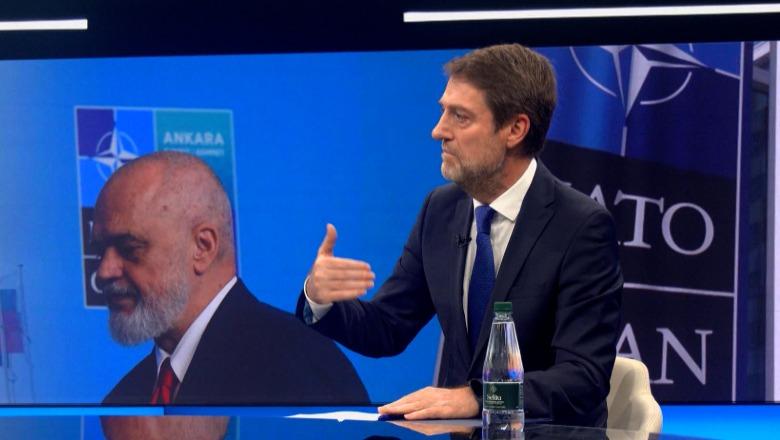
Albania’s Minister for Europe and Foreign Affairs, Ferit Hoxha, has said that Tirana will host the next NATO summit regardless of when the allies decide to hold it. In an interview published on Friday, he dismissed suggestions that the Albanian capital could lose the event.
Speaking to journalist Nertil Agalliu on Report Tv’s “Sot Live në Shqipëri”, Hoxha said Albania has submitted its negotiating positions for five chapters of the EU accession talks and expects drafting of the Accession Treaty to begin next spring. He said the governments of Albania and Kosovo are preparing their first joint meeting in two years, and that the negotiating team for the sea issue with Greece is in place and awaits the agreement of the President of the Republic.
The summit
The NATO summit in Tirana was initially planned for 2027. Agalliu asked the minister why it had been postponed.
“There are two decisions, whether the summit will be held in Tirana and when it will be held. The first has been answered. The next summit, whenever it is held, will take place in Tirana,” Hoxha said. “As to when it will be held, that question remains open.”
The date is set in agreement with the NATO Secretariat and the other allied countries, he said, once there is a need for a summit and enough substance to justify one.
“If the member states judge that 2027 is too close to the summit held in Ankara, we understand that,” he said. “But at any time and in any circumstance, whenever it is held, the next summit will be in Tirana.”
“This has nothing to do with Albania, nor with the situation, nor with its credentials,” he added. The decision is taken jointly, he said, in order to give the summit as much content and weight as possible at the moment it takes place, and member states can decide at any time.
Albania is happy to be the host, Hoxha said, and to show the credentials of a country that has invested, and continues to invest, in security in the region, in Europe and in the Euro-Atlantic area.
A record budget
The Ministry for Europe and Foreign Affairs will have 3.91 billion lek in 2027, an increase of 85 per cent. “We are almost at the doubling of everything,” Hoxha said.
He had told the parliamentary Committee for Europe and Foreign Affairs that the 2027 budget is an investment in Albania’s international capacity and in its preparation to be a member of the European Union. Asked how it supports that effort in concrete terms, he called it the largest budget ever in the history of Albanian diplomacy.
The budget, he said, is oriented towards investments that make Albania European and bring it as quickly as possible to what it is aiming for, to be a credible partner at the future European table. Support for the accession process sits at its centre, and 180 million lek is earmarked for dedicated activities linked to EU membership.
On whether the money would mean more staff, more funds for embassies or more financial support for diplomats, Hoxha said the first step is to strengthen the mission in Brussels. It will need between 60 and 80 members, which is what the smallest EU member state has today. Once Albania is a member, that staff will come from the Foreign Ministry and from all the fields in which the EU acts.
“Today we have about a quarter of that number,” he said. “My commitment is to have the personnel we need to defend the country’s interests there.”
The ministry also wants its missions in the member states to have more people, more energy and more confidence. “That is the essence of the process, to be credible in Tirana, in Brussels and in every European capital,” he said.
Hoxha said the ministry will do what it can to support Albanian exports to the European market today, so that the country is as well prepared as possible to compete tomorrow. An assessment within the service will reflect results as accurately as possible, he said, and those who are on the front line and deliver the most will be rewarded, through bonuses or in other forms.
Five chapters, perhaps six
The European Commission’s roadmap for Albania, Agalliu noted, foresees the closure of six chapters by the end of the year.
“We are at the stage we planned,” Hoxha said. “The negotiating team has submitted our negotiating positions for five chapters. We will see whether five or six are closed.”
Assessments will follow, along with meetings in COELA and COREPER, the Council’s enlargement working party and the committee of member states’ permanent representatives. “I hope that five or six chapters will be closed within the year,” he said.
“We have done our work. It is now in the hands of the European Commission,” he added. After discussions, the member states, together with the presidency, will give the final verdict.
The Commission recommends that the Council begin drafting Albania’s Accession Treaty next year. Asked whether that would come easily, given that the decision belongs to the member states, Hoxha answered with a precedent.
“The same thing happened with Montenegro. After it closed around 12 chapters, the Council decided to create an ad hoc group for drafting the draft treaty,” he said. “I expect the same for Albania.”
Once Albania reaches a critical mass of closed chapters, he said, he expects the Council to open the drafting process. The Commission’s roadmap for Albania sets that step for spring.
“On 14 October 2024 we did not have a single chapter open. Next spring the drafting of the treaty will begin,” he said. “It is a wonderful journey, full of hope, and the basis on which we will continue.”
Kosovo
The governments of Albania and Kosovo have held eight joint meetings, Hoxha said, and none in the last two years, because Kosovo was in an electoral process.
“We are working to find the right moment for the next meeting,” he said. “I cannot give you the date, but we will have a next meeting, because relations between Albania and Kosovo are institutionally consolidated and are followed at all levels, up to the highest level.”
The relationship was never interrupted during those two years, he said. But it had not been easy to organise a meeting between the governments while Kosovo was continuously in an electoral process and in the formation of new institutions.
“Now there is a government in Kosovo that has a clear four-year mandate,” Hoxha said. “We have absolutely no reason not to continue this close relationship.” The situation now allows the two sides to plan better and more clearly what they need and what they will do.
The governments are also reviewing the more than 60 agreements they have signed. “We are analysing the agreements that have been implemented, those that are being implemented and those that may have fallen behind,” he said, “so that we have a full picture of where we are, what we have done and what we still have to do.”
Serbia
Tirana will wait for the formation of the new government in Belgrade following the victory of the Student List in the elections of 25 October. Hoxha noted that he has already taken a public position on the elections themselves.
“As for what we might call the new administration, it has not yet been formed. So far we have the parliament and the speaker of the parliament,” he said. “We will wait for the formation of the government, because it matters a great deal who will be in government.”
Albania will see who is put in charge of foreign policy and will then establish first contacts. It will offer the readiness it has always had to build relations that are as practical as possible and in the mutual interest, Hoxha said, and it will set out its positions on Kosovo, on bilateral relations and on regional cooperation.
The political programme the Student List presented during the election campaign does not, for now, reflect a different approach. “That is true,” he said. “But as we have seen in many other cases, when an opposition comes to power, it tends to have a more realistic approach. We will see what their approach will be.”
If the approach stays the same, he said, Albania will make it very clear that on Kosovo there is complete disagreement.
“We will defend the interests of Kosovo and we will make it clear to them that the defence of its interests and support for Kosovo are non-negotiable for any government in Tirana,” he said. “That will be our line.”
“If we do not agree on Kosovo, we will try to find every space to cooperate pragmatically,” he continued. Albania will state its interests clearly and leave open the possibility of practical cooperation where it can.
“There are many other issues as well. We have to defend the interests of the Albanians in the Presheva Valley,” he said. Such matters require a diplomatic approach that is as practical, pragmatic and concrete as possible.
Tirana will also watch who heads Serbian diplomacy, what approach the new government takes to relations with Albania and the region, and what its European orientation and programme will be.
Greece
In relations with Athens, Agalliu said, a small issue is sometimes enough to sour the atmosphere. He asked which matters are most urgent between the two countries today.
“It has been a long time since we have seen tension between Albania and Greece,” Hoxha replied. “We have seen, on the contrary, cooperation, support, maturity and restraint in the positions of both countries.”
Above all, he said, there has been a fundamental agreement that matters a great deal to him: Greece has supported and continues to support Albania’s European future. He had said so before, he added, and it might sound familiar, but it is very important.
“Without Greece’s agreement, no chapter would have been opened or closed and no chapter could be closed from here on,” he said. The agreement of Greece, together with that of the 26 other countries, is what has allowed Albania to move forward.
Greece will hold the presidency of the Council of the European Union in the second half of next year and will draw up and set the agenda.
“This will be the most important year in the history of our relations with the European Union, and perhaps also for the future of Albania,” Hoxha said. “It is the year in which we aim to close all chapters.”
An agreement to take the sea issue to the International Court of Justice in The Hague has existed for years, Agalliu said, but the matter appears to have been left in silence.
“It has not been left in silence,” Hoxha replied. “The negotiating team has been set up and we are waiting to receive the agreement of the President of the Republic.”
The Albanian team includes representatives of a large number of institutions. Every aspect of the process is discussed in detail within it, he said, and the process is very complex.
“We have tried twice to resolve the issue by agreement, through talks between the parties. That was not possible, and there is nothing unusual here,” he said. Many other countries have tried to settle such questions between themselves and have then turned to a third party.
Albania and Greece have agreed to go to the International Court of Justice in this case. The two sides will agree very soon, Hoxha said, on how to proceed, the steps to follow and the approach of each country.
The question of pensions is also under discussion between the two countries.
“You have five minutes”
Hoxha recounted for the first time the conversation in which Prime Minister Edi Rama proposed that he take over Albanian diplomacy. He was Albania’s ambassador to the European Union at the time, and the exchange took place on the way from the airport into Brussels.
Rama asked what answer he would give if he, in his capacity as prime minister, told him that the country needed him.
“I thought for two minutes and told him that diplomats are public servants,” Hoxha said. He told Rama he did not know whether he was capable of doing the job, that he had not prepared for it, had never thought about it and had not had it in his plans. He asked for a little time to think.
“The Prime Minister told me, ‘You have five minutes,’” he said.
Hoxha said he was very, very happy, and just as worried about whether he would be able to do such a job, because the transition is not an easy one. In a career of 35 years, he had always dealt with a particular issue, with a particular focus, from a particular angle.
“When you come to the head of diplomacy, you have to see things in 360 degrees,” he said. “Above all, the responsibility is much greater, because it is political, professional and institutional.”
There is a more particular side to it as well, he added. “It seems as if it is easy to return and run the house where you were born and raised, but it is not that easy.”