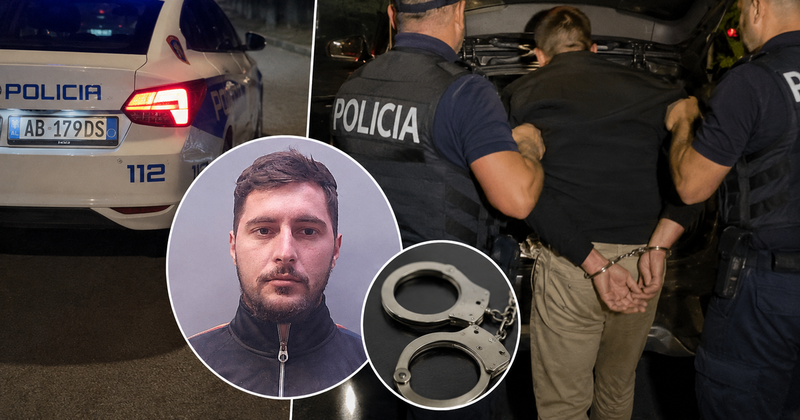
Albania’s police found the suspect in five hours. Under Skënder Hita, they have spent the summer arresting police chiefs, suspending officers and stripping security licenses. The Principote case is the next test of that campaign.
By Drizan Shala
The video from Levan shows a car with foreign plates stopped on the roadside and a woman of thirty one stepping out of the driver’s seat with her hands somewhere between surrender and disbelief. Police open the boot. Inside is a man of twenty nine, still wearing the trousers he wore at work the night before. There is blood on them. The man is Sokrat Vata, employed until that morning at the Principote complex in Ksamil, the most photographed stretch of the Albanian Riviera, facing Corfu. The blood is understood to belong to Luis Miguel Varela Mendes, a twenty year old Portuguese tourist who came for a French DJ night and was found dead on a sunlounger at first light.
In the coming weeks this case will be argued as a question about whether the Albanian state works. The opposition Democratic Party has already declared a failed public security. Somewhere a cable is being drafted that reads the country through one beach bar. Everyone in that argument will be answering the wrong question, because the state itself answered it inside five hours, and the answer convicts it.
Here is what those five hours contained. A manhunt coordinated across three police directorates, Sarandë, Vlorë and Fier, that pulled the suspect out of a car boot two districts away the same morning. Forty one people brought in, eleven arrested the same day, and a charge sheet that ran the full chain: Vata and a second man, now wanted, for intentional murder in cooperation; the two Turkish nationals who hid him, regular clients who told investigators “Ishim miq dhe e shoqëruam për shkak të miqësisë,” we were friends and we accompanied him because of the friendship, for harboring; four waiters who by the police account punched Mendes before the blade reached him, for failure to report; the venue’s operating owner, present that night, who drove toward Tirana instead of toward a telephone, the same. And the state’s own men by name: of the four guards on duty, three drew state salaries, a border investigation specialist, a Fier prison employee, a municipal police officer, and all three were arrested within the day, the first of them by the Police Supervision Agency, the AMP, Albania’s independent body for investigating its own law enforcement.
Hold that performance, and hold it for the right reason. Its function in this story is calibration. A state that can find one man in a boot in Fier before breakfast, charge thirteen people in a day, and arrest its own officers by name has demonstrated the exact capacity it would have needed to prevent the killing. Everything that follows must be read against that demonstration, because it removes the only innocent explanation, which is that the state could not have known.
The performance also has a pedigree, and the pedigree is what the coming commentary will miss. The State Police has been run since late 2024 by Skënder Hita, a career crime investigator, and his directorate has spent this year conducting a documented campaign against exactly this pathology, in exactly this county. In mid May, an operation with the AMP and the Sarandë prosecution arrested the leadership of the Sarandë commissariat itself, the commissariat chief among them, over police tolerance of illegal construction on the coast of Sarandë and Ksamil; Hita suspended all four the same day and opened expulsion proceedings. Five days later he stood in Sarandë and said that whoever “favorizon grupet kriminale,” favors criminal groups, “do të përjashtohet nga Policia,” will be expelled from the force. At the end of May, after private site guards beat a protester at Zvërnec while local police watched and the Vlorë directorate put out a false account of it, he suspended the Vlorë police director within hours, ordered a disciplinary investigation of the entire county command chain, told the public his own force had appeared “e fjetur dhe joprofesionale,” asleep and unprofessional, and, the detail this case now makes heavy, his directorate revoked the licenses of two private security companies, Myrto Security and Major Security. In June the same treatment reached Shkodër. And on 16 August, two days before Mendes died, the pattern arrived within walking distance of this story: guards at a bar on Rruga “Butrinti” in Sarandë brawled without calling the police, beat the commissariat’s own chief of crime investigation when he intervened, and Hita suspended two officers, one of them from the special forces, for working that bar’s security without authorization. Press reporting on that case and on Principote names the same private security company, Elite Security. The police notices name none.
So the five hours were the campaign, and the campaign is real, dated, and enforced against the state’s own. Which recasts the question this piece exists to ask. It is no longer why capacity appeared after a death. It is how a venue of Principote’s visibility stood outside a live zero tolerance campaign that had already reached a commissariat’s leadership, a county command chain, and the moonlighting officers of an ordinary bar in the same town two nights earlier, and was reached itself only behind a body.
Part of the answer sits in the statute book the campaign enforces. Albania’s law on private physical security, Law no. 75/2014, prohibits in its Article 30 any employee of a licensed security company from simultaneously serving in the interior ministry’s structures, the Armed Forces, the State Intelligence Service, or the Prison Police. Two of the four men standing as Principote’s security that night were barred from that door by the plain text of the article. The third, the municipal officer, slips through a hole the drafters left, because municipal police answer to mayors and never made the list. That hole has now been measured in Ksamil.
Vata’s own position at the venue is one of the things the remand file will have to settle, and both possible answers accuse. Several outlets place him in security through the same company; one account has him working as a host, hired for the languages he learned abroad. If he wore security, Article 12 conditioned his certificate on never having been convicted of a criminal offense by a final court decision, and Vata carried one: Cambridge Crown Court, 25 September 2024, five years, after admitting two counts of possession of Class A drugs with intent to supply, two counts of dangerous driving, cannabis possession and drug driving, following pursuits in Kent and Cambridge that ended with cocaine thrown into a bush and £560 in his pockets. The sentencing judge, His Honour Judge Grey, told the court that drug dealing “directly leads to significant amounts of serious violence, particularly knife crime.” Any certificate issued to him was issued in breach of the law’s own criterion, to a man the law says could not hold one. If instead he was a host, then the man with the knife fell outside the security law entirely, and the only vetting that ever touched him was a job interview. And inside Article 12 sits a third finding that holds either way. The criterion the law states is universal, no final conviction anywhere; the verification it builds is domestic, a check against the registers of Albanian state institutions. A country whose citizens are the largest cohort in British prisons, and which receives its removed offenders by the thousand, decides who may keep order on its beaches with a law that demands a clean record everywhere while looking only at home. The statute even scripted the aftermath: Article 26 obliges a security company’s technical director, when a crime occurs at a guarded site, to secure the scene and notify the State Police. The body lay on the beach for close to three hours.
Then the venue. It has operated since 2022 under a company registered that January with capital of one hundred thousand lek in the name of a woman in her seventies, while the man reported across the Albanian press as its operating owner carries a detention order from the Kukës district court dated 14 October 2019 for threats and illegal weapons, an extradition from France in February 2021, and, by consistent reporting in multiple outlets citing investigative material, a name French authorities forwarded to Albanian institutions in connection with a Paris cocaine network, activity on which the State Intelligence Service had reported, and money laundering verifications opened by the National Bureau of Investigation, the investigative arm of SPAK, Albania’s special prosecution against corruption and organized crime, the institution on which a decade of European and American justice assistance has been spent. Allegations about his Ksamil structure circulated publicly at least a year before Mendes died. SPAK has confirmed none of it, opened nothing the public can see, and said nothing since the killing.
Two questions therefore stand, and both have live precedents this same summer. What did SPAK hold on the owner of Principote before 18 August, and when did it hold it. And since this directorate stripped Myrto Security and Major Security of their licenses within days of Zvërnec, when does the license of the company that press reporting places at both the Orange bar and Principote follow.
One layer of this failure genuinely does not belong to Tirana, and honesty requires saying so before taking the excuse away. Vata reached that door through the United Kingdom’s Early Removal Scheme architecture, section 260 of its Criminal Justice Act 2003, under which foreign offenders are removed from prison for immediate deportation long before release; a statutory order in force since 23 September 2025 cut the minimum served to thirty percent of the custodial period and stretched the removal window to four years, and by those rules Vata was removable from late 2025 under either regime. Over five thousand foreign offenders were returned in the twelve months to mid 2025, more than half through this scheme. Deportation bans them from Britain and imposes nothing on the other side of the border: no sentence to enforce, no supervision, no notification that would surface in a background check unless someone thought to send it. Neither ministry has disclosed the instrument in Vata’s case, and neither has volunteered it. So far, an imported failure. But the statute that should have caught him at the door is Albanian, the registers his certification was never checked against are Albanian, and the information on his employer sat in Albanian institutions whose holders now owe a public accounting. London built the pipeline. Tirana left the tap open.
Five hours for the response. Four years for the conditions. The record now dates that division more finely than the slogan does, because the four years split again in late 2024, and this summer’s record belongs to a directorate demonstrably willing to arrest commissariat chiefs and suspend county directors. What kept Principote outside that campaign until 18 August has to be established rather than assumed: neglect, protection, or a decision not to look, and only the last of those left a signature somewhere. The opposition’s failed state and the sympathetic reading of an overstretched summer force both dissolve against the same fact. Capacity was never the missing element, and after May, neither was will.
The two men still wanted were last reported traveling toward Tirana. The remand hearings begin this week in Sarandë. What the prosecution does with the men in uniform, whether SPAK finally says what it held, and whether one more security license falls, will show whether the campaign that reached a commissariat’s leadership, a county command chain, and a bar on Rruga “Butrinti” has a perimeter, and who drew it.
Drizan Shala writes on security, institutions, and political violence for Kosovo Dispatch and Tirana Examiner. He is a doctoral candidate at the University of Sarajevo.