The Newsroom (Tirana)
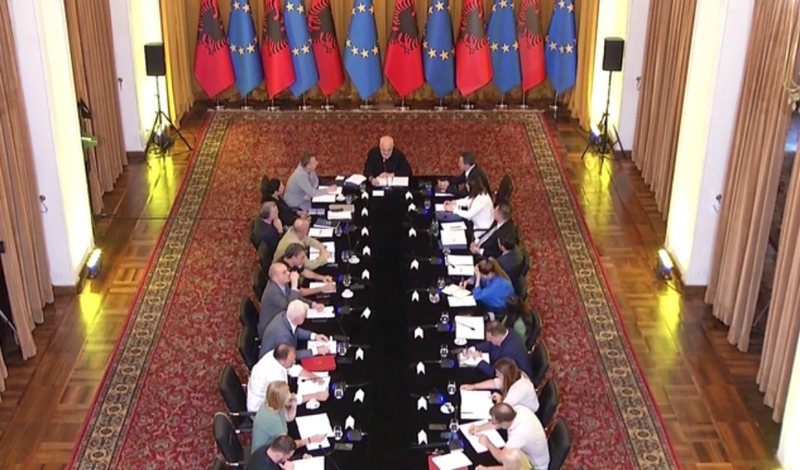
Prime Minister Edi Rama presented a new internal party document to the Socialist Party leadership on Thursday, telling regional political directors and the chairs of the parliamentary committees that the party’s electoral machinery must undergo what he called a vital transformation and be saved “from itself.”
The document, titled “Prania Besnike” (“Loyal Presence”), is an annex to the strategic platform “Besa” that Rama unveiled earlier this month as the programmatic turn of his fourth governing mandate. Unlike the parent document, which addresses governance, the annex is directed exclusively at the party organization. Rama described it as a discussion paper for internal use.
“If last time I spoke about governance, today I will speak about our party machine,” he told the gathering.
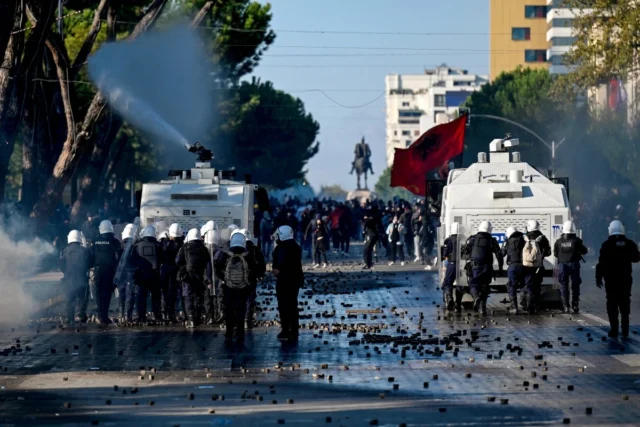
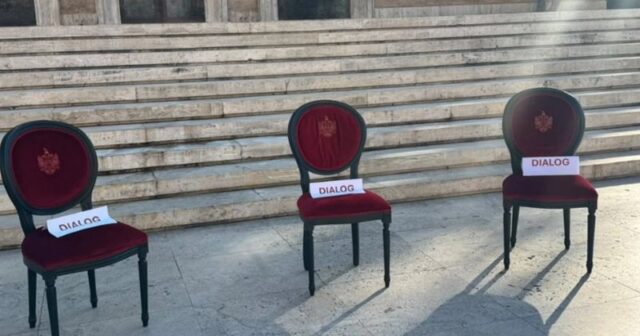
The presentation came one day after the sixtieth consecutive day of protests in front of the Prime Minister’s office, where demonstrators have demanded the government’s resignation since the beginning of June.
Five commitments
Rama presented the document’s content as a set of five commitments governing the party’s relationship with citizens and its own internal conduct.
The first, he said, is respect understood as readiness to listen, “not listening as waiting for one’s turn to speak, but listening as the party’s first job, as a new discipline, even when there are no cameras, no campaign, no applause, even when there are no sympathizers.”
The second is empathy as an engagement to interact. “Empathy is a force that no algorithm can produce,” Rama said, adding that a person who opens the door of their troubles has given the party something more valuable than a vote. “He has given you trust. By giving you trust, he has also placed his dignity in your hands, and his trouble is not currency for the political exchange rate.”
The third is solidarity as unconditional assistance. The party, he said, must listen to and serve anyone “without asking whose side you are on, who you have been, what you once did, without asking about the vote, indeed without asking about politics at all.”
The fourth is correctness as an obligation to respond. “Nonresponse must be declared forbidden in the PS,” Rama said. Citizens do not expect the party to hold a magic key, he argued, but they expect an answer, “yes, no, when,” because a person’s trouble becomes humiliating when it is ignored.
The fifth is commitment to transforming the machinery through individual example, beginning with the officials in the room. “This turn starts with us who are in this hall, or it does not start at all. It starts with the government, or it gains no credibility,” he said. Internal criticism, he added, is welcomed and should be cultivated as nourishment for the team, but has only one honest path: spoken openly inside the party, and expressed publicly only as self criticism in the name of the team, not as the maneuver of “a spectator who exploits his own interest.” That, he said, “is not loyal presence, but a cheating one.”
“Save the machine from itself”
Rama told the party leadership that the Socialist electoral machine had won in what he called the era of shortages by mobilizing gratitude for what had been built, but that this era had ended.
“In the era of expectations, this machinery must undergo a vital transformation. Gratitude is no longer the key element, and the confrontation with the new reality of expectations has only just begun,” he said. “Our task is not to protect the machine from what is around and outside it, but to save the machine from itself.”
He cited the fate of Barack Obama’s 2008 campaign organization as a cautionary example, saying that no leader “lost power from listening; they all lost listening from power.” Obama, he said, won with more than two million volunteers, whom Rama also referred to as “patronazhistë,” and thirteen million connected addresses, but within a month of the victory the movement was absorbed into the administration and placed in the service of the White House agenda. Two years later, at the first midterm elections, “the machinery that had enchanted the world no longer had life,” a development Rama said Obama later acknowledged as one of his greatest political failures.
The Albanian model, Rama said, must borrow lessons from others without inheriting their diseases. “The Loyal Presence of the Socialist Party cannot be the office of the Argentine puntero, nor a complaints counter, nor any Albanian copy of the Singapore ritual, nor a failed nostalgic attempt at the mass parties of the last century,” he said, listing its method as “presence without clientelism, listening without theater, organization without bureaucratization, help without conditions, and digitalization without robotization.”
He also instructed the party to treat listening as its core capability. “Listening must become the most advanced technology of the PS,” he said, arguing that citizens who have never voted for the Socialists but who believe in work and self improvement “are our people,” separated from the party only by the absence of direct communication. Parties that have squandered winning coalitions, he said, shared one trait: “they won with their ears open and governed with their ears closed.”
The stakes of the transformation, in his telling, extend beyond the current leadership. “If the PS becomes an exception, it will enter among the exceptions; the PS will be not merely on the stage but at the center of the stage even after at least some of us are no longer in this duty. If not, then there will be no stage for the PS,” he said. He added that the parliamentary group, the cabinet, the mayors and the entire party leadership in the territories “must live with a sense of daily priority.”
Response to the resignation demand
Rama devoted an extended passage to the protesters’ demand that he step down, which he rejected while acknowledging the legitimacy of the underlying question.
“After thirteen years in government, ‘why do you want to stay longer’ is perhaps the most legitimate question that can be put to us,” he said. He read aloud examples of the comments the party receives, including “get up from there and go home, you are not the only ones here,” saying that questions and even loudly voiced wishes and orders in the air are expressions of freedom, while curses and insults he does not consider, “because they are a multiple conflict of interest.”
A political party, he argued, neither inherits power nor holds it as property, and exercises it only as long as it has the people’s vote and the votes in parliament. Neither the protesters nor the governing party can claim to be the people, he said; only the vote determines who governs and who sits in opposition. He stressed that this responsibility does not mean Albania should not know rotation, which he said the people determine, but that the task received from the people is to carry the accession battle to its end.
“To leave office only because a minority shouts is not a leadership trait, nor institutional responsibility. It is the abandonment of a very great responsibility,” he said.
Rama said his refusal to resign is tied to what he called the hour at which Albania finds itself in the European Union accession process. Were it not for the daily urgency of the membership agenda and the EU door standing open “not in words, but concretely,” he said, “in all likelihood I would have withdrawn with very great gratitude to my small village after twelve years lived body and soul” in office.
Albania after twelve years of Socialist government, he said, has become so different from the country his party “took on its back when we found it at the edge of the abyss in 2013” that, absent the historical hour at Europe’s doors, the record could have been called a mission accomplished. After that effort, he said, “the fourth mandate was not only the most natural continuation, but the only logical solution,” and he pledged that “until the last day of the fourth mandate, I will do the impossible so that our party gives everything of itself for Albania and the Albanians.”
He argued that Albania cannot yet afford the interruptions that consolidated democracies absorb. Albania, he said, “is not yet a country on an ordinary road that can walk, stop, change the government, and continue where it left off, as if time had no price and history were a train waiting at the station.” Old democracies are places where this does not happen, he said, because their states are long established.
He framed the accession endgame as a national rather than a partisan undertaking. “This is not the battle of the PS to remain in power, but the battle of Albanians to take the place that belongs to them at the table of the EU,” he said, adding that Albania must not circle “the last crossroads” or change its mind “in the middle of the roundabout,” because the European door “opens once in every generation and closes suddenly.” The task received from the voters, he said, is to ensure that the year 2030 finds Albania “inside Europe’s door.”
Responding directly to the chant heard daily beneath his office windows, Rama said the song calling for his resignation pleases and energizes him, and improvised verses in reply: “Let whoever wishes sing, let them rest when they wish, our mission will continue until it ends with the placing of the flag of Skanderbeg and Ismail Qemali in the courtyard of the EU.”
Fourth mandate as a turn
Rama told the leadership that the fourth mandate must not resemble its predecessors, describing it as the chapter of a great turn: the closure of accession negotiations, a gross domestic product surpassing thirty billion euros a year, and for the party itself a strategic shift “from the current chapter of electoral presence to the new chapter of human presence.”
Staying long in power, he said, means opening the party, its decision making and the governing process to people who are new “not simply in age, but in mentality,” producing leaders rather than followers. Parties rust when they stop changing, he said, and age when they confuse experience with infallibility.
“Our task is not to prove to them that we are not attached to power, but not to become attached to power,” Rama said. “Shame is only wanting to hold power while forgetting why it was given to you.”