The court administration builds the obstacle, the court fines the lawyer who objects, and the man in pretrial detention pays the price.
By Ylli Manjani
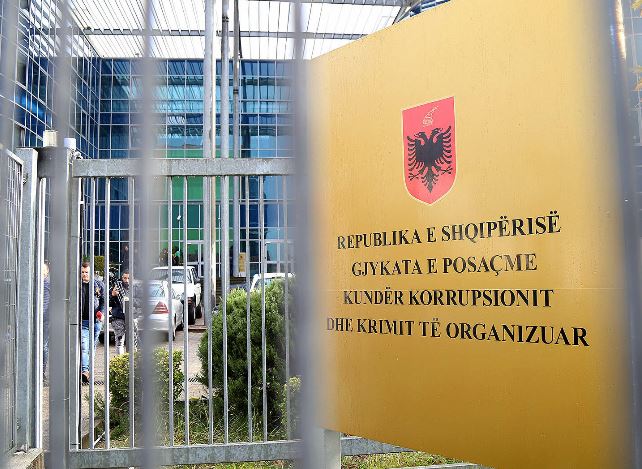
Editor’s note: Ylli Manjani is a former Albanian Minister of Justice. This piece appeared on his blog on 12 October. It returns to a dispute he first addressed in September: the internal security regulation of the Special Court against Corruption and Organised Crime, in force since 1 September, which among other things bars lawyers from using mobile phones in the courtroom and subjects entry to checks by the Republican Guard. On 8 September the National Chamber of Advocacy declared an indefinite boycott of hearings until the regulation is suspended and reviewed. Since then trials before the court’s first instance, including those of former President Ilir Meta and of Erion Veliaj, have been adjourned repeatedly. Some panels have fined the absent lawyers, in amounts reported at between 5,000 and 50,000 lekë each. Others have declined to. On 1 October the court also suspended the running of the pretrial detention time limits in Mr Meta’s case, over his objection that he has been present at every hearing. The regulation was drafted by the head of the court, the “commander” of the text below.
For more than a month now, the first instance Special Court against Corruption and Organised Crime, the GJKKO, seems to have changed its function. An institution meant to deliver justice has turned into one that does nothing but hand out fines!
It has even entered a feverish race with the Traffic Police to see who can impose more of them. With one essential difference: the infractions the Traffic Police fine are defined in law. The GJKKO is fining for an infraction the law does not recognise!
This is no small difference. It is the difference between applying the law and acting arbitrarily. The Code of Criminal Procedure provides for the possibility of taking measures against lawyers when, through unjustified conduct, they obstruct the normal course of judicial proceedings.
But nowhere does the law say that a collective reaction by lawyers to an administrative decision of the head of the court is, in itself, a ground for punishing them individually.
Nowhere!
The lawyers are not staying away from trials to damage the proceedings. They are not trying to drag cases out. They are not refusing the duty of defence, and they are not abandoning their clients.
They are objecting to the administrative conditions imposed on them for practising their profession and entering the courtroom.
The cause of the conflict, then, is not lawyers refusing justice but the imposition of certain administrative rules that hinder the normal exercise of the defence.
The lawyers want to enter the court and do their job. Instead they run into a soldier of the Guard, enforcing a regulation drafted by the GJKKO’s acting commander.
This is where the real absurdity begins.
Instead of examining whether the administrative obstacles are lawful, proportionate and compatible with the right of defence, the court chooses to punish those who object to them.
The administration creates the obstacle, and the court punishes the person obstructed!
Is there any greater legal absurdity?
The court, which should be where a citizen seeks protection from the arbitrariness of the administration and the police, is itself behaving like a punitive administration.
In this comparison, in fact, the Traffic Police stand on firmer legal ground than the special court. The officer who fines you for running a red light or for speeding has a specific provision to rely on. The court that punishes a lawyer for taking part in a collective reaction has yet to explain which provision makes that reaction an individual procedural violation.
It is not enough to have the power to impose fines. You also need a legal ground for imposing them.
The power to punish is not a licence to invent violations, for heaven’s sake!
But the problem does not end there. The first instance GJKKO is going further still.
As well as turning into an issuer of fines against lawyers, it is undermining one of the most basic guarantees of due process: respect for the time limits on pretrial detention.
Because by charging the failed hearings to the lawyers’ account, it is also justifying the suspension of those time limits.
That is far more serious than a fine!
The time limits on pretrial detention are not a favour the court grants to those arrested. They are legal limits on the state’s power to keep a person deprived of liberty.
Suspending them requires a ground that is specific, lawful and reasoned. Suspension cannot serve as the automatic answer to an administrative conflict created inside the institution itself.
It cannot be that the court administration creates an obstacle, the court fines the lawyer who objects to it and, in the end, the detainee pays the heaviest price!
That turns the logic of criminal procedure on its head.
A detainee cannot be made hostage to the administrative stubbornness of the head of the court. Nor can his liberty be used as leverage to impose a regulation.
In a state governed by the rule of law, the regulation yields to the law, not the law to the regulation. And, above all, the administrative head of a court is not the master of the judicial process!
He administers the institution, but he cannot dictate, through rules of entry, how the right of defence is exercised.
Otherwise, what does a judge’s independence mean if an administrative head, through a soldier at the door, can in practice decide whether a trial takes place?
What does the right to a lawyer mean if its exercise depends on obeying a regulation the lawyers themselves consider unlawful?
What does due process mean if the court, instead of resolving the conflict, uses the fine to shut down the debate?
Absurdity follows absurdity, until by now they have piled up into a haystack.
Where there should be legal reasoning, we have punishment. Where the conflict should be resolved, we have escalation. Where procedural guarantees should be respected, we have a contest to show who holds the power.
But a court is not an institution that needs to win a battle with lawyers. A court is an institution that must guarantee the rights of the parties, including their right to an effective defence.
The lawyer is not the judge’s subordinate. Still less the subordinate of the court’s administrative head. He is an independent participant in the administration of justice.
A court that treats the lawyer as an institutional adversary has misunderstood its own function.
A court that thinks its authority comes from the number of fines it imposes has confused the authority of the law with administrative authoritarianism.
A court’s authority is measured not by its capacity to punish but by its capacity to deliver justice.
Justice is not done by fining those who ask for their rights to be respected.
Someone should remind the leadership and the judges of the first instance GJKKO of an elementary truth: a court is not a police station. A judge is not a traffic officer. A lawyer is not an offender merely for objecting to an administrative order. And a detainee is not a hostage in the conflict between the court and the defence.
If a court cannot tell the exercise of a right from the commission of a violation, the problem no longer lies with the lawyers. It lies with that court’s very idea of justice.
The logic of the fine is neither due process nor justice. It is simply the administration of power through punishment.
When a court replaces justice with punishment, it may still be called a court on the sign above the door, but it has lost the meaning of the name it bears.
Let them enjoy the great page counts of the rulings they hand down, because for now they are merely issuers of fines!