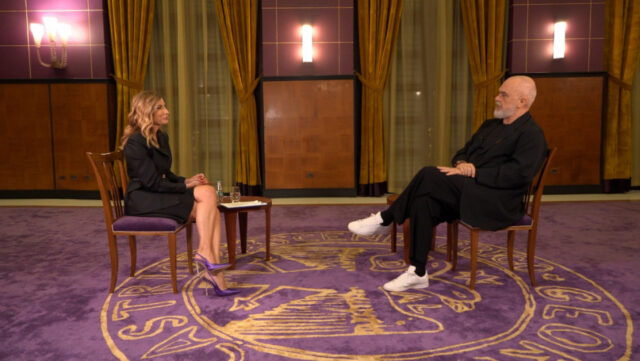
Interview with Minister for Europe and Foreign Affairs Ferit Hoxha, on the program “World News” on Klan television 24 April 2026
Linda Karadaku: The main issue under discussion with Greece is the delimitation of the maritime border. Prime Minister Rama said the matter is in Strasbourg. Is there any movement, or has it simply been sent there and we are waiting?
Minister Hoxha: First, I do not believe it is the main issue. It is one of the main issues we have in the relationship with Greece, because that relationship is more complex than this single file. That said, I understand the sensitivity you have for this matter, which remains unresolved.
It is not about Strasbourg. There may have been a misunderstanding, or it may have been heard incorrectly. We have agreed that, since for roughly twenty years we tried to resolve it bilaterally, and we all know the history, but we did not succeed, both sides should turn to an independent body.
Given that the international legal framework exists, in the recent meetings between the prime ministers, and in the meeting I had with my counterpart, Gerapetritis, we agreed that this matter should go to international arbitration. So we will refer it for adjudication, and we hope to find a solution that is equal, fair, and acceptable to both sides, at the International Court in The Hague, not in Strasbourg. Strasbourg has nothing to do with this matter. We are turning to an independent international body.
Q: You said this is not the most important issue with Greece. Then what is?
Minister Hoxha: No, because there are many issues. The bilateral relationship has a number of files that matter. For me, today, the main thing is to have the healthiest possible relationship, so that with Greece we can continue this journey of bilateral relations, in the joint interest of each country, of our peoples, of the Albanian community in Greece, and of the Greek minority in Albania.
Above all, to have Greece as a partner in our European journey, which I believe is Albania’s greatest national priority. That is paramount for me, and within that, of course, sit all the questions that need to be addressed and resolved with Greece.
Q: Meanwhile, the state-of-war law remains in force. Have you discussed this with your counterpart Gerapetritis?
Minister Hoxha: Absolutely. We have discussed this as well. As I told you, the prime ministers met yesterday morning. I met my counterpart after that meeting, and we agreed that across the whole basket of issues, and I do not think we need to list them one by one, since we know what they are, on some we have advanced, on some we have processes still open, and on some, including the one you mention, we have not advanced as far as we should.
So we agreed that for all of these matters we will, first, draw up an action plan, and second, set up technical teams between the two sides which will work over the coming months.
As you heard yesterday from the prime minister in his exchange with the editor in chief of Kathimerini, he pledged that all of these matters will not only be addressed, but that we have the hope, the intent, and the determination to resolve them before the end of the year.
So bear in mind that this is a highly active work site, and I will of course be engaged together with my team, not only at the Ministry for Europe and Foreign Affairs, but with the entire Albanian team, naturally in agreement and in continuous coordination with the Greek side’s team, or teams.
Q: Minister, to close the Greece section, it is by now public knowledge that relations between Albania and Greece have been strained. There have been accusations, tensions over various issues, from the Beleri case to other matters. This time, what we see at the Delphi Forum, with the Prime Minister’s arrival, your arrival, and the Rama–Mitsotakis meeting, these are not merely diplomatic events, not just meetings for the sake of meeting. There is a warming, an opening of issues for discussion and resolution. My question is: what happened, that we now have this “spring” in Albanian–Greek relations?
Minister Hoxha: I would put the framing of the relationship’s history slightly differently from how you did. I would say that we have tried everything with Greece. We have had moments of tension, moments where we tested each other’s patience, moments where we agreed and moments where we did not.
And my impression is that, drawing on this experience, on the maturity and the trajectory of our relations, both sides have arrived at a moment where they understand that the only thing in the best interest of our countries, in the interest of regional cooperation, if we view Greece within the wider region of Southeast Europe, and in our own indisputable interest, is to have the best and most positive relationship possible. That holds also for responding to the needs of the Albanian community in Greece, which is well integrated, settled, contributes to the Greek economy, and represents added value in our relationship. All of these are pieces of a puzzle that, in the end, have produced what you are calling a “spring.” But my impression is that both sides have understood that there is sincere desire and very positive energy here, which we do not want to lose in any form. It is true that the Prime Minister is not coming here to take photos. I, modestly, also have no time to waste on photos. We came to work. We have used every possible moment within this international forum, and I assure you we will continue with uninterrupted effort to do our best, because we have no time to lose on the road to Albania 2030.
Q: Let us turn to the role, however symbolic, that Albania plays on the international stage. In current geopolitical developments, the position of every country becomes very important, even of a small country like Albania. Albania is part of the Board of Peace, set up and led by President Trump, and it appears we will be sending soldiers to Gaza, is that correct?
The point is that, whether we send thirty or fifty soldiers, they are going into a war zone, a very delicate area where a kind of hybrid war continues and where the security risk is very high. Is there a concern, at least on your part, that our soldiers there could face a potential risk that would carry a cost for your government as well?
Minister Hoxha: First, Albania’s participation in the Board of Peace was approved by consensus by the Albanian Parliament, which authorised Albania and Prime Minister Rama to represent the country. So this is one of those rare cases where the Albanian Parliament unites around a question that is in the country’s interest and that is rightly seen as serving Albania’s image and its role on the global stage.
As you said, even if Albania is a small country and the participation may appear symbolic, we should be proud to take part in an effort to build something somewhere, to contribute to the construction of peace in a place with a very painful history. We are speaking of one of the longest conflicts in modern history, since the Second World War.
If Albania’s participation, alongside the other members of the Board of Peace, can contribute to a different tomorrow for the people of Gaza, we will be proud and pleased. If Albania can contribute to making real, one day, the project supported by the European Union, which Albania also supports, the project of two states living in peace, Palestine and Israel, then this is something we should be glad and proud of. As for the concrete engagement, my impression is that nothing has yet been agreed. The Ministry for Europe and Foreign Affairs is part of the discussions, but it is not the institution leading them on operational matters or specific military participation. Those discussions involve other institutions as well. At present, nothing has been decided. There are only various assumptions, as you mentioned. In any case, these are very serious questions and they will be handled at the highest level.
Nothing will be done in haste, nor by putting anyone’s life at risk, least of all our soldiers, who have represented Albania with dignity in other operations of equal seriousness and sensitivity. We will not send people anywhere unless we are certain that they are going to build, to keep the peace, and, to the maximum extent possible, to be out of harm’s way. Naturally, all of these decisions rest on our own analysis, on our partners’ analysis, and on discussions with the United States, which leads the project. Each thing will be decided in its proper place, but I would not want to speculate on individual elements. We want to do the best we can, and we will do the best we can.
Q: Meanwhile, Minister, the war in that region continues. The United States and Israel are in a coalition against Iran, and we have a kind of status quo whose direction we cannot yet read. The main issue here has been that Washington’s position has not been the same as that of its European allies. The United States entered into a war with Iran together with Israel, while European partners have said this is not their war.
Where does Albania stand here? Are we with the position of the United States and Israel, or with the position of the European partners? Is this our war or not?
Minister Hoxha: No one is going to give you a clean-cut answer, because these are very complex matters, woven together with many factors. Do not ask me for a direct reply, but let me refer you to the statement made by the Albanian Prime Minister on 28 February, on the first day of what is now considered the escalation, the war, or the military confrontation between the United States and Israel on one side and Iran on the other.
The Albanian Prime Minister made it clear that we were not part of this operation. Albania, like every NATO member state, was not consulted on this operation. Nor were European partners consulted. This was a decision by the United States and Israel, but they remain our partners, and we understand the reasons that led them to such a decision. Looking at things in their full complexity, the Prime Minister stressed, and this is also Albania’s position, that we will not shed tears over the fall of a regime known for creating and maintaining a nuclear programme prohibited by Security Council resolutions, on which Albania kept a clear position, including as a non-permanent member of that Council. Albania will not shed tears over the destruction of a ballistic programme that Iran developed and used, as we saw in its military responses against the Gulf states. That programme also contravenes international law and Security Council resolutions. Albania will not shed tears for a regime that has been bloody toward its own population, as seen in the suppression of peaceful protests, with tens of thousands of victims. Nor can Albania feel sorry for a regime that has contributed to destabilising the region through so-called proxy forces, not only against Israel but also against the Gulf countries. Any such instability in that region constitutes a direct risk for southern Europe, for the Mediterranean, and for Albania. Within that frame, Albania’s position is also clear given the fact that we have no diplomatic relations with Iran, for reasons connected to the 2022 cyberattack and to other repeated attacks, including some that are not made public. Albania is targeted every day by hybrid and cyberattacks from groups verified as linked to Iran. So this has been our position. Naturally, Albania has not taken part in military operations, but if at some point the possibility arises for a contribution within the framework of allies, that will be analysed separately.
Q: But meanwhile, there is the Mojahedin camp at Manëz, and my question is direct, Minister: how long will they remain there?
Minister Hoxha: We have an agreement with them and with our partners from the time when they were settled there. It is a humanitarian agreement. Albania carried out a humanitarian act, in line with Albania’s stance toward people in need.
Just as Albanians protected, at the risk of their own lives, Jews during the Second World War, making Albania a unique case that had more Jews after the war than before it, just as we did with Italian soldiers after Italy’s capitulation, just as we did with our Kosovar brothers, welcoming around 500,000 Albanians in 1999 with open arms in every Albanian household, and just as we did with the Afghans after the withdrawal of NATO and international forces from Afghanistan, this falls in the same line.
Naturally, this has placed us in an uncomfortable and awkward situation in relation to Iran. Iran has always seen this as a threat. We have always been clear that they are not here as a political platform against the regime in Tehran.
I myself have been in positions where I had to take firm stances with their representatives, to make it clear that they are here for humanitarian reasons and under Albania’s word of honour. Naturally, this has carried its own risks, but it is a manageable situation.
How long they will stay, I cannot tell you. They are of course welcome in Albania, but it must be very clear that Albania is not, and cannot be, a platform for political activity or any other activity of that nature.
Q: Let us speak briefly about Ukraine, because we now have conflicts overlapping with one another. We had Ukraine, then the Middle East, and now we have two ongoing conflicts, two major crises. The war in Ukraine has entered its fourth year and there is no peace agreement in sight. Meanwhile, President Trump and his administration take a markedly different approach from previous American administrations, such as President Biden’s, toward Ukraine and toward President Zelensky. Has Albania’s position toward Ukraine changed, or does it remain the same?
Minister Hoxha: Albania’s position has not changed in any respect toward Ukraine. From the very first moment until today, Albania supports Ukraine’s just war and its resistance to safeguard its territorial integrity within internationally recognised borders, as well as its sovereignty. Albania supports Ukraine’s just cause, and Ukraine’s right to make the choices it wishes, where it judges them necessary and reasonable. Albania has stood with Ukraine on the humanitarian, political, and military planes. There are many details that have not been made public and need not be, but everything we have been able to do to help the Ukrainian people, government, and state, we have done.
This includes the political stance at the Security Council. In our very first month of work at the Security Council we were forced to revise nearly our entire approach and programme because of Russian aggression in Ukraine.
We will continue to support Ukraine, alongside our European partners. My impression is that, together with the United States, they remain an indisputable partner and a key actor in this process.
They are in a process of negotiation, and we hope this process will lead where it should: to a ceasefire and a peace plan. We all know it is not easy to bring two countries with diametrically opposed interests, like Ukraine and Russia, into a single peace plan, but that is the work of diplomacy.
We hope a settlement is reached as soon as possible, because the cost of this war is borne not only by Ukraine but also by Europe. This conflict is a permanent risk to the security architecture in Europe, which directly affects us as well.
Q: Albania seeks to enter the European Union; this is our dream, and we are Europeans, despite our often complicated history. Meanwhile, the European Union itself appears to be in a quite sensitive, not to say delicate, situation in relation to the Trump administration.
We have seen exchanges of accusations, openly expressed mistrust, and statements from President Trump and his administration toward European leaders. We have also seen leading European countries decline to align with the American administration’s positions on very important global issues.
In this situation, our small Albania is, in a sense, in the middle. In such a context, if we can split this in two: what does Albania expect, and what does it receive, from the European Union, and what does it expect and receive from the United States?
Minister Hoxha: Albania is not “in the middle.” Albania is in its own place. I do not know whether it is in the middle, on the side, above or below, but Albania is in its own place.
We have excellent relations with the United States, for all the reasons that you, I, and all Albanians know. Likewise, we have absolutely excellent relations with the European Union.
And we are not merely “seeking” to enter the European Union; we are insisting on entering, and we will enter the European Union. If we set this in terms of priority, this is our national priority. Albanians established this from the first moment after the fall of the dictatorship and have confirmed it consistently ever since; all political forces and actors have set it down.
There is no party or political actor in Albania that does not support EU membership. This is great fortune for us, because we have a society with a clear direction.
We have no need to position ourselves “in the middle” of anyone. We will follow our interests, we will keep the best possible relations with a country that is our friend, ally, and partner, with a country with which we share an unbreakable history from the very genesis of the Albanian state, and at the same time we will pursue our interest in becoming a member state of the European Union, because that is where we are: in Europe.
Among partners there will always be agreement and disagreement, better moments and more delicate ones. But in the final analysis, the Western world is, and will remain, one, and within the Western world, the European Union and the United States have far more interests that bind them than divide them.
Such moments are not new in history; there have been others. The future may be unpredictable, but I am fully confident that what we consider the principal pillar of relations after the EU itself, between Europe as a continent and the United States, the transatlantic link, will continue to remain strong, an element and an indisputable guarantee that makes the ocean separating us invisible.
Q: One last question, related to something we celebrated in Tirana that has been very important for Albania, and not only for Albanians wherever they live in the region: NATO and Albania’s membership in it.
But the Alliance does not appear to be living through its best days. We had a warning from President Trump, who said he is considering the possibility of the United States withdrawing from NATO. Meanwhile, European allies have strongly defended the Alliance, as we do, because it is the vital security umbrella. My question is: do you believe that, in a worst-case scenario, NATO could survive if the United States were to leave?
Minister Hoxha: Look, in my profession we live with options, with assumptions, but we never speak in terms of assumptions. In our work we draw on options, “what happens if, what will we do if,” but I have no reason to speak about them, and I will not. NATO today is strong and solid. In a few months the next summit will be held in Ankara. Next year, we hope to first close the Ankara summit, and the summit after that will be in Albania. I have no concern about the strength, the solidity, the importance, or the role of NATO on a continent and in a world this turbulent and with a future this unpredictable. I see no other way of organising beyond NATO, because nothing replaces it. Statements come one after another; some are stronger, some softer, but what matters are the decisions that are taken. And I am convinced that the decisions will be taken, as always in NATO, together.