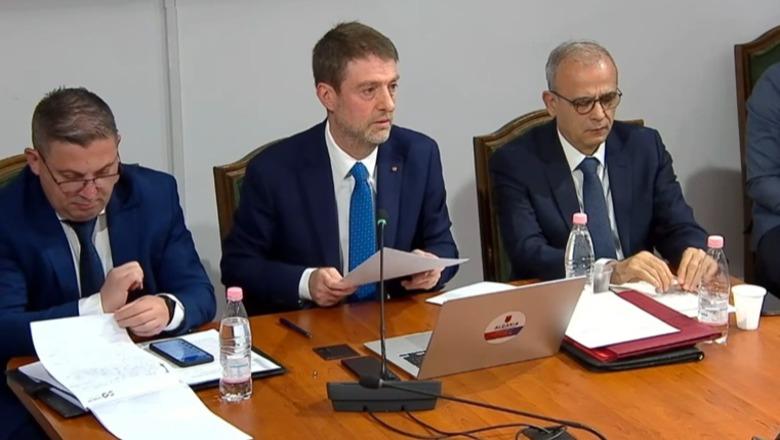
Foreign Minister Ferit Hoxha appeared before the Foreign Affairs Committee on Monday to brief deputies on the state of Albania’s EU accession negotiations, the Commission’s Interim Benchmark Assessment Report, and the joint Frankfurter Allgemeine Zeitung op-ed signed by Prime Minister Edi Rama and Serbian President Aleksandar Vučić. Hoxha rejected the opposition’s central claim that the process has stalled, defended the FAZ piece as an opinion rather than a project, and distanced Albania’s accession trajectory from any consequences arising in Belgrade.
His core message was procedural rather than rhetorical. The negotiation process, he told the committee, is operating within its own mechanics, on its own calendar, and according to the methodology the European Union itself designed. “Nuk ka pasur dhe nuk ka bllokim, nuk ka pasur dhe nuk ka veto nga asnjë shtet anëtar,” he said: there has been no blockage, and there has been no veto from any member state. The EU Delegation in Tirana, he reminded deputies, has confirmed this publicly. Commissioner for Enlargement Marta Kos and High Representative Kaja Kallas have repeatedly underlined Albania’s progress.
The IBAR Mechanics
The hearing’s analytical centre was the Interim Benchmark Assessment Report, the verification stage that, under the new enlargement methodology, must clear before chapter closures can begin. Hoxha walked the committee through the timeline in some detail, an exercise that also functioned as a corrective to the more dramatic narratives circulating in domestic political commentary.
On 13 October 2024, he reminded deputies, Albania had zero chapters open. By 17 November 2025, just over thirteen months later, all thirty-three chapters were open. “Pati shumë skepticizëm edhe atëhere kur deklaronim se plani ynë ishte të hapeshin të gjithë kapitujt brenda vitit 2025,” he said: there was much scepticism when we declared the plan was to open all chapters within 2025. “Disa e quajtën shakanë e radhës, të tjerë krejt të pamundur. E pur, accidit.” It happened.
The Second Intergovernmental Conference produced twenty-four interim benchmarks for the Fundamentals cluster. These were, between December 2024 and March 2025, broken down by Albania and the Commission jointly into ninety-two concrete measures. From April 2025 through February 2026, Albania reported on those measures: legislative acts, strategic documents, evidence of practical implementation. The Commission then drafted the Interim Benchmark Assessment Report and submitted it to the Council, where the COELA working group, comprising representatives of the twenty-seven member states, has been reviewing it through March and April 2026.
This is the procedural moment. “Ajo që dimë me siguri është se rekomandimet e Komisionit për Këshillin kanë qenë pozitive,” Hoxha said: what we know with certainty is that the Commission’s recommendations to the Council have been positive, acknowledging the progress achieved, recognising the fulfilment of benchmarks, and recommending continuation toward their adoption. The distinction between Commission recommendation and Council adoption was preserved throughout his remarks; he did not claim the latter, only the former.
The methodology, he stressed, is being applied for the first time with Albania. Through this exercise, the EU is establishing a standard it will apply in subsequent cases. The process is therefore by design demanding: “nuk është as i paracaktuar dhe as i kufizuar në kohë,” neither predetermined nor time-bound. Twenty-seven member states bring twenty-seven sets of sensitivities and interests into the room.
The Time Question
The sharpest exchange of the morning came on the question of timing. Tritan Shehu, deputy from the Democratic Party benches, pressed the minister on the claim that Albania is now late, that the IBAR review has dragged beyond what should have been expected. Hoxha’s response went directly to the structural point.
“Nuk ka pasur asnjëherë një kohë që IBAR për Shqipërinë duhet të mbushej për 6 javë,” he told the committee, “përndryshe Shqipëria është me vonesë, mund të shkojë edhe 6 vjet. Nuk ka kufizim kohor.” There has never been a defined timeline within which Albania’s IBAR was supposed to be completed. It could take six weeks, it could take six years. There is no time limit. The exercise is being conducted for the first time with this methodology, and it is establishing the standard for others.
The defence is procedurally sound. It is also self-serving in a familiar way: the absence of a comparable benchmark functions, in this framing, as a shield against the very scrutiny it would otherwise invite. But the substantive content of Hoxha’s argument, that the Commission has recommended favourably and that the Council mechanics are continuing in their normal rhythm, is consistent with what is publicly known about the COELA agenda over recent weeks.
The FAZ Op-Ed: Two Registers
The most politically charged segment of the hearing concerned the joint Rama-Vučić op-ed published in Frankfurter Allgemeine Zeitung. Hoxha had prepared an extensive set of remarks on this question, and the register he adopted was carefully diplomatic, distinct in tone from the more combative defence the head of the Socialist parliamentary group, Taulant Balla, would offer in the same room.
“Anëtarësimi i plotë në Bashkimin Evropian është dhe mbetet i panegociueshëm,” Hoxha told the committee. Full EU membership is and remains non-negotiable. It is not an option but a strategic national objective. The article, he insisted, does not propose abandoning that goal, nor relativising it, nor replacing the path Albania is currently following. What it proposes is an accelerated and more flexible mechanism allowing gradual approximation to key EU structures, particularly in economic, single-market, and mobility domains, while the full membership process continues in parallel.
On the question of why the article was co-signed with the Serbian president, Hoxha was firm: “Është veçse një artikull: as aleancë e as projekt.” It is only an article, neither an alliance nor a project. Countries in the region, despite often deep differences, including Albania’s “diametrically opposed and irreconcilable” position with Serbia on Kosovo, are capable of finding common language when strategic interests align. Nothing in the article, he said, weakens in any way Albania’s clear and unwavering position on Kosovo or on other regional questions where Tirana and Belgrade differ.
He went further on the substance. The integration mechanism proposed, he noted, would extend to all countries of the region, including Kosovo, in an inclusive approach. “Dhe nëse ka ndonjë vend në rajonin tonë që ka nevojë për një qasje të tillë, ky është pikërisht Kosova.” If any country in the region needs such an approach, he said, it is Kosovo specifically. The framing, while contestable, is the government’s most direct attempt to date to fold Pristina into the proposal’s logic rather than treat the op-ed as a Tirana-Belgrade transaction conducted over Kosovo’s head.
The strategic argument behind the proposal was the closing line of Hoxha’s prepared remarks on the FAZ piece. Geopolitics does not wait, he told the committee. European security architecture is under the greatest pressure since the Second World War. War has returned to the continent, geopolitical competition is sharper and more unpredictable than at any point in living memory, and if new models of cooperation are not built that make the region indispensable to the EU, the Western Balkans risks remaining at the periphery. The op-ed, he said, was a call for the EU to think more strategically about its southeastern flank rather than leaving the region in a grey geopolitical zone.
Balla, taking the floor on the same question, struck a different note. He opened with a comparison that captured his contempt for the opposition’s intervention more directly than any policy argument: the parliamentary debate on the FAZ piece, he said, reminded him of trade union meetings, “kur mblidhej dhe thoshte filani ka lënë flokët e gjata,” where members would gather to complain that one colleague had let his hair grow long. “Në cilin vend të botës mblidhet Kuvendi dhe bën redaktimin e një gazete kur kryeministri Rama ka parashtruar një mundësi të përshpejtimit të procesit të anëtarësimit?” he asked: in which country in the world does parliament convene to edit a newspaper when the prime minister has put forward a possibility for accelerating the membership process? “Pse jeni kundër? S’duhet të jeni kundër.” Why are you against this? You should not be against this.
Balla extended the argument into a broader claim about Albania’s regional positioning. “Shqipëria jonë është shumë përpara Serbisë,” he told the committee: our Albania is far ahead of Serbia. The region now speaks of two frontrunners, Montenegro and Albania. Montenegro’s advantage, he said, is purely temporal: it began negotiations ten to twelve years earlier. “Kurse ne kemi rekordin historik të hapjes së negociatave.” Albania, by contrast, holds the historical record on chapter openings. The Reform in Justice, he added, is the achievement on which “the roads diverge” with the opposition, the dividing line between the government’s and the opposition’s competing visions of Albania’s place in Europe. “Ne jemi sot vendi 100% e njehsuar politika jonë e jashtme me BE,” he said: we are today the country whose foreign policy is one hundred percent aligned with the EU. No other country in the region, he claimed, can say the same.
The split between Hoxha’s careful institutional defence and Balla’s parliamentary combat reflects a recurring division of labour within the governing majority. The minister’s task was to recover the diplomatic register; the group leader’s task was to absorb the political cost. That both registers were deployed in the same hearing room, on the same morning, says something about how the government continues to manage the FAZ piece domestically.
Decoupling from Serbia
A separate question pressed Hoxha on whether the European Commission’s review of Growth Plan disbursements to Serbia, prompted by the Mrdić judicial laws and broader concerns over Belgrade’s foreign-policy alignment, could carry consequences for Tirana. His answer was categorical. “Plani i rritjes është i njëjti plan për 6 vendet e Ballkanit Perëndimor,” he said: the Growth Plan is the same plan for the six Western Balkan countries, but each country has its own reform agenda, with concrete measures defined for it specifically. “Nuk kanë asnjë gjë të përbashkët, s’kanë asnjë element. Çfarëdo lloj gjëje që ndodh me Serbinë, s’ka asnjë ndikim për Shqipërinë.” There is no common element. Whatever happens with Serbia has no impact on Albania.
The decoupling is procedurally accurate. Each country’s Reform and Growth Facility tranche is conditioned on its own reform agenda, and Albania has been the regional top performer in the most recent reporting cycle. Belgrade’s exposure is its own. The political logic Hoxha was managing, however, extends beyond the regulatory architecture. The FAZ op-ed pairs Albania’s accession trajectory with Serbia’s in a public European venue at the same moment that the Commission is actively reviewing whether to suspend Belgrade’s Growth Plan disbursements over rule-of-law backsliding. The minister’s task on Monday was to insist that the procedural separation holds even as the rhetorical pairing complicates it.
Diplomatic Engagement
Hoxha framed the IBAR moment as the product of a sustained diplomatic effort. High-level contacts, bilateral exchanges, and engagement at international forums have, in his account, built and maintained political support across member-state capitals. The recent visit to Tirana by the foreign ministers of Austria, the Czech Republic, and Slovakia, in their capacity as the Friends of the Western Balkans group, was offered as the most visible recent confirmation of supportive momentum.
Coordination with successive EU presidencies, he told the committee, has been essential to maintaining the rhythm of the process. Public communication, both at home and abroad, has aimed to render integration a genuinely national project rather than a partisan one and to position Albania as a country contributing to European security and values rather than merely receiving from them.
Where Things Stand
The minister closed his briefing with a procedural appeal that doubled as a political squeeze. The accession process, he said, is continuing normally, in line with jointly agreed plans, “dhe kjo duhet të na gëzojë të gjithëve duke ditur që të gjithë anëtarët e këtij komisioni, pa përjashtim, e mbështesin anëtarësimin e Shqipërisë në BE”: and this should bring satisfaction to all of us, knowing that every member of this committee, without exception, supports Albania’s EU membership. The line was directed at no one in particular and at the opposition specifically.
What the hearing did not resolve, and could not have resolved, is the Council’s adoption of the IBAR. The Commission has recommended favourably. The COELA process continues. The Council vote, when it comes, is where any genuine resistance among member states would surface, and where the line between the government’s “no veto” framing and the opposition’s “blockage” framing will be tested in the only forum that can settle it. Until then, Tirana is producing political theatre at one volume and Brussels is processing paperwork at another.