The Foreign Ministry and the Albanian Jewish Community both condemned the act on Sunday. It did not arrive from nowhere.
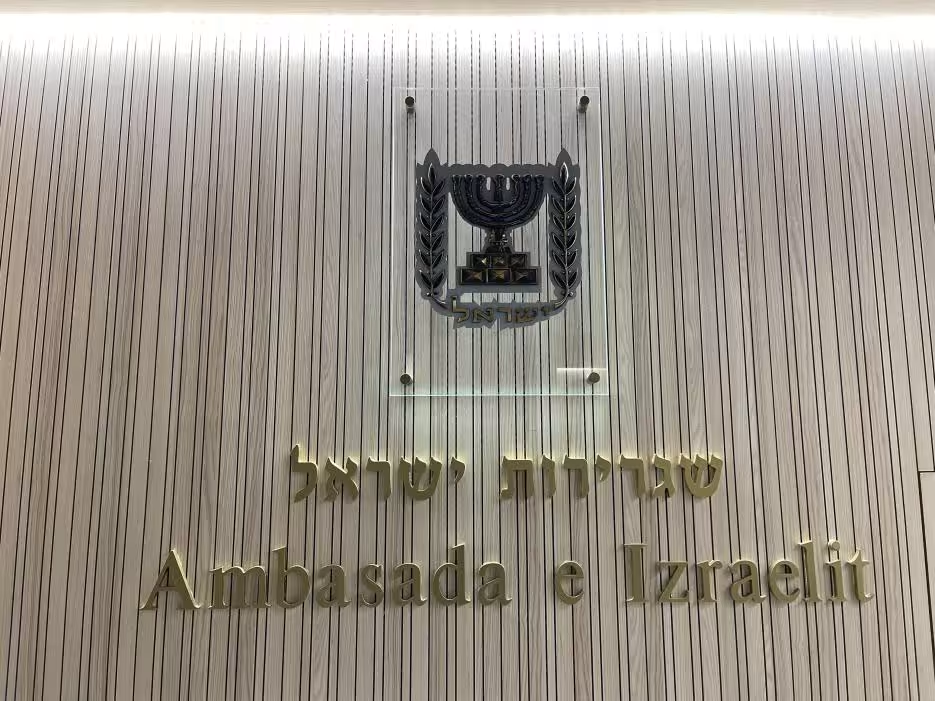
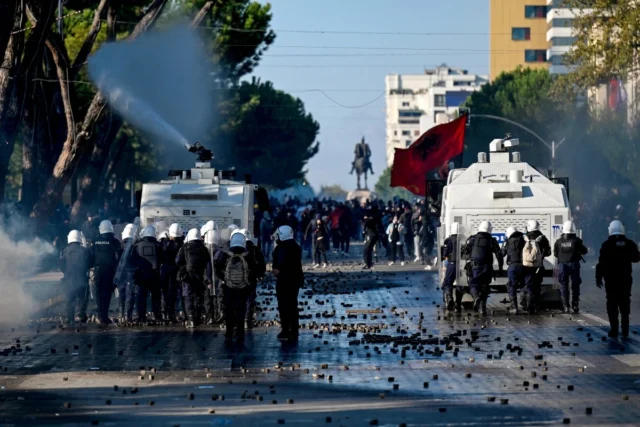
Masked protesters removed and desecrated the flag at the Embassy of the State of Israel in Tirana on Saturday night, during the latest demonstration in the cycle that began over the Zvërnec coastal development. The Ministry for Europe and Foreign Affairs condemned the act on Sunday morning, calling it a display of hatred and incitement with no connection to the right to peaceful protest.
In its statement, the ministry said such actions have nothing to do with freedom of expression or legitimate demonstration, and described the flag’s removal as incompatible with the democratic values and European standards the country is building. It invoked the Vienna Convention on Diplomatic Relations and Albania’s obligation to protect diplomatic missions and their symbols, and expressed solidarity with the Israeli embassy. The act, the ministry said, represents neither Albania nor the Albanian people, but only those who seek to provoke, divide, and spread hatred by abusing legitimate rights and freedoms.
A second institutional voice followed within the hour. The Albanian Jewish Community issued its own statement expressing shock and indignation, and framed the act in sharper terms than the ministry had. It called the desecration not an incident but an alarm signal, an act of hatred against the norms of international law and against the culture of tolerance for which Albania has long been recognised. The community welcomed the ministry’s response and called on responsible institutions to investigate the event seriously, identify the perpetrators and organisers, and ensure that Albania does not become ground for the propaganda of hatred, antisemitism, or extremism. Silence before hate speech, it said, is not neutrality but danger.
The incident did not surface in a vacuum. For weeks, a minority current inside the protest cycle has advanced the claim that the Zvërnec project conceals an “Israeli agenda,” with some videos and images purporting to show “Israeli settlers” taking Albanian land. Euronews and other fact-checking desks traced this material to fabrication: one widely shared image of a barbed-wire border flying Israeli and Albanian flags was digitally manipulated, and a viral clip of “settlers” being chased off actually showed an unrelated protest in northern Albania from February. The older claim that the development is a covert scheme to relocate Palestinians to Albania, which has recirculated for years, was denied by Prime Minister Edi Rama in remarks to Euronews.
The Israeli ambassador to Tirana, Galit Peleg, had warned of exactly this trajectory at the start of June. She said the protests demonstrated that Albania is a functioning democracy and that she understood the demonstrators’ concerns, but that a small group was attempting to use a legitimate protest to promote other, dangerous agendas. She described the anti-Israeli banners as recalling an element seen in 1930s Germany, when a country’s internal problems were blamed on its Jewish minority, and called it false that Israel or Jews were buying Albanian territory, noting how easily fabricated images now circulate.
The contrast with Albania’s historical record is the reason the act registered as it did. Albania is widely cited as one of the few European states that emerged from the Second World War with a larger Jewish population than it entered, having sheltered Jews under occupation, and the relationship between Tirana and Jerusalem has deepened markedly under the current government. Peleg’s first public address as ambassador was delivered at Tirana’s Holocaust memorial.
The condemnation also lands inside a movement the government is otherwise working to delegitimise. In a parallel message on Sunday, Rama cast the protest cycle through the analogy of Waterloo, telling demonstrators they were becoming an instrument of others’ interests and that the world had relocated its battle against the American president to Nartë. The two tracks sit uneasily together: a foreign-policy condemnation of an act committed at the protest on one side, a domestic effort to frame the protest itself as foreign-steered on the other.
What is established is narrow and serious. A diplomatic mission’s flag was taken down and desecrated by masked individuals; two institutions, one state and one community, have called it what it is; and the act gave physical form to a conspiracy strain that fact-checkers had already identified as manufactured. What remains unestablished is who did it, who organised it, and whether the investigation the Jewish Community has demanded will name them.