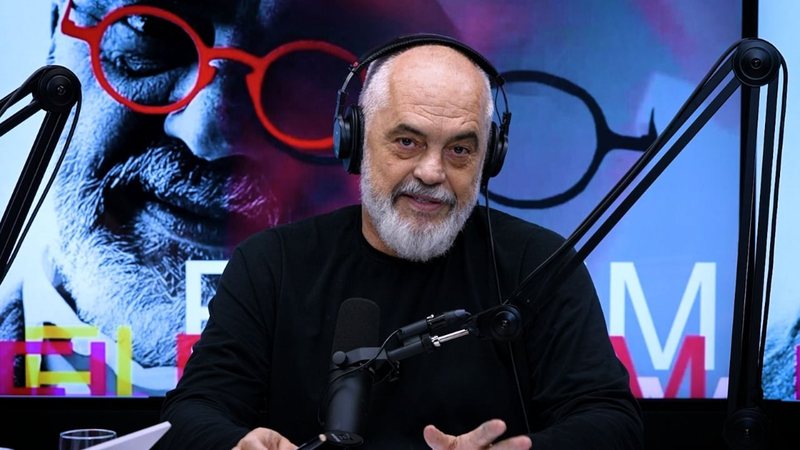
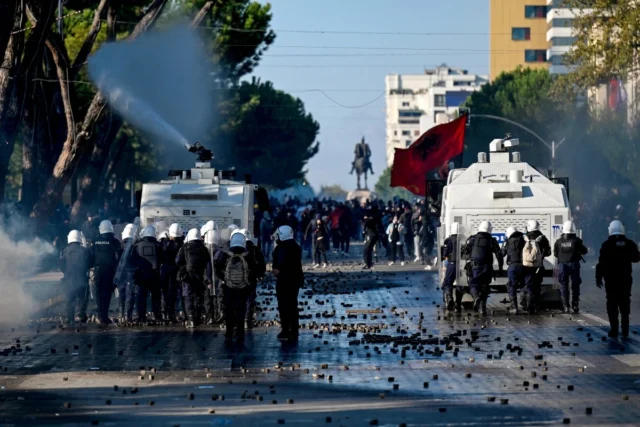
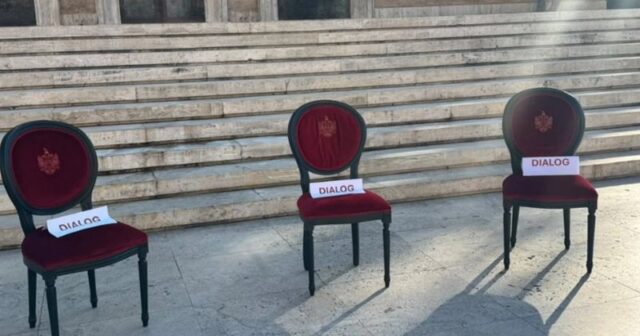
Prime Minister Edi Rama used the twenty-fourth episode of the sixth season of his weekly podcast, Flasim, to open the weekly notes with a sustained literary and philosophical reflection on the nature of idealism, illusion, and manipulation in the digital age, framed through Stendhal’s character Fabrice del Dongo at the Battle of Waterloo, and directed at those protesting against the Zvërnec coastal development project. Below is an edited transcript of the weekly address, reconstructed and condensed for clarity from the original recording.
I want to open this block of notes with a story written by one of the greatest masters of world literature, Stendhal, who gave an extraordinary character, Fabrice del Dongo, one of the most striking and most tragic experiences of disillusionment in literary history.
Fabrice del Dongo was a young man intoxicated by the legend of Napoleon, who set out toward Waterloo with his heart on fire. In his imagination the battle was the scene where history writes about heroes, where honour is won with courage, where a person rises above themselves. He dreams of glory, he dreams of greatness, he dreams of participation in an unforgettable epic, and of course he dreams of his own brilliance within it. He believes he will touch with his own hand what until then he had only dreamed.
But when he arrives at Waterloo, everything collapses. Before him there is nothing of the beauty of the dream. There is mud, smoke, dust, wailing, the smell of blood, open wounds, severed limbs, shattered heads, people being killed who understand nothing, soldiers fleeing as terrified as those who are attacking, and the question of why loses every possibility of finding an answer. An imaginary heroism dissolves in the chaos of brutal reality. The romantic dream of history collides with real history.
And history reminds us precisely of this. Not how dangerous it is to have ideals. To have ideals is extraordinary, it is healthy, it is the good energy that propels you forward. But what is dangerous is to let ideals be built on illusions, or worse still, to surrender them to hands that may hold you hostage. Because when the dream no longer becomes a light that helps you understand the world, but a curtain that prevents you from seeing it, it is no longer a dream. It is a nightmare. And this is both the nightmare and the curse of our age, where illusions are no longer produced only by propaganda or fanaticism as in the past, but are also produced in the space of freedom, with the boundlessness of the possibility of selecting and multiplying, through algorithms that have no interest in the truth but only in our attention, false narratives, wrong paths, and the painful collapse of illusions.
The more anger, the more fear, the more shock, the more it spreads: the illusion that, little by little, by detaching from reality, the person living in the reality curated by the algorithm can change the world, can destroy what prevents them from being happy, can make a sweet leap, no longer judging on the basis of facts, but on the basis of a version of facts served without stop, without stop, without stop on the screen of the mobile phone, without necessarily following the truth, but becoming part of a story constructed for them, assembled, amplified, and surrounded by others, as part of something that makes you think you are experiencing the embodiment of your conviction shared with many others, and suddenly you are no longer alone.
That is why today there are many people who go to protests with sincere convictions, as there are here, not far from where I am speaking, people who sincerely think that by going to the protest they are protecting nature, protecting the flamingos, protecting a heritage that belongs to everyone. All of this is noble and legitimate and deserves much respect as an intention. But who are they protecting it from? They are protecting it from me, they are protecting it from us, who have had the protection of nature, protected areas, the banning of illegal hunting, the banning of the felling of forests, as our leitmotif and as the leitmotif of our work. And that is why my call is simply this: with respect for the intention, the obligation to verify the facts must not be excluded. Because when emotion is fed by half-truths, by images stripped of context, by slogans that circulate faster than evidence, by an algorithm that always rewards what shocks rather than what explains, then idealism, the sincere desire, the need to express oneself in a community, becomes an instrument, an instrument in the hands of those who have entirely different interests.
The person thinks they are protecting the flamingos, protecting Zvërnec, protecting Albania, while in fact they are protecting the interests of someone else, for whom the interests of Albania have no value. The person thinks they are fighting for something very noble, while they have become a soldier in a battle that is in fact no longer their own. Just like Fabrice del Dongo, they enter the battlefield drawn by the magnet of a noble dream, and slowly they risk discovering far too late that the battle they are caught up in was not what they had believed. And the lesson of Fabrice del Dongo is not to give up on dreams, is not to give up on the noble desire to be a soldier of nature, to be a volunteer in defence of biodiversity, to be a voice, an activist in search of the most perfect possible harmony between nature and development. On the contrary, it is to not allow the dream to become stronger than the truth, and by becoming fanatical, to destroy the possibility of cooperating with the facts and with others who you will not see as thinking like you, as wanting the same thing as you.
The flamingos do not need crowds seized by the hysteria of the algorithm and incited by interests that are not ours at all, that are not Albania’s interests at all, in a globalised battle. Not because the world suddenly woke up alarmed by the fate of the flamingos, but because the world displaced onto Narta a great battle against the President of America for reasons that have nothing to do with Narta. And all this hatred and resentment and anger, political and ideological in nature, for reasons that do not concern us, created the conditions for opening also a channel, an imaginary revolution for those who mistakenly thought it became a sea of easy pickings for the rusted spoon of their political careers, or for their little parties that quickly became old and small, which want to grow by throwing stones, hiding hands, extending one hand while concealing the other.
I am here. We are here to do together what is best for Albania, for nature, for Zvërnec, for the flamingos, but to cooperate with reality, not outside reality, to share the facts together and not to fly into a territory where facts no longer have any value. And above all to discuss a project that is not yet finished, and to engage with how the project can be made as excellent as possible, and not to destroy it while it is still being born.
I believe this note, or more precisely this opening of this block of notes, is sufficient to call the block closed for today, because everything else you have learned from other news sources if you have learned it, but even if you have not yet learned it, it is less important than the acquaintance with Fabrice del Dongo.
Thank you very much.