Merit must work both ways, Ferit Hoxha said in Luxembourg. Then he described his country in the one language that guarantees it never will.
by Albatros Rexhaj (Tirana)
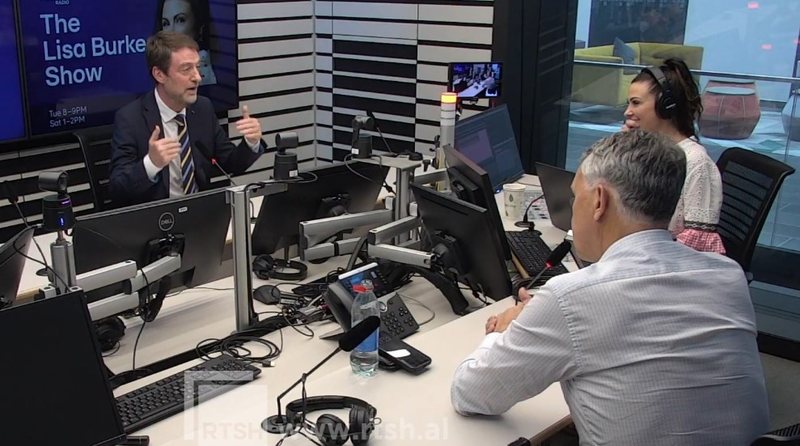
Ferit Hoxha said something in Luxembourg last week that needed saying, and we want to give him full credit before we quarrel with him. Merit-based, he told RTL’s Lisa Burke, has to work on both ends. Albania takes commitments and does the reforms, but the European Union has to keep its own part of the bargain. A candidate that fulfils an agreed condition must be allowed to move forward, because otherwise public trust deteriorates and reformers cannot explain why difficult changes bring no visible reward. Every word of that is true, and Albania has earned the right to say it the hard way: six clusters opened in thirteen months, every chapter on the table, the first candidate through the interim assessment of the Fundamentals under a methodology the Union itself designed to be unforgiving. When the minister says the sprint was work and not luck, he is right.
And then, having made the argument, he surrendered the language. The negotiation, he said, is about the gap: where Albania stands, where it must reach, how it will bridge the distance. To his own administration he offered the exhortation of a man before an examiner: don’t lose a moment, don’t lose a minute, don’t lose an hour. Work, work, work. The framing is Brussels’ framing down to the metaphor. There is a gap. The gap is in Albania. Albania closes it. The Union, generous and patient, holds the measuring tape.
Minister, you have spent a career in rooms where language is the whole game, so you know exactly what a vocabulary smuggles in. Allow us to itemize what this one carries.
The gap idiom assumes the instrument is calibrated. It is not, and you know it is not, because you passed its test in May and are still explaining yourself in July. The genre in which Albania’s deficits are described has a signature: it names no threshold, sets no date, and survives every delivery intact. “Concerns remain.” “Further efforts are needed.” “Under close scrutiny.” A sentence that cannot be discharged by any conceivable performance is not an assessment. It is a reserve of discretion, held by capitals that have their own reasons to hesitate and prefer to dress hesitation as conditionality. When you adopt the gap language, you countersign the discretion.
Watch how the genre works when nobody is watching it. Within a day of your interview, the region’s newsrooms were reporting that the minister had admitted Albania’s long road on corruption, justice, media freedom and the environment. We went back to the original. The catalogue appears in the programme’s own narration, under the heading of what “remains under close scrutiny.” Your contribution was to accept that the list is long. By the time the relay reached Tirana, acceptance had become admission, and the narrator’s list had become your confession, rendered differently by every outlet because none of them was translating a quote. That is what a talking point is, Minister. It reproduces without a speaker. And every time Albania’s own government answers in its cadence, the litany gains a citation. You accepted that the list is long. The question a foreign minister exists to ask is who wrote the list, and by what measure it ever gets shorter.
Here is what the borrowed vocabulary cannot say, and what your own could. The enforcement record the benchmarks celebrate is a volume statistic: cases opened, figures detained, activity counted. A volume statistic cannot tell an independent prosecutor from a well-aimed one. It could not see that this country’s pretrial detention practice runs at multiples of comparable European systems, because detention reads from abroad as seriousness. It did not ask why the three-term mayor of the capital, charged and convicted of nothing, sat more than a year in a cell before he was permitted to read the file on which his defence depended. The benchmark counted his arrest. It had no column for the rest. Meanwhile the corruption your citizens can actually name, the folded note in the hospital corridor, the tariff at the registry window, is the one form of corruption research knows how to measure honestly, by asking people whether they paid, and it appears in no benchmark at all. A decade of spectacle has been counted; the corridor has never been counted. Work, work, work is advice for a student. A foreign minister’s job is to interrogate the exam.
So say the second half of your own sentence, the half that both ends actually implies. Do not ask Brussels to reward the homework. Ask it to specify. Which threshold, by which date, measured by which instrument, and what follows when it is met. Ask why citizens’ bribery experience, falling or not falling in the clinics and courtrooms where Albanians meet their state, is not the headline metric of an anti-corruption policy supposedly conducted for their benefit. Ask what evidence would revise the standing assumption about this country, because a framework that cannot answer that question is not assessing Albania. It is officiating over it. You told Luxembourg that when Albania made its choice, it did not order from a menu: we take the full package. Well said. Now insist that the package includes the one item Brussels keeps off its own table: a definition of enough.
In the waiting time, we didn’t just watch the stars, you said. We worked. Agreed, Minister. Now stop reciting the astronomy of the people who own the telescope.