By Ardit Rada, EU Integration Desk
On 18 September the Russian consulate general in Bonn closed its doors. The German government had announced the closure on 1 September, the day it concluded that Russia was behind the attempted drone attack on Leipzig airport in early August. Interior Minister Alexander Dobrindt said police findings, the pattern of the attack and intelligence together established Russian responsibility.
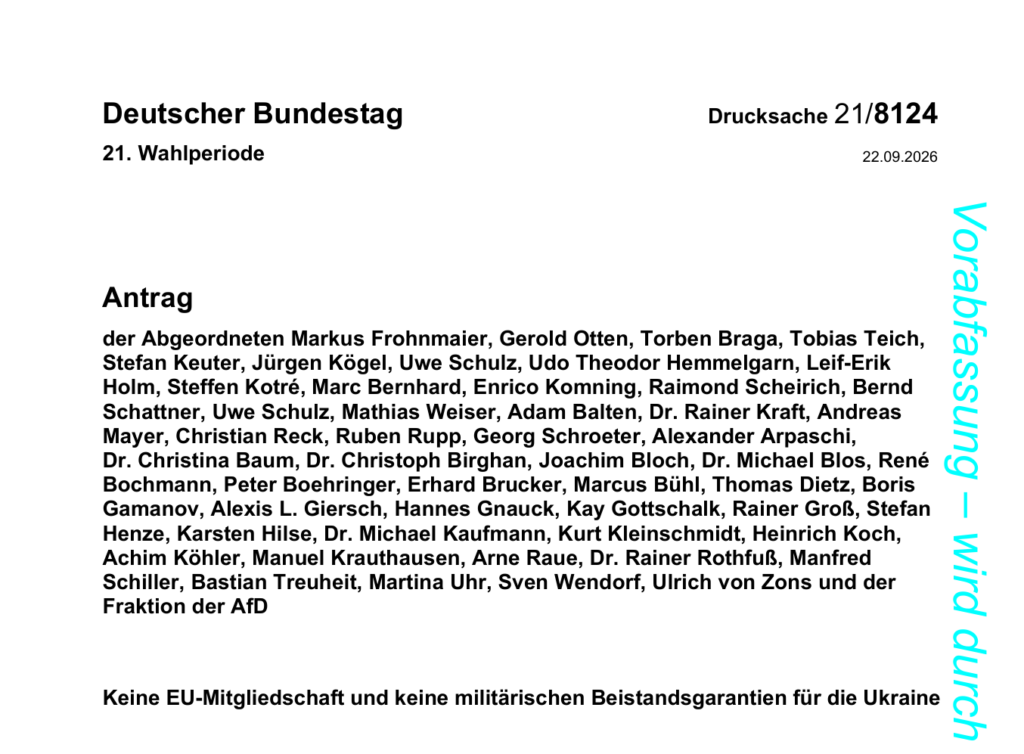
Four days after the closure, on 22 September, the AfD group in the Bundestag tabled a motion asking the government to reverse it. The document is Drucksache 21/8124, circulated as an advance version. It carries the names of fifty AfD members and is signed for the group by Alice Weidel and Tino Chrupalla. Its title is about Ukraine: no EU membership, no military assistance guarantees. The consulate appears in a footnote on page 4.
Six of the ten demands belong to the title. Points 1 and 2 reject the application of Article 42(7) of the EU Treaty to Ukraine and any “associate membership”. Points 6 to 8 reject security commitments made by declaration, new special memberships for third states, and a Ukrainian status that grows by increments. Point 9 asks for the Chancellor’s letter to Brussels. The remaining four concern aid, Ukrainian raw materials, reconstruction, Nord Stream and sanctions on Russia.
The letter
In May, Reuters reported that Chancellor Friedrich Merz had proposed an “associate member” status for Ukraine, a category that does not exist under EU rules, together with the extension to Ukraine of the security guarantees of Article 42(7), with the current war excluded.
The AfD’s legal observation is accurate. Article 42(7) obliges member states to assist a member state under armed attack, and Ukraine is a candidate, not a member. The motion goes on to argue that a commitment of this weight should rest on a treaty and a Bundestag vote. German constitutional law is less categorical than that. Treaties fall under Article 59 of the Basic Law and troop deployments need parliamentary approval, but the Constitutional Court has long treated non-treaty acts of foreign policy as the government’s competence. The AfD is making a political argument, and a serious one. A promise of mutual defence to a country at war is a decision a government might put to parliament even where nothing compels it, and the request to see the letter in full is one any opposition group could sign.
The rule on page 4
The motion states a principle in its own words. Over Nord Stream, it notes, the government proposed no measures against Ukraine “mit Rücksicht auf laufende Gerichtsverfahren”, out of regard for ongoing court proceedings. Leipzig, it argues, deserves the same treatment: no hasty conclusions, transparency first.
Both cases are before the courts. In Leipzig, the government’s attribution is political, and the criminal investigation continues. On Nord Stream, federal prosecutors charged a former Ukrainian army officer in July with co-perpetrating a war crime, accusing him of acting on behalf of Ukrainian state entities. He denies involvement, and Ukraine’s government has always denied ordering the attack.
The principle is then applied to Leipzig alone. For Nord Stream the motion describes the damage as “mutmaßlich”, presumably, caused by Ukraine, and on that presumption demands that Ukraine repay the full follow-on costs. Should Ukraine fail to pay within ten years, its state assets are to be pledged. The cost figure the motion uses is €295 billion in higher LNG bills for the EU economy. Footnote 15 sources it to ng.ru, the Moscow daily Nezavisimaya Gazeta.
The consulate is one item on a longer list. Footnote 10, sourced to the weekly Junge Freiheit, names visa restrictions and entry controls for Russian citizens, the action against the shadow fleet, which the motion says risks escalation in the Baltic, the summoning of the Russian ambassador, and new EU sanctions listings. The termination of the Russian House in Berlin is dealt with in the main text, where the motion records that Moscow answered by banning the Goethe-Institut and calls the result the loss of “the last cultural bridges” between the two countries. Point 10 asks the government to refrain from further sanctions “not in Germany’s interest”.
After the condemnation
The reasoning section opens by condemning Russia’s war as a breach of international law. It adds that the war followed years of provocation and Ukraine’s “creeping” de facto integration into NATO structures, that a diplomatic solution was available, and that Russia “unfortunately” failed to pursue it to the end. The West, meaning the Biden administration together with Germany, France and Britain, is assigned joint responsibility for prolonging the war.
Point 4 winds down German financial and military support, including through the European Peace Facility, until Ukraine is ready for “serious” peace negotiations. Humanitarian aid is excluded. Russia is given no condition to meet. In return for loans already made, Germany is to secure privileged access to Ukrainian rare earths, metals and gas.
Point 5 covers reconstruction. Russian-occupied areas are to be rebuilt from frozen Russian state assets released after a peace agreement. Areas under Ukrainian control are to be rebuilt from Ukraine’s own raw-material sales. German funds are ruled out. In that arrangement Russia’s money is spent on the territory Russia holds, while Ukraine pays for the rest by selling what lies under the ground it kept, with Germany holding a preferred claim on those resources.
A threshold with a history
In place of membership the motion offers a “privileged partnership”. Goods would receive full single-market access once Ukraine fully meets EU standards. Services and establishment would follow only when Ukrainian GDP per capita, at purchasing-power parity, reaches 68 percent of the EU average, the level of Greece and Bulgaria. Ukraine, the motion says, stands at 29 percent.
Bulgaria and Romania entered the Union in 2007 at well under half the EU average on that measure. Whether the same rule should have applied to them, the motion leaves unsaid.
The clause for the others
Point 7 is the passage that concerns this region. It rejects any new security-based special membership for third states that goes beyond the treaties and “could serve as a precedent for further accession candidates or neighbouring states of the European Union”. The wording covers more than Ukraine. Moldova is already in the text, in the scenario where a Ukrainian intervention in Transnistria and a Russian response might trigger Article 42(7). The Russian troops stationed in Transnistria, whose presence makes the scenario possible, go unmentioned.
The government position the motion opposes is on record. Merz’s letter stated that the Ukraine proposal would not affect other candidate countries and asked the EU to look into innovative solutions for those that have waited longest. At the EU-Western Balkans summit in Tivat on 5 June, he and Macron tabled a proposal on gradual integration, and he told the region’s leaders that the EU wants them to become members soon. Albania, with Montenegro, is the candidate closest to that point.
Ordinary accession is outside point 7’s scope. Intermediate formats with a security element are inside it, and the other candidates are named as the reason for keeping them out. That is the largest opposition group in the Bundestag setting down its position on the region in a document whose title mentions only Ukraine.
What the text records
The governing majority is unlikely to adopt the motion. The document still records something: a rule of restraint while court proceedings run, stated by the AfD itself, and the two uses it is put to. For Russia, the rule produces a demand to reopen a consulate and stop sanctions. For Ukraine, it produces a bill of €295 billion, priced by a Moscow newspaper.