Ardit Rada (Tirana)
A member of the European Parliament published an ordinary letter as evidence of corruption. The letter was real. The corruption was the frame.
On 16 June, the evening before the Parliament fixed its position on the 2025 Report on Albania, two Albanian members of parliament wrote to their counterparts in Strasbourg. Taulant Balla co-chairs the Stabilisation and Association Parliamentary Committee, the standing body built for precisely this correspondence between Albanian and European legislators. Bora Muzhaqi serves as deputy chair of the parliamentary committee on Europe and foreign affairs. They wrote about a report on their own country, on the eve of a vote on their own country, to the institution that grades their country’s road into the Union.
There is a word for this. The word is representation.
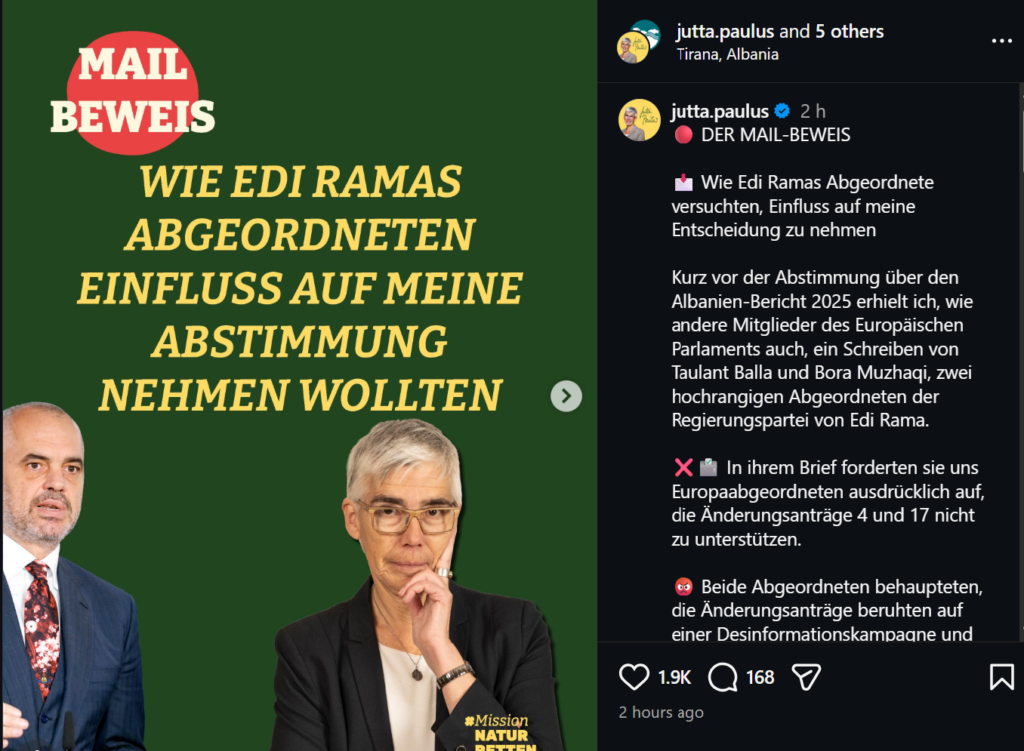
The next morning a German member of the Parliament, Jutta Paulus of the Greens, posted the letter to her audience beneath a red circle and a single word. Beweis. Proof.
Proof of what is never said, because the instant it is said it collapses. No rule was broken. No procedure was bent. A candidate state argued its own case in the forum convened to judge it, which is the entire purpose of the accession framework and the only reason the Stabilisation and Association Committee exists. To call that letter proof of anything is to assert, without daring to spell it out, that an Albanian deputy has no standing to address the body deciding Albania’s future. The charge cannot survive being written down. So it is never written down. It is only implied, in red, above a document that proves the opposite of what it is offered to prove.
Watch the mechanism, because it is a familiar one.
A genuine artifact is acquired. Its authenticity is not in question, which is the source of its power: the letter is real, the signatures are real, and a reader can see for himself that the deputies wrote it. Onto this real object a false meaning is fixed. Routine advocacy becomes pressure. A normal act becomes a transgression. Then the framed object is released at speed, and the frame travels with it. When the first version proves too crude to hold, it is adjusted just enough to survive. Paulus initially told her followers the letter came from Prime Minister Rama himself. It did not, and she corrected it. The correction altered the name. It did not touch the accusation. The scandal had already left on the earlier copy, and the retraction, as retractions do, arrived later and reached fewer.
This is not how a politician answers an argument. It is how an argument is made to vanish: by recasting the fact that it was raised at all as the misconduct. Once that move takes, the facts cease to matter. The presentation of them is the charge. The method needs no foreign hand to run. It needs only an audience prepared to believe that a country in the dock has no right to speak in its own defence, and a public figure willing to supply that audience its daily proof.
Set the frame aside and read the letter for what it contains, since Paulus declined to. The deputies advanced four factual claims. The Zvërnec project holds a development permit, not a construction permit. No work may proceed before an in depth environmental impact assessment compliant with EU and Albanian law. The Pishë Poro and Nartë landscape has held its protected status, IUCN Category V, since 2004, a category that admits regulated development. The land is privately owned, and the state is party to no transaction. These are claims that can be tested against the public record. Paulus tested none of them. She filed no reply at all. Confronted with a factual document, she did not contest the facts. She reclassified the act of presenting them as a crime, and treated her own refusal to read as a credential. European law is not for sale, she answered, to a letter that had asked her to buy nothing.
The chamber itself drew the line she would not. Of the two amendments the deputies addressed, the Parliament rejected the one that named a private company and presumed, as settled, a corruption case still under investigation. It retained the narrower amendment, which calls for environmental review and alignment with the acquis, an instruction the government had already accepted in substance. The deputies did not obtain everything they asked. The result that mattered was institutional: a legislature declining to convert an allegation into a finding by show of hands. Even Strasbourg distinguished the question from the propaganda attached to it. One member of Strasbourg did not.
So the small event closes, and the question it leaves is larger than a single post. Ask who gains.
Whoever taught a European audience that an Albanian MP’s letter to Brussels is presumptively corrupt has gained a great deal. He has established that Albanian self-representation is itself the evidence of guilt, that the candidate’s proper posture is silence, that any defence offered in the country’s own file is proof the country has something to hide. He has made the act of speaking the confession. This is worth more than any single vote, because it does not expire when the vote ends. It is a standing instrument, available for the next report and the one after, and it works on every claim regardless of merit, because it operates on the speaker rather than the speech.
The letter was real. That was always its use. A forgery can be exposed. A true document wearing a false frame can only be read, slowly, to the end, by an audience that has not already been trained to see a signature and call it a crime.
That training is the operation. The letter was only the occasion.